
Additive Manufacturing Defects: Euler's Layer-Camera Fix Explained
Nuho India Team
Nuho Creative Team
Key Takeaways & TL;DR
- Euler's platform is software only and hardware agnostic, so a fleet can be monitored without retrofitting new sensors into machines that already photograph every layer of a build.
- In a 54-build study with the Danish Technological Institute, 27.8% of total print time went to builds that ultimately failed, and 77% of that wasted time could have been saved by stopping at the prediction point.
- For anyone ordering 3D printed goods in India, the useful question is when a defect is first caught: during the build, or only after the batch has already been scrapped.
printer, 3d, pressure, 3d printing, 3d printing, 3d printing
Additive Manufacturing Defects: Euler's Layer-Camera Fix Explained
Euler de-risks metal additive manufacturing by reusing the layer camera that laser powder bed fusion machines already have. Its software-only platform watches the images each build produces and warns the operator about a likely failure before the job is scrapped, instead of days later when testing reveals a warped internal geometry [1].
Key takeaways
- Euler's platform is software only and hardware agnostic, so a fleet can be monitored without retrofitting new sensors into machines that already photograph every layer of a build.
- In a 54-build study with the Danish Technological Institute, 27.8% of total print time went to builds that ultimately failed, and 77% of that wasted time could have been saved by stopping at the prediction point.
- For anyone ordering 3D printed goods in India, the useful question is when a defect is first caught: during the build, or only after the batch has already been scrapped.
What Euler actually built
Most modern laser powder bed fusion systems already capture layer images during every build, and in many cases those gigabytes of data sit unused on a hard drive. Euler's platform is software only and hardware agnostic, and because the camera is already in place the company says it can connect to an existing setup in under five minutes, with results visible immediately [1].
Rather than flagging defects after they occur, when it is already too late, the platform takes a predictive approach that alerts the operator well in advance, on the reasoning that most defects show early indicators [1].
For regulated users it offers on-premises and private cloud options, including GovCloud, which can matter to aerospace and defense users who are unable to send build data to a public service [1]. The platform supports major metal printer brands, among them EOS, Nikon SLM and Renishaw, and the company collaborates with Autodesk and Scanlab [1].
Why good-looking parts still fail testing
Additive manufacturing is the process of creating an object by building it one layer at a time, and it is the opposite of subtractive manufacturing, in which an object is created by cutting away at a solid block of material until the final product is complete [3].
In powder bed fusion, the ASTM standard term for the process, a high power-density laser is used to melt and fuse metallic powders together, with the CAD file sliced into layers usually from 20 to 100 micrometers thick [2]. The components are built layer by layer inside a chamber containing a tightly controlled atmosphere of inert gas, either argon or nitrogen [2].
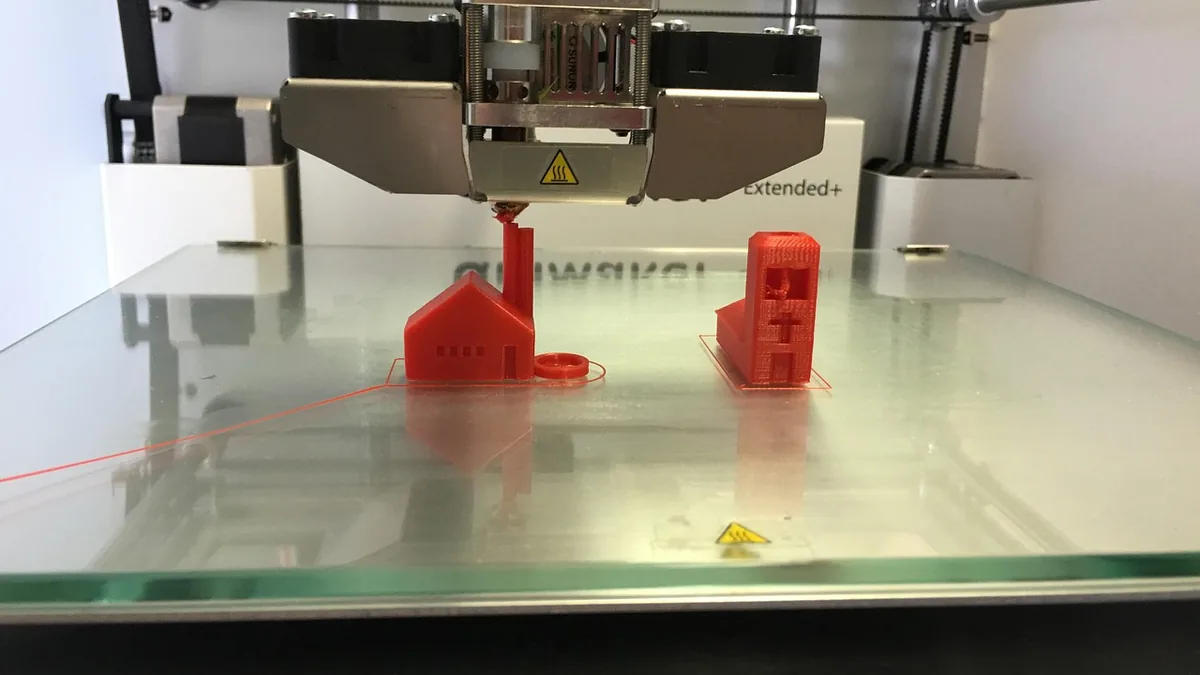
That precision is why a finished job can still be scrap. Two of the most common mechanical defects include lack of fusion and cracking, and the thermal dynamics of the process can produce unintended porosity that affects the overall strength of a printed structure [2]. On a desktop machine the same failure modes appear as warping, stringing or layer shift and as delamination between layers, both of which are visible long before a part is put to work.
What the 54-build study measured
Over 47 days, Euler monitored 54 builds across four Nikon SLM systems at the Danish Technological Institute, covering six metal alloys including 316L stainless steel and Ti6Al4V titanium [1].
The paper found that 27.8% of total print time was spent on builds that ultimately failed, and 77% of that wasted time could have been saved by halting at the point of the failure prediction, equivalent to roughly 10 days of 3D printing [1].
Referring to a Wohlers Report estimated operating cost of $75 per hour for a $1M machine, the authors put the potential annual saving at over $115,000 per machine in operating costs alone, before accounting for wasted powder, personnel time or post-processing [1].
One case from the study is worth remembering: a production build uploaded as part of a quality investigation, where manual review of nearly 14,000 layer images had failed to locate the problem [1]. The platform flagged the defective layers immediately, and the authors calculate that an early alert would have saved 38 hours and 43 minutes of partial-part printing from becoming scrap and prevented a further 48 hours of wasted printing, over 86 hours of print time affected by the failure [1].
The table below turns those findings into questions a buyer can actually use.
| Measurement | What the study reported | Why it matters |
|---|---|---|
| Builds monitored | 54 builds over 47 days on four Nikon SLM systems | Six metal alloys, including 316L stainless steel and Ti6Al4V titanium |
| Print time spent on failed builds | 27.8% of total print time | More than a quarter of machine time produced scrap |
| Time recoverable with an early warning | 77% of the wasted time, about 10 days of printing | Stopping at the prediction point recovers most of the loss |
| Annual operating cost quoted | Over $115,000 per machine at $75 per hour | Operating cost only, before powder, personnel or post-processing |
| Manual review of one failed build | Nearly 14,000 layer images | The platform flagged the defective layers immediately |
What this means in India
Additive manufacturing has explicit national policy backing in India.
India's national strategy on additive manufacturing, released in February 2022, aspires to 5% of global AM market share and nearly US$1 billion added to the GDP, alongside targets of 50 India-specific technologies, 100 new start-ups, 500 products and 1 lakh skilled manpower [4].
The same discipline shows up at the other end of the scale. Nuho India is a digital manufacturing studio in Coimbatore, Tamil Nadu that prints in PLA+, PETG, ABS, TPU and tough resin, holds a dimensional tolerance of ±0.2 mm or ±0.2% whichever is greater, manufactures standard orders in 24 to 48 hours and ships to serviceable pincodes across India through Delhivery and Bluedart.
A custom name keychain printed in 3D is listed at ₹79 and a custom car numberplate keychain at ₹99, small enough that one bad part is an annoyance rather than a disaster. The industrial logic is the same in both cases: catching a defect while the machine is still running costs far less than discovering it after the batch is finished.
What to ask before you order a 3D printed batch
- When is a defect first caught? Ask whether problems are detected during the build or only after post-processing and testing, because the second answer means scrapped material and lost machine hours.
- What tolerance is guaranteed? Nuho publishes a dimensional tolerance of ±0.2 mm or ±0.2%, whichever is greater, and our guide to 3D printing tolerances and keychain fit explains what that means for a part that has to clip onto a ring.
- Which process and material? Fused filament, resin and powder bed fusion each fail in different ways, so name the process before you compare quotes; our breakdown of 3D printing cost in India covers how material, time and power add up.
- What does a failed part cost you? Ask for the remake policy on a defective batch, and remember that a supplier who checks during the run is cheaper than one who only inspects at the end.
If you also order printed collateral, the same question applies to a custom shape sticker uploaded from your own artwork: ask how the cut is verified against the artwork before a full run is printed.
Frequently asked questions
What is Euler's role in additive manufacturing?
Euler is an Icelandic software startup whose platform connects to the layer camera a metal printer already has, reads the images produced during a build and predicts a likely failure well before the job finishes [1].
Is this only for metal powder bed fusion?
The published evidence covers laser powder bed fusion: 54 builds across four Nikon SLM systems at the Danish Technological Institute, spanning six metal alloys including 316L stainless steel and Ti6Al4V titanium [1].
Does a desktop FDM printer need this kind of monitoring?
The Euler results quoted here are for industrial powder bed fusion machines, not desktop printers. On a desktop machine the failures worth watching are the ones covered in our guides to warping, stringing and layer shift and to delamination.
How is this different from bolting on another sensor?
In-process monitoring often means retrofitting machines with dedicated sensors, which is manageable for a couple of printers and harder to justify across a fleet, whereas this approach reuses the camera already in place and connects in under five minutes [1].
Conclusion and next step
Euler's argument is not that metal additive manufacturing has become riskless, but that the cause of a failed build is usually visible in the layer images the machine has already captured, days before anyone runs a CT scan. The study puts numbers on the gap: 27.8% of print time lost to failed builds, most of it recoverable by acting on an early warning [1]. Your next step is simple: before your next batch order, ask the supplier one question, namely when in the process a defect is first caught, and compare the answer with what our guides to tolerances and printing costs in India tell you to expect.
Sources
Featured Custom Products



Frequently Asked Questions
More Articles You Might Like

3D Printed Tablets: PharmaTher's Colon-Release Dose in India
PharmaTher is 3D printing oral tablets of two peptides, KPV and BPC-157, designed to pass through the stomach and release their dose in the colon using Craft Health's...
Bambu Lab H3C: Nine Tools, US$2,499 and What It Means for India
On 3 November 2026 Bambu Lab launched the H3C, a nine-tool desktop 3D printer built around its Swaptek tool changer, priced at US$2,499 for the AMS Combo. Each tool keeps its own...
3D-Printed Beams in Space: What Orbital Matter Proved for India
Short answer: Orbital Matter's Replicator 2 satellite 3D-printed a half-meter rigid beam in the vacuum of orbit, the first structural print by a free-flying spacecraft outside a...