
3D-Printed Beams in Space: What Orbital Matter Proved for India
Nuho India Team
Nuho Creative Team
Key Takeaways & TL;DR
- Replicator 2 printed a half-meter rigid beam in open orbit, the first structural print outside a pressurized spacecraft cabin.
- The process is ultraviolet-cured resin extruded in coils, not melted filament, so the layer-bonding rules are different in vacuum.
- The first print attempt failed with gaps between layers of printed material; a firmware update produced the bonded beam.
- Nothing changes for Indian buyers today: materials, tolerance, turnaround and prices on Nuho's catalogue stay exactly as they are.
- India has its own stake in this technology through Agnikul's single-piece 3D printed rocket engine flown from Sriharikota.
satellite, orbit, spacex, aeronautics, nasa, space
3D-Printed Beams in Space: What Orbital Matter Proved for India
Short answer: Orbital Matter's Replicator 2 satellite 3D-printed a half-meter rigid beam in the vacuum of orbit, the first structural print by a free-flying spacecraft outside a pressurized module, and the boom deployed a small solar array. It changes nothing about ordering a 3D-printed keychain in India, but it shows how much layer bonding depends on the air around the printer [1].
A German startup putting a plastic beam in orbit is not a gadget headline. It is a stress test of the one thing that decides whether any printed object holds together: whether one layer actually bonds to the next. That test simply failed on the first attempt, was fixed in software, and is exactly the same failure you can trigger on a desk printer.
Key takeaways
- Replicator 2 printed a half-meter rigid beam in open orbit, the first structural print outside a pressurized spacecraft cabin.
- The process is ultraviolet-cured resin extruded in coils, not melted filament, so the layer-bonding rules are different in vacuum.
- The first print attempt failed with gaps between layers of printed material; a firmware update produced the bonded beam.
- Nothing changes for Indian buyers today: materials, tolerance, turnaround and prices on Nuho's catalogue stay exactly as they are.
- India has its own stake in this technology through Agnikul's single-piece 3D printed rocket engine flown from Sriharikota.
What actually happened in orbit
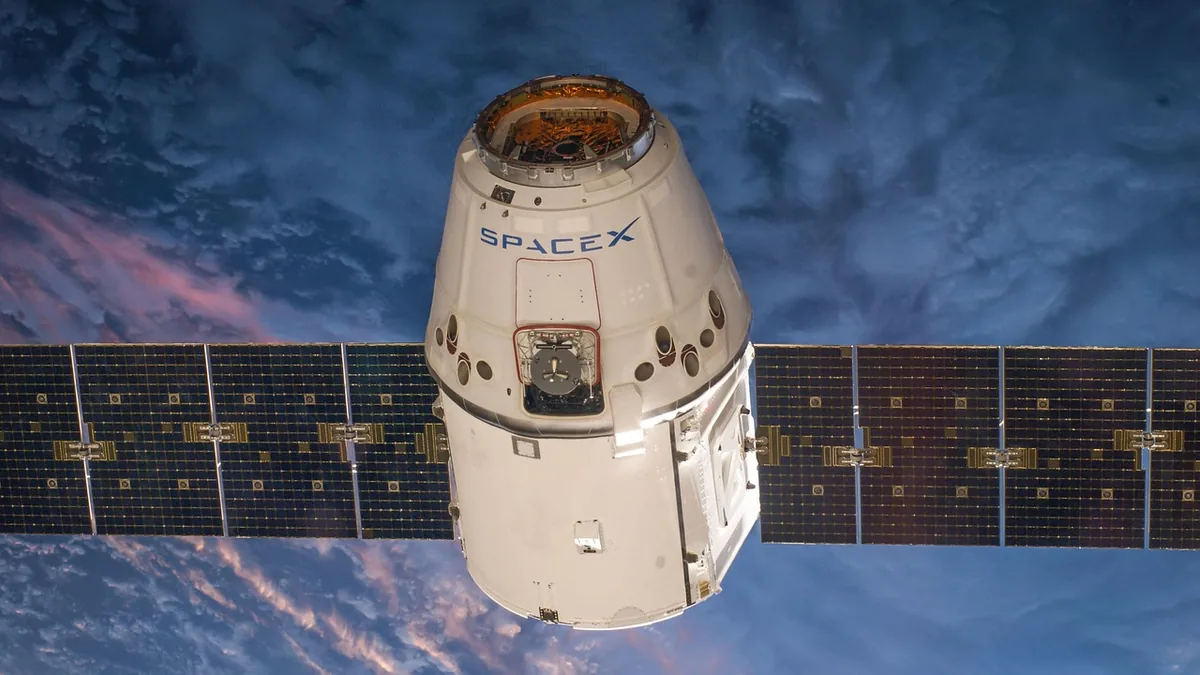
A satellite built by the German startup Orbital Matter 3D-printed a half-meter long beam out of a custom plastic material, which its executives called a first for a free-flying spacecraft in orbit and a step toward constructing large structures in space [1].
Replicator 2 flew on a SpaceX rideshare mission this summer with four of the company's 3D printers onboard, and each printer builds a rigid, cylindrical beam by extruding coils of resin that are cured by an ultraviolet light [1]. The company compares the recipe to cement and water, and it is working with the European Space Agency and Thales Alenia on the mission [1].
The beam is not the point — the fairing is. Future spacecraft need to be larger to generate more electrical power and radiate more heat into the vacuum of space, particularly if they serve as orbital data centers, yet they must still fit inside the tight confines of the fairing on top of the rocket that carries them into orbit [1]. Two of the four printers were assigned to a flexible solar array, one failed after an anomaly, and the boom that was built still deployed the array successfully [1].
The failed print is the interesting part
Replicator 2 launched on SpaceX's Transporter-17 rideshare in July on an EnduroSat bus carrying four printers, and its first print job in August ultimately failed to create a fully viable structure because there were gaps between layers of printed material [2].
The company then spent two months running terrestrial print jobs before updating Replicator 2's firmware to print a second, fully bonded structure 32.5 cm long, which was used to partially deploy the solar array [2]. That sequence is worth sitting with: the geometry was fine, the resin was fine, and the fix was a software change controlling how the material went down.
For anyone who has watched a print delaminate at home, this is the same family of failure. A layer that never wets the surface below it leaves a horizontal weakness, and the part stays weak until the interface is made properly. Our guide to 3D print delamination covers what that looks like on a desk-sized machine, and it is the same interface weakness that had to be solved twice in orbit.
The follow-up matters more than the demo. Orbital Matter will partner with EnduroSat on a 2028 mission to deploy a 5 kW solar array about 5 m in length, aimed squarely at the orbital data center market where AI compute in orbit will require hundreds of kW per satellite [2].
Why a vacuum printer fights different physics
The Replicator 2 satellite weighs approximately 13 kilograms and launched on July 7, 2026 aboard a Falcon 9 rocket as part of the Transporter-17 mission, carrying four printers that each extrude liquid resin in coils while ultraviolet radiation triggers the reaction that turns it into a solid polymer [3].
This is the entire engineering problem in one comparison: on the ISS, printers operate inside a pressurized module with air and a stable temperature, but in open space volatile substances can evaporate from uncured resin, while sharp temperature changes alter its viscosity and prevent layers from bonding [3].
| Condition | Printer in Coimbatore (FDM, PLA+) | Replicator 2 in orbit (UV-cured resin) |
|---|---|---|
| Surrounding atmosphere | Normal air; heat from the nozzle dissipates into it | Vacuum, so volatiles boil straight out of uncured resin |
| Temperature | Room temperature with the bed and nozzle setting the heat | Sharp swings between sunlight and shadow change resin viscosity |
| How a layer hardens | Molten plastic cools and fuses into the layer below | Ultraviolet light cures extruded coils into a solid polymer |
| Bonding failure looks like | Cracks and splits along a layer line | Gaps between resin layers, so the beam never becomes continuous |
| What it can build | Parts inside a 256 × 256 × 256 mm envelope | Structural booms limited only by the resin onboard |
The trade is obvious: a printer on Earth trades freedom of atmosphere for freedom of size, and a printer in orbit trades a controlled environment for a build volume that no factory door can hold. Beam length is limited only by the amount of resin onboard, and engineers consider 100 meters achievable, against 20-meter solar arrays on SpaceX Starlink V2 satellites [3].
What this changes for a buyer in India — and what it does not
Nothing in your cart moves. Orbital printing is a structural technology for spacecraft, and the products people actually order in India are still made from the same stock materials: PLA+, PETG, ABS, TPU and resin, printed to a stated tolerance of ±0.2 mm or ±0.2 % inside a 256 mm cube build volume, manufactured within 24 to 48 hours in Coimbatore and shipped pan-India through Delhivery and Bluedart.
If anything, the orbit result is a useful reminder that humidity and heat are the terrestrial version of the same problem. Vacuum pulls volatiles out of uncured resin; Indian monsoon air puts moisture into filament, and a spool that has been sitting out prints with bubbles and weak layer lines. Storage is the cheap fix, as our filament storage for Indian humidity guide explains.
The space theme does, however, translate very well into small objects:
- Ringed Planet Sticker — a glossy die-cut sticker, listed at ₹15, for laptops, notebooks and water bottles.
- Telescope Star Gazer Sticker — the same glossy die-cut format at ₹15, sized up to 80 mm.
- Custom Name Keychain – Personalized 3D Printed Name — a personalised 3D printed name keychain at ₹129.
- Custom 3D Printed Car Numberplate Keychain — a mini number plate keychain at ₹99 for anyone who wants the miniature-engineering angle.
 Ringed Planet glossy die-cut sticker, a space-themed design printed and cut by Nuho India
For context on why a small personalised run is cheaper to print than to mould, see 3D printed versus injection moulded; for what actually drives the price of a printed part, see 3D printing cost in India.
India's own version of this story
India does not have to borrow this narrative. The IIT Madras-incubated start-up Agnikul launched the world's first rocket with a single piece 3D printed engine from Sriharikota on the morning of 30 May 2024 [4].
The Agnibaan - SOrTeD flight also has the distinction of being India's first semi-cryogenic engine-powered rocket launch, lifted off from the country's first private launch pad called Dhanush, and ISRO's chairman said the success involving a 3D printed semi-cryogenic engine demonstrates the prowess of indigenous design and innovation [4].
IN-SPACe chairman Pawan Goenka framed it as a sector-wide shift, saying that young innovators leading with cutting-edge technology such as the world's first 3D printed semi-cryogenic engine are driving the transformation of India's space sector [4]. Printed hardware is already load-bearing in India's space programme; orbital printing is the next distance marker, not a different sport.
Frequently asked questions
What exactly did Orbital Matter print in space?
A rigid, cylindrical beam about half a meter long, built by extruding coils of a custom resin and curing them with ultraviolet light aboard the Replicator 2 satellite. The boom was then used to partially deploy a flexible solar array.
How is printing in space different from printing at home?
A desk printer works in normal air with a stable room temperature, while a printer in orbit works in vacuum where volatile substances evaporate from uncured resin and sharp temperature swings change the material's viscosity. Both failures end the same way: layers that do not bond.
Does this change what I can order from Nuho today?
No. The same materials, tolerances and turnaround apply — PLA+, PETG, ABS, TPU and resin, ±0.2 mm or ±0.2 % tolerance, 256 mm cube build volume, 24 to 48 hours manufacturing and pan-India shipping through Delhivery and Bluedart.
Is India doing anything like in-space manufacturing?
India's contribution so far is on the launch side: Agnikul's Agnibaan SOrTeD flew with the world's first single piece 3D printed engine from Sriharikota in May 2024, developed with IIT Madras and supported by IN-SPACe and ISRO.
Should I care about this as a small business or a gift buyer?
Only as a signal of where the technology is heading. The parts you buy today are printed on Earth in a controlled room, and the practical decisions — material, wall thickness, artwork and price — have not moved at all.
The bottom line
Orbital Matter proved that a free-flying spacecraft can print a structural part in vacuum and use it, after a first attempt failed on interlayer gaps and a firmware update fixed the bonding. The physics lesson travels home: layer adhesion is decided by the environment around the printer, whether that is a vacuum in orbit or monsoon humidity in an Indian workshop.
The next step is small and concrete: if you have been putting off a personalised order, send the artwork for a custom name keychain or a die-cut space sticker, or browse Nuho's product catalogue and let the material and tolerance questions be solved for you.
Sources
- Orbital Matter 3D-printed the first rigid beam in the vacuum of space — TechCrunch
- Orbital Matter, EnduroSat Announce an In-Space Manufacturing Mission in 2028 — Payload
- A beam for a solar panel was printed in orbit in outer space — Universe Magazine
- Agnikul launches World's First Rocket with Fully 3D Printed Engine — Press Information Bureau, Chennai
Featured Custom Products



Frequently Asked Questions
More Articles You Might Like

3D Printed Tablets: PharmaTher's Colon-Release Dose in India
PharmaTher is 3D printing oral tablets of two peptides, KPV and BPC-157, designed to pass through the stomach and release their dose in the colon using Craft Health's...
Additive Manufacturing Defects: Euler's Layer-Camera Fix Explained
Euler de-risks metal additive manufacturing by reusing the layer camera that laser powder bed fusion machines already have. Its software-only platform watches the images each...
Bambu Lab H3C: Nine Tools, US$2,499 and What It Means for India
On 3 November 2026 Bambu Lab launched the H3C, a nine-tool desktop 3D printer built around its Swaptek tool changer, priced at US$2,499 for the AMS Combo. Each tool keeps its own...