
3D Printed House Name Plates for Indian Homes: Weather and Mounting
Nuho India Team
Nuho Creative Team
Key Takeaways & TL;DR
- PLA+ stays rigid in shade up to roughly 60 °C, well above Coimbatore's 42.6 °C record high, so heat only threatens a dark plate in direct afternoon sun.
- Coimbatore averages 618.5 mm of rain a year, with 156.1 mm in October — 8–10 mm standoffs plus silicone in every fixing hole are what keep water out.
- Nuho India fuses each letter into a continuous PLA+ backing plate at about 215 °C, so there is no glued letter to lift off in the monsoon.
- Acrylic transmits 92% of visible light and tolerates UV well, but it is brittle under impact, which is why thin acrylic plates chip at narrow letterforms.
- Custom plates are quoted by size and despatched in 24–48 hours from Coimbatore, with personalised keychains at ₹129–₹149 as the price reference point.
Are 3D printed house name plates good for Indian weather?
A 3D printed house name plate in PLA+ handles Indian sun and monsoon well when it hangs in shade — under a porch, on a gate pillar, or on a north-facing wall. On a west wall that bakes all afternoon it is the wrong material: PLA+ softens near 60 °C, and sunlight slowly fades any plastic. Match the material to the wall, and a printed plate lasts for years.
Most name plate advice online is written for a mild climate. An Indian front wall is harder: 40 °C afternoons, four months of driving rain, dust in every groove. This guide covers where a printed plate belongs and how to mount it so water cannot get behind it.
What does an Indian front wall actually throw at a name plate?
Start with measured numbers. India Meteorological Department normals for Coimbatore (1991–2020) show a mean daily maximum of 32.5 °C, a record high of 42.6 °C in April, annual rainfall of 618.5 mm, and 156.1 mm in October alone — the heaviest rain month, with November close behind at 139.7 mm. The Coimbatore climate record is a fair stand-in for most of Tamil Nadu's interior.
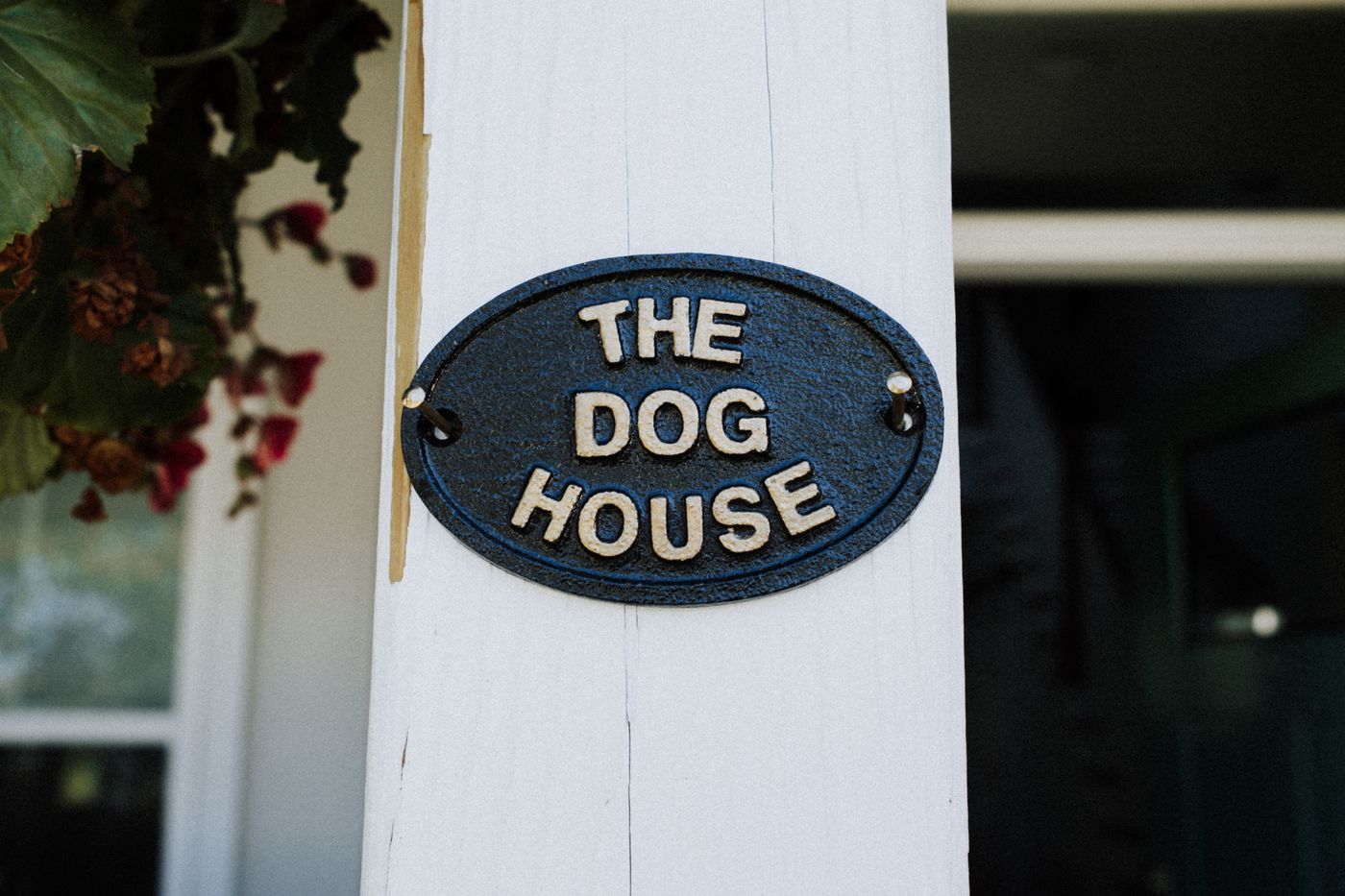 house name plate 3d printed — Close-up of a rustic 'The Dog House' sign on a white wooden post with foliage
Photo: K / Pexels
Two details matter more than air temperature. A dark plate in direct afternoon sun runs hotter than the air around it, because it absorbs solar radiation instead of reflecting it. And rain rarely falls straight down — it arrives at an angle, driven by wind, which is why plates mounted flush against a wall collect water behind them.
Does PLA+ soften or melt in Indian summer?
No, not at air temperature. PLA's glass transition temperature is 60–65 °C, and it has poor heat resistance unless annealed, as the material literature on polylactic acid describes. Melting begins near 150–160 °C, far above anything an Indian summer produces. Nuho India prints PLA+ at about 215 °C, so a cooled plate is dimensionally stable in ordinary shade.
The honest caveat is the transition zone, not melting. A black plate bolted to a wall that takes direct sun from noon to 5 pm can approach that 60 °C band on the hottest days, and a plate under stress — screwed tight at four corners, or hanging from one hook — can creep and bow before it ever "melts". Three consequences:
- Light colours are cooler. White, cream and pale grey reflect much of the incoming sunlight; black and deep maroon absorb it.
- Never screw a plate down hard at four corners. Thermal expansion needs somewhere to go; slot two of the four holes so the plate cannot pull itself into a bow.
- A printed plate does not belong in a parked car or above a griddle. That is where PLA+ genuinely fails.
Where should a 3D printed name plate hang?
Placement decides more of the outcome than the plastic does. This is the short version we give customers in Coimbatore:
| Location | Summer heat | Monsoon exposure | Verdict for a PLA+ plate |
|---|---|---|---|
| Under a porch or balcony overhang | Low | Low | Best. Years of service with a wipe-down twice a year. |
| Gate pillar, east or north face | Moderate | Moderate | Good. Shade for most of the afternoon. |
| Boundary wall, west or south face, full sun | High | Moderate | Marginal. Light colour and a small hood, or choose metal. |
| Directly under a roof drip line | Moderate | Very high | Avoid. Concentrated water finds every fixing hole. |
| Beside a garden tap or wash area | Low | High splash | Poor. Constant wet-dry cycling and mud splash. |
| Coastal wall within a kilometre of the sea | High | High, with salt | Short-lived. Salt and UV age any plastic quickly. |
If your only fixing point is a full-sun west wall, a white plate with an air gap and a 100 mm overhang can work — but brass or powder-coated aluminium is the more honest recommendation there.
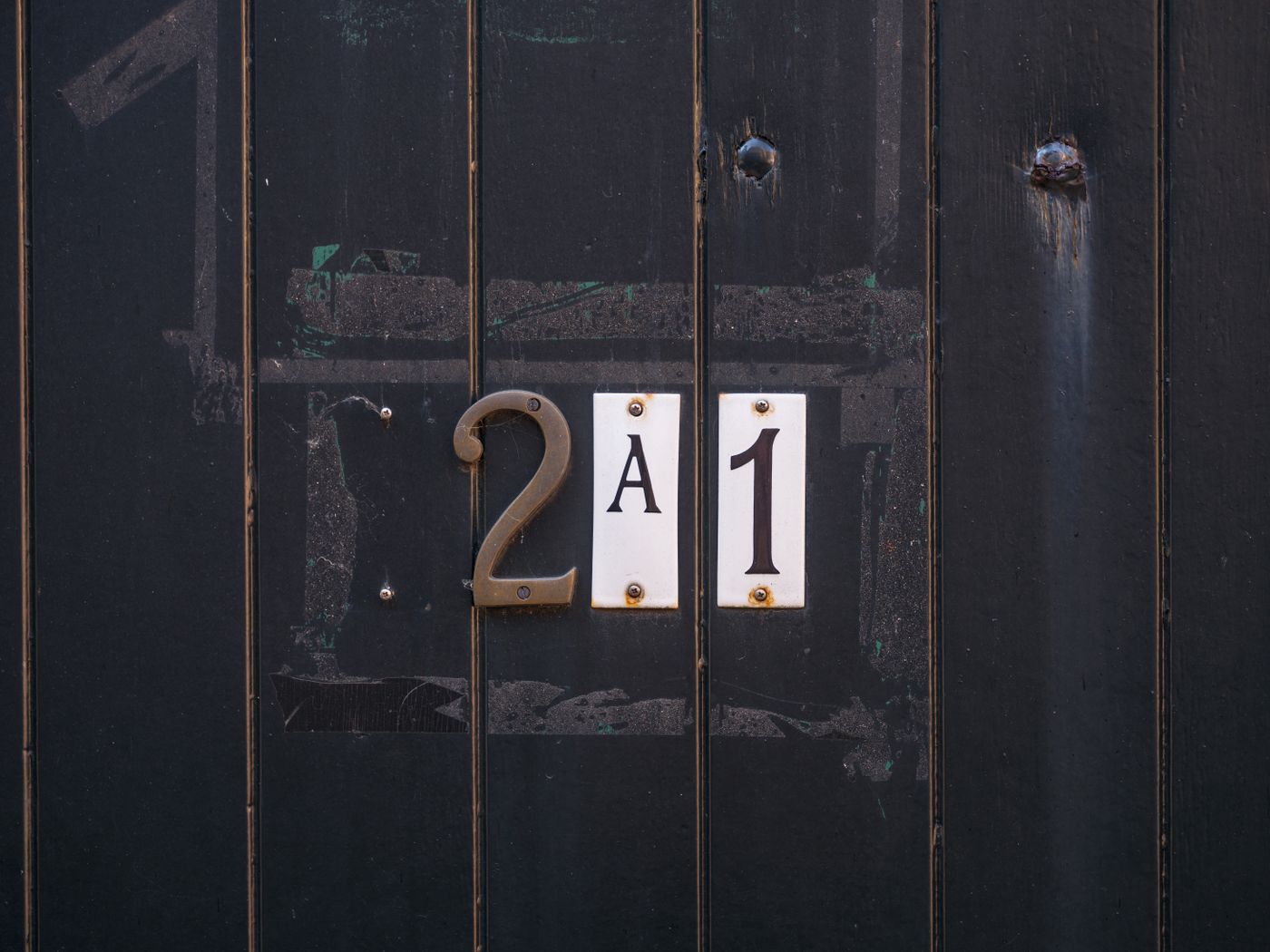 house name plate 3d printed — Close-up of a dark wooden door with vintage-style number signage displaying '2A1'
Photo: Haberdoedas Photography / Pexels
Is a 3D printed name plate waterproof in the monsoon?
The plastic is. PLA+ absorbs very little water in normal conditions, and hydrolysis — the route by which PLA eventually degrades — is slow at ambient temperature. A plate that gets wet for four months and dries for eight is not the failure case; a plate trapped against a damp wall is.
Water damage in name plates is almost never the sheet material. It is the joint between letters and backing: acrylic and wood plates usually have letters cut separately and glued on, and that adhesive line is where monsoon water gets in. The bond fails, a letter lifts at one corner, and the plate looks tired within two seasons.
Nuho India's plates avoid that joint. Letters are fused to a continuous backing plate at print time at about 215 °C, so there is no glued interface for water to attack and no brittle cut-out to chip at a narrow stroke. The remaining water paths are the mounting holes, and those are solved with hardware rather than glue.
3D printed vs acrylic vs brass vs wood: which lasts?
Every material wins somewhere, and the comparison is more useful when it admits that.
| Material | Weather behaviour | Narrow letters | Best suited to |
|---|---|---|---|
| 3D printed PLA+ | Waterproof; fades slowly in direct UV; softens near 60 °C | Excellent — letters are printed, not cut, so i, l and t stay intact | Shaded outdoor walls, gate pillars, indoor doors |
| Acrylic (PMMA) | Very good UV tolerance and 92% light transmission, but brittle under impact and softer than glass, so it scratches | Weak at thin strokes; separate letters rely on adhesive | Backlit plates, indoor lobbies, sheltered porches |
| Cast brass or zinc | Survives sun and rain for decades; needs polishing; dents and scuffs | Good, but letter depth is fixed by the mould | Heritage gates, full-sun walls, long-term builds |
| Laser-engraved wood | Swells and warps with moisture; engraving darkens unevenly | Fair | Indoor use, covered verandahs |
| Granite or stone | Essentially permanent | Carved, deep, legible | Gate pillars and compound walls |
The acrylic row is the one people push back on, because acrylic name plates are everywhere in Indian cities. They are popular for good reasons — excellent light transmission, clean edges, easy backlighting — but PMMA behaves in a brittle manner under impact and scratches more easily than glass, as the PMMA material reference notes. A stone chip from a passing two-wheeler is a real failure mode for a thin acrylic plate.
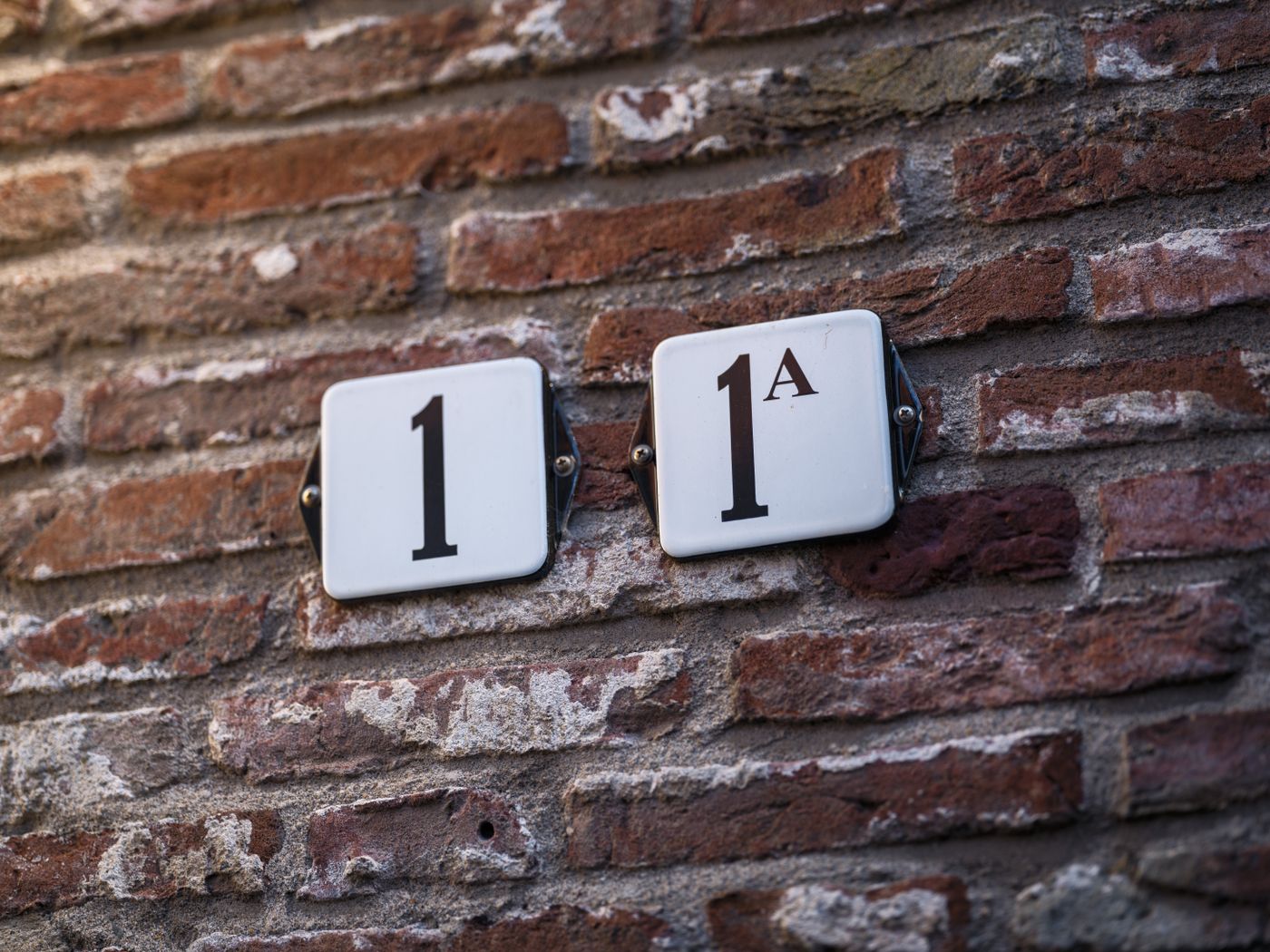 house name plate 3d printed — Close-up of a textured brick wall with mounted street numbers 1 and 1A in focus
Photo: Haberdoedas Photography / Pexels
How do you mount a name plate so it survives the monsoon?
Eight steps, in order:
- Choose the wall before the design. Pick a spot shaded for most of the afternoon and not under a drip line, then measure the space.
- Set the centre at eye level, roughly 1.5 m, on the doorbell side of the gate. Too high and couriers squint; too low and it takes street splash.
- Mark the holes with the plate held in place, not from a paper template — printed plates are rigid, and a 2 mm error stops a screw going in.
- Drill with a masonry bit and fit wall plugs, slightly deeper than the plug, and blow the dust out.
- Put a bead of silicone in each hole before the plug goes in. This is the highest-value step: it stops water tracking down the screw into the wall.
- Use stainless screws and 8–10 mm standoffs so air moves behind the plate and water drains instead of sitting against the back face.
- Leave the bottom edge open. If you seal a flush plate, seal the top and sides and leave the bottom free — trapped water is worse than a draught.
- Re-check the fixings after the first monsoon. Thermal movement works screws loose; a quarter turn in November saves a plate on the ground in December.
Keep the hardware in one metal family — stainless screws into galvanised brackets corrode faster than either alone.
What should the artwork include for an Indian home?
A name plate has one job — being read from the gate by someone who has never been there.
- House number, large. Bigger than the family name. Delivery riders and ambulances look for the number first.
- Name in the script you use at home. For most households in Tamil Nadu that means Tamil and English on one plate; printing both costs nothing extra because there is no tooling.
- Street name in small type at the bottom, if the layout allows. It settles most "which house" phone calls.
- Letter strokes that survive distance. Strokes below about 3 mm print soft and close up visually from four metres. Ask for a heavier stroke and a slightly larger plate rather than squeezing in more text.
Two details that quietly help outdoors: a raised border, which stiffens the plate and channels water off the edge, and a matte or lightly textured surface, which hides dust and scratches far better than gloss. For the indoor version, see our guide to custom desk name plates; for why thin walls and sharp internal corners fail first, read the 3D print design tips.
How much does a 3D printed house name plate cost?
Printed plates are quoted by size, not by the letter, because filament use scales with area and depth. A 300 mm plate uses several times the material of a 150 mm one, and a two-colour plate with a printed border takes longer on the machine than a single-colour rectangle. Comparing quotes without comparing dimensions tells you nothing.
For scale, our personalised keychains sit in the ₹129–₹149 band; a name plate is the same print process at a larger size. Ask for dimensions, colour count and whether hardware is included before comparing prices.
Timelines are more predictable. Manufacturing and despatch from Coimbatore take 24–48 hours after artwork approval, and courier transit adds a few days depending on pincode. A plain plate prints in under an hour; the window covers the queue, not just machine time.
Can Nuho India print a custom house name plate?
Yes — it is the keychain process scaled up. Nuho India prints PLA+ at about 215 °C at GN Mills, Coimbatore, Tamil Nadu 641029, fusing every letter into a continuous backing plate so nothing is glued on. Send the house number and the name in Tamil and/or English; approve a mock-up; the plate is printed and despatched in 24–48 hours.
Start from the Nuho India product range. If the plate is for a new house, a matching personalised keychain for the house makes a sensible housewarming pair — same material, same 215 °C print. Support is on +91 90808 85390 if you would rather send a photo of the wall.
What are the honest limitations?
A printed plate is not a brass plate, and pretending otherwise would be bad advice:
- UV fade is real. Colours, especially reds and bright yellows, lose saturation after a few years of direct sun. Shade slows this considerably.
- It is not a 20-year fixture in full sun. Under a porch, expect many years. On an exposed west wall in May, expect to replace or refinish sooner.
- Heat, not rain, is the failure mode. Waterproofing is straightforward; thermal bowing at 55–60 °C is the thing to design around.
Choose the wall honestly, mount with an air gap and silicone, keep the hardware stainless, and a 3D printed house name plate will do the one job it has: tell a stranger at the gate that they have found the right house.
Frequently Asked Questions
More Articles You Might Like

Keychain Gifts for Boyfriend: Personalised Ideas That Get Used
Keychain gift for boyfriend ideas he will actually carry: personalised PLA+ tags from ₹129–₹149, 14–18 g, made in Coimbatore in 24–48 hours.
Name Keychain Makers Online: How Your Design Becomes a PLA+ Tag
Ordering from a name keychain maker online? See how your text becomes a tough PLA+ tag in 24-48 hours - the files, the price band and the checks that matter.
Cartoon Stickers for Kids: Where They Stick and How They Wear
Cartoon stickers for kids, surface by surface: where they stick, how they wear on walls, cupboards and bottles, and how to make them last.