
Name Keychain Makers Online: How Your Design Becomes a PLA+ Tag
Nuho India Team
Nuho Creative Team
Key Takeaways & TL;DR
- A name keychain maker online turns your typed name into a printed PLA+ tag with 24-48 hours of manufacturing time before shipping.
- Custom 3D printed name keychains from Nuho India cost ₹129-₹149 and weigh about 14-18 g with the split ring fitted.
- Letters print fused to one continuous backing plate at about 215 °C - no glue joints - which is why narrow fonts don't snap off.
- PLA melts only at 150-160 °C but softens well below that: never leave a PLA name keychain flat on a car dashboard in Indian summer.
- Free online 'name keychain generators' usually output PNG previews or untested STLs - a real maker builds the printable file from your text.
What does a name keychain maker online actually do?
A name keychain maker online takes a design — a name, initials, a number-plate layout — and turns it into a finished, printed tag that ships to your door. At Nuho India in Coimbatore, Tamil Nadu, your text is checked, prepared for printing, then printed in tough PLA+ filament at about 215 °C, with the letters fused into one continuous backing plate instead of glued on. Manufacturing takes 24–48 hours, and a custom name keychain costs ₹129–₹149. You never need to touch a printer, a file or a hacksaw.
The "name keychain maker near me" search still has its place, but most neighbourhood shops either resell acrylic tags cut elsewhere or offer a font list that hasn't changed in a decade. An online maker that owns its machines gives you three things a local counter usually cannot: photographs of actual prints, a stated material with real properties, and a price that doesn't depend on how well you bargain.
Do you need a file to send a name keychain maker?
Usually, no. Most online name keychain makers — Nuho included — work from typed text: you enter the name, pick a font and colours, and the maker builds the printable model on their side. This matters, because the free "name keychain generator" tools people keep finding in search mostly output a PNG preview or a rough STL built with fonts that were never designed for 3D printing. A preview image is not a printable model, and a raw generator STL still needs checking, slicing and hardware before it becomes a keychain you can actually use.
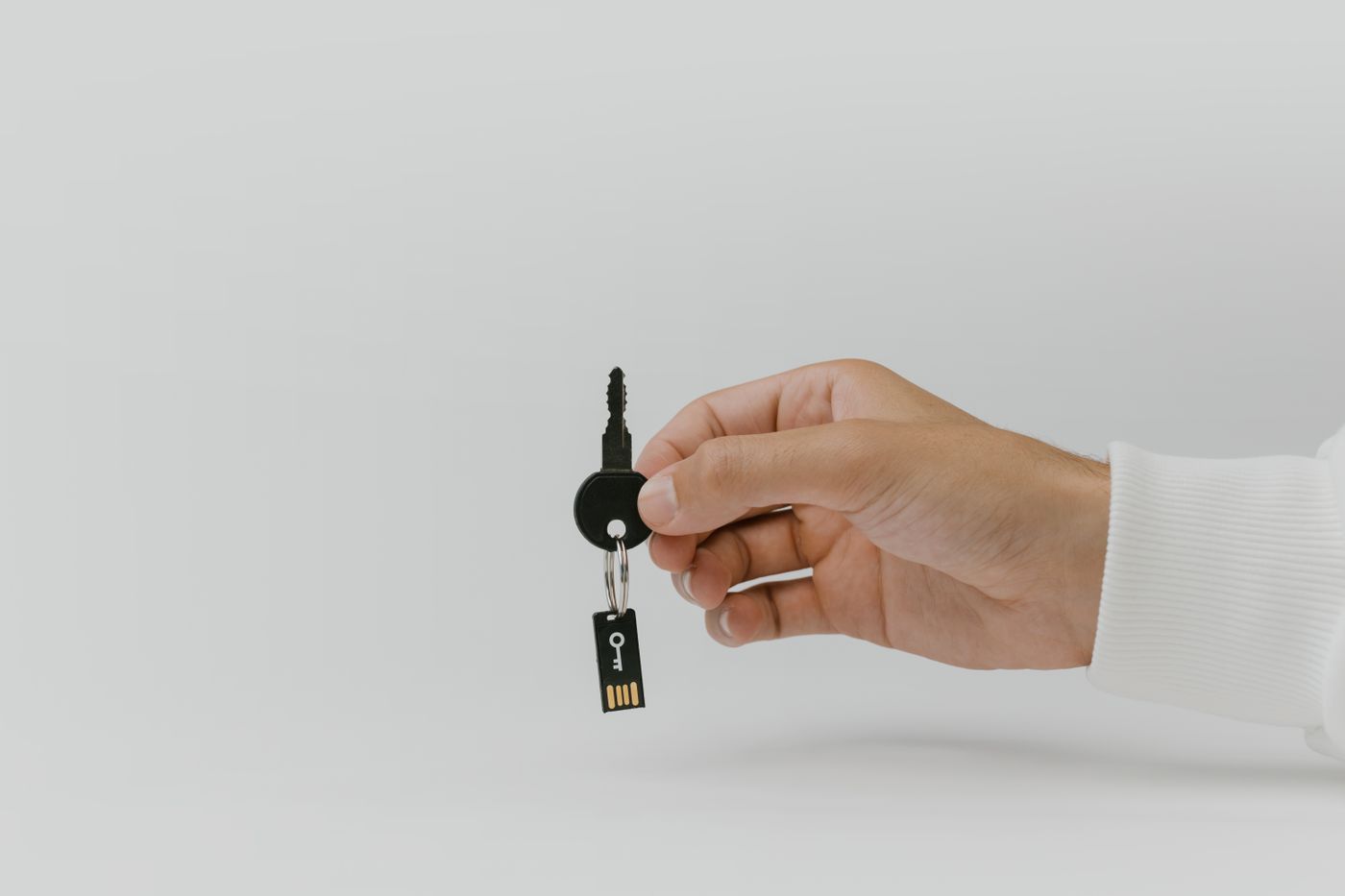 name keychain maker online — Hand holding keychain with integrated USB flash drive against a plain background
Photo: cottonbro studio / Pexels
If you do have your own artwork, send it as a vector file (SVG, AI or PDF) or a high-resolution PNG. Screenshot-quality images blur the letter edges, and a printer reproduces exactly what it is given — including the blur.
How your design becomes a PLA+ name keychain (the real process)
Six steps cover what every serious online maker does, with small variations between shops:
- Order and artwork check. The maker confirms spelling, font, colours and overall length. A long Tamil or Malayalam name needs a different backing-plate size than a four-letter English name, and this is where typos get caught — before any plastic melts.
- Model preparation. Text is converted into 3D geometry: typically 2–4 mm thick letters standing on a backing plate, with a printed loop or hole for the split ring. A keyring hole modelled into the part is far stronger than one drilled after printing.
- Slicing. The model goes into a slicer, which converts the 3D file into layer-by-layer toolpaths (G-code) for the printer — the standard fused filament fabrication process that desktop 3D printing runs on. Layer heights of 0.12–0.2 mm are typical for visible parts: finer layers cost print time but smooth the letter faces.
- Printing. The tag prints in PLA+ at roughly 215 °C. The key structural decision happens here: the letters and the backing plate print as a single fused piece. Glued-on acrylic letters snap at narrow strokes; a one-piece printed tag has no joint to break.
- Finishing. Supports are removed, the split ring is fitted, surfaces are cleaned. No painting step is needed for colour changes — the colour comes from the filament itself, so it doesn't chip off later.
- Quality check and dispatch. Spelling is checked against the order, the ring is given a tug test, and the tag is packed. Manufacturing takes 24–48 hours at the Coimbatore facility before the courier leg starts.
For the deeper version of steps 2–4, see how a 3D printed keychain is actually made.
What does a name keychain cost from an online maker?
In India, a custom 3D printed name keychain sits in the ₹129–₹149 band when you buy direct from the maker. The variables that move a quote are predictable: total length in centimetres, number of colours, double-sided printing, and hardware. Bulk return-gift orders price per piece lower than a single gift order, but the slab depends on quantity — ask for the per-piece rate at your quantity rather than asking for "a discount". Marketplace resellers layer their commission on top of the maker's price, so a seemingly identical tag can cost noticeably more. Our earlier 3D printed keychain price breakdown goes line by line through what you are actually paying for.
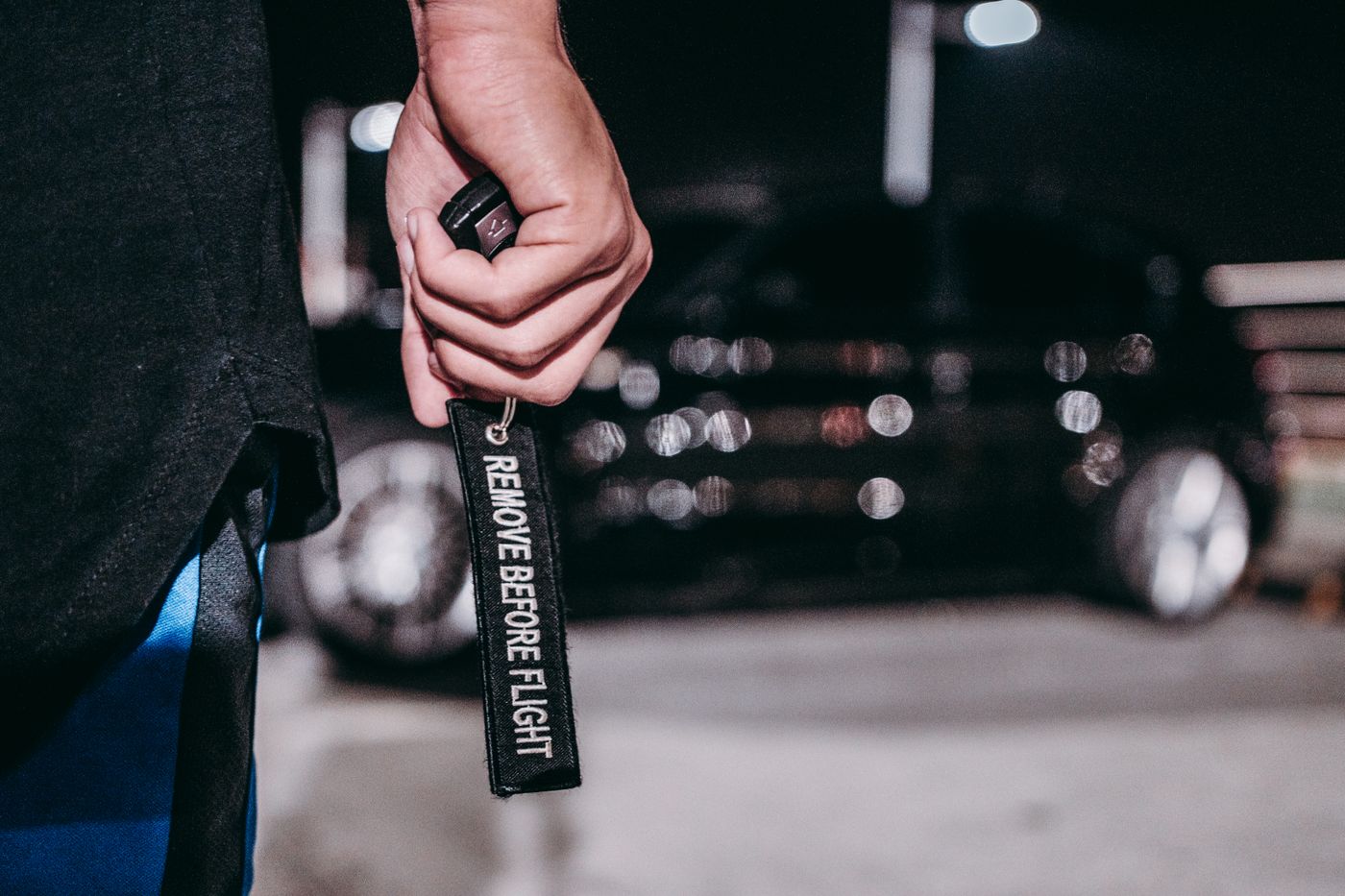 name keychain maker online — A hand holding a 'Remove Before Flight' keyring in front of a blurred car at night
Photo: Luis Quintero / Pexels
What material should a name keychain be printed in?
PLA+ is not the only option, and an honest comparison is the point:
| Material | Weight | Water | Narrow letters | Typical weakness |
|---|---|---|---|---|
| 3D printed PLA+ | ~14–18 g | unaffected | strong — one fused piece | softens in extreme heat |
| Acrylic | light | fine | brittle, snaps at thin strokes | edge chipping |
| Cast zinc / brass | heavy | fine | fine | scuffs, drags on the keyring |
| Laser-engraved wood | light | swells | fine | moisture damage over time |
PLA is the most widely used filament in FDM 3D printing precisely because it prints with good layer adhesion and high strength for its cost, and because its low thermal expansion keeps thin parts like name plates dimensionally accurate. Its honest weakness is heat: PLA melts only at about 150–160 °C and has poor heat resistance unless annealed. A keychain in a pocket or a backpack never approaches that temperature. A keychain left flat on a car dashboard in May, in direct sun, can warp — no marketing claim changes that physics. Keep it off dashboards and it will happily outlast the acrylic alternative.
Name keychain maker online or near me — which should you use?
"Near me" wins when you want the tag in your hand today and you accept whatever fonts and materials the shop stocks. Online wins on choice, evidence and price transparency: you can compare real photographs, stated materials and delivered cost before paying, and the total wait is just manufacturing (24–48 hours) plus courier. For a gift with a date attached, order online early rather than betting on a local shop's supplier schedule. We covered the full trade-off in custom keychain maker near me vs online.
Choosing fonts and names that print well
Not every design survives contact with a printer. Thin hairline fonts need a minimum stroke width — below roughly 1 mm, letters chip regardless of material. Block capitals and semi-bold weights print cleanly; ultra-thin script fonts are the usual disappointment. All-caps names look sharper on a number-plate-style tag, while mixed case reads better on longer names. And check the spelling twice at checkout: a printed name is a printed name — fixing it means reprinting, not re-spelling.
 name keychain maker online — Close-up of a business professional holding a house key and architectural plans, symbolizing real estate
Photo: Pavel Danilyuk / Pexels
How to check a name keychain maker before you order
Five checks, all doable in five minutes:
- Real photographs, not renders. Zoom in: printed layer lines should be visible, and letters should meet the backing plate with no glue line.
- Material named. "Plastic" is not a material. PLA+, PLA, acrylic and resin behave differently in sun, water and pockets; a maker who names the filament is a maker who chose it.
- Lead time stated. Anything promising same-day shipping on a custom print is reselling stock, not manufacturing it.
- Price in a sane band. Well under ₹100 for a fully custom printed tag usually means thin material, a stock design with a name stuck on, or both.
- A human to answer. Nuho India publishes a support number (+91 90808 85390) for exactly this — confirm spelling and size before the print starts, not after it ends.
What people actually use name keychains for
School bags and hostel keys are the everyday case: a flat printed tag weighs around 14–18 g and won't scratch the key it travels with. Water-bottle tags, car and bike key sets, and bulk return gifts for birthdays, baby showers and weddings are the other common uses — a 50-piece return-gift order is simply a 50-piece print queue, which is why per-piece rates drop. The current Nuho India range covers name tags, number-plate tags and photo-based designs, all printed to order in PLA+ in Coimbatore and dispatched within 24–48 hours of manufacturing.
Ordering a name keychain online is not mysterious: type the name, check the maker's material and photographs, pay a sane price, and wait one to two days for the print plus courier time. Everything else — the fonts, the plate size, the split ring — is the maker's job. That's the job we do at Nuho, every day, in Coimbatore.
Frequently Asked Questions
More Articles You Might Like
Cartoon Stickers for Kids: Where They Stick and How They Wear
Cartoon stickers for kids, surface by surface: where they stick, how they wear on walls, cupboards and bottles, and how to make them last.
Personalised Keychains Online in India: Materials, Prices and Timelines
Buying personalised keychains online in India? Compare PLA+, acrylic, metal and wood on price, weight and durability, with realistic 24–48 hour timelines.
How to Print Custom Shape Stickers: Cut Lines, Files and Machines
Cut lines, file formats, the right sticker paper for your printer and three ways to cut any shape — a practical guide to printing custom shape stickers.