
Sticker Lamination Types: Gloss, Matte and Holographic Compared
Nuho India Team
Nuho Creative Team
Key Takeaways & TL;DR
- Gloss laminate takes water, dust and scrubbing best, but it throws glare and shows every fingerprint and speck of dust.
- Matte laminate reads well under tube lights and hides fingerprints, yet it softens colour and does not like being scrubbed.
- Holographic is normally the face film rather than a laminate, so it still needs a clear protective layer over the print.
- Lamination adds material cost and lead time, and short-lived or UV-cured prints often do not need it at all.
wall, ornament, umbrella, toy, baby, colors
Sticker Lamination Types: Gloss, Matte and Holographic Compared
Sticker lamination types fall into three practical groups: gloss film for colour punch and wipe-clean durability, matte film for low-glare readability under tube lights, and holographic, which is usually an embossed face film that still needs a clear laminate printed over it. The right choice depends on where the sticker lives, how much sun and monsoon moisture it faces, and whether the artwork or the object should stand out.
Key Takeaways
- Gloss laminate takes water, dust and scrubbing best, but it throws glare and shows every fingerprint and speck of dust.
- Matte laminate reads well under tube lights and hides fingerprints, yet it softens colour and does not like being scrubbed.
- Holographic is normally the face film rather than a laminate, so it still needs a clear protective layer over the print.
- Lamination adds material cost and lead time, and short-lived or UV-cured prints often do not need it at all.
What Sticker Lamination Actually Is
Lamination is the technique of manufacturing a material in multiple layers so that the composite achieves improved strength, stability and appearance, and a laminate is a layered object assembled using heat, pressure, welding or adhesives [1] (Wikipedia, Lamination).
For a printed sticker the process is shorter than it sounds. The printed item is passed through a machine whose rollers apply a sticky-back clear plastic to one or both sides, pressure and heat make it stick, and the item is cut to size once the plastic has been applied [2] (The Print Authority, Guide to Types of Lamination).
Two things follow from that order of operations. The laminate sits above the ink, so it takes the scratches and the solvent wipes instead of the artwork, and the cut happens after lamination, so a die-cut shape leaves a sealed edge all the way around its outline.
The Three Types a Quote Sheet Will Name
Sticker lamination types mostly reduce to three films: gloss, matte and soft touch. CustomAny defines sticker lamination as an extra layer of material added to a sticker to make it stronger, last longer and look better, and it names gloss, matte and soft touch as the three main types of laminate for stickers [3] (CustomAny, Laminate stickers vs non laminate stickers).
The same source puts a number on "longer": an additional coating on top of manufactured stickers can extend their useful life by one to three years in harsh environments such as scratchy dirt and acid rain, and it also shields the sticker from the sun's rays [3].
Soft touch is the fourth answer you will hear on a call. It generally looks like matte lamination, it feels soft and silky, and that velvety feel is chosen when the printed piece is meant to feel luxurious rather than merely protected [2]. A quieter variant, nylon lay flat laminate, is mostly used for book jackets because it does not produce the curl that other laminates tend to create [2].
Gloss Lamination: Protection First
Gloss is the protection-first choice, and the trade-off is glare. Those who are not afraid of glare in daylight or bright artificial light choose gloss, and the only drawback is the rapid appearance of traces of settling dust and fingers [4] (AIVA Paper Group, Types of lamination for stickers).
Gloss also does the colour work. Enclosing the print in a completely see-through layer keeps the sharp, bright colors the artwork intended, and gloss lamination in particular makes the print far less subject to water, while fingerprints, smudges and oil are easily wiped off [2].
On a sticker that gets handled daily, gloss is also the forgiving finish at cleaning time: it wipes clean with a damp cloth, and water beads off it instead of sitting in a texture. That matters on a water bottle, a helmet or a delivery box that goes out in the rain.
Matte Lamination: Readability First
Matte is the readability choice. The film is fixed with a transparent adhesive, it slightly reduces the original brightness of the shades of the image or lettering, and it is in demand for its presentable appearance and lack of glare when exposed to sunlight [4].
There is a heavier version as well. Where the usual protective film has a thickness of 85 microns, matte hardened increases it to 180 microns, eliminates the appearance of fingerprints, is not scratched and has a low degree of wear, though it reduces the brightness of colors even more and is not recommended for very light shades [4].
A third variant, diamond matte, is complemented with iridescent splashes and has a texture reminiscent of a fine abrasive [4]. It is the finish to pick when a plain matte looks too flat on a dark artwork, and it is a reminder that "matte" covers several different films rather than one.
Holographic: Face Film First, Laminate Second
Here the naming gets confusing. Holographic simply means the design is printed on iridescent vinyl, giving an eye-catching rainbow effect, and holographic stickers are made like most other stickers: ink is printed onto the holographic vinyl, then a clear laminate is applied over the printed layer to protect the design and make the sticker durable, waterproof and resistant to fading in the sun [5] (Sticker It, How Are Holographic Stickers And Labels Made?).
The rainbow is not printed either. Holographic material starts as a metallised polyester film run through rollers with a textured surface, and the embossing is so thin, around 10 microns or about a fifth of a human hair, that it cannot be perceived by touch [5].
A gloss laminate is the usual partner, because a glossy laminate enhances the reflective nature of the material, and a matte finish can be requested instead when the rainbow has to sit back [5]. Security-grade holograms are a different budget: the embossing rollers have to be engraved with your design, which is only economically viable for large quantities, with starting quantities around 30,000 pieces, against a small printed imitation at 50 stickers [5].
Where that rainbow actually survives Indian heat, dust and fuel vapour is covered separately in our guide to holographic stickers in India.
Do You Need Lamination At All?
Not always. Lamination costs more, it increases lead time, and it is unnecessary for short-term sticker usage, for graphics printed with ultraviolet light that cures the ink as it lands, or where a laminated sticker would be too thick to apply easily to an uneven surface [3].
If you are laminating yourself, the choice is between cold and hot. Cold lamination uses self-adhesive laminate and a squeegee, while hot lamination sends the laminate and the sticker paper into a heat machine where they are sealed using a high temperature, which suits bulk production but risks warping a design [3].
The practical rule for a small business is simple: a sticker that lives for weeks on a window or a carton probably does not need a laminate, and a sticker that will be washed, rained on or rubbed against a bag does.
Gloss vs Matte vs Holographic at a Glance
| What you are buying | Gloss laminate | Matte laminate | Holographic face + clear laminate |
|---|---|---|---|
| What it does to the artwork | Deepens colour, adds shine | Softens colour, removes shine | Rainbow bands slide across it |
| Readability under tube light | Glare can wipe out fine lines | Reads flat from any angle | Reads only where light hits |
| Fingerprints and dust | Very visible | Largely hidden | Visible on the metalised layer |
| Water and scrubbing | Wipes clean, handles rain | Does not like being scrubbed | Survives only if sealed |
| Typical best use | Bottles, helmets, outdoor decals | Laptops, planners, product labels | Return gifts, packaging seals, indoor panels |
| Main watch-out | Highlights in photos | Light greys merge together | Heat dulls and lifts it |
How to Judge a Finish Before You Commit
A finish is not a mood; it is a measurement, and the numbers behind it are easy to read.
Gloss is an optical property that indicates how well a surface reflects light in a specular, mirror-like direction, and the factors that affect it are the refractive index of the material, the angle of incident light and the surface texture [6] (Wikipedia, Gloss (optics)).
That is why a finish is judged at a defined angle rather than by eye. The standard test method for specular gloss uses a 60 degree geometry, with 20 degrees for evaluating high gloss finishes and 85 degrees for matt or low gloss [6].
Three cheap checks beat any spec sheet. Look at the sample under a warm tube light and again in indirect daylight, tilt it to see whether a highlight crosses the artwork, and rub a corner twenty times with a thumb to see whether the texture changes.
Indian Conditions: Monsoon, Heat and Tube Lights
Indian conditions decide this argument faster than a brochure does. Frequent changes in temperature and the changing activity of the sun lead to the aging of stickers, which is exactly why a thin film layer applied with a thermal protection method is added [4].
The barrier does real work. Laminate safeguards stickers from harmful UV rays, allowing the colors and images to seem original for much longer, while rain, wind and sunlight are the elements it has to survive [3].
For an Indian buyer the order is simple: pick the surface first, then the finish, because the surface decides how much rain, dust and handling the sticker will meet.
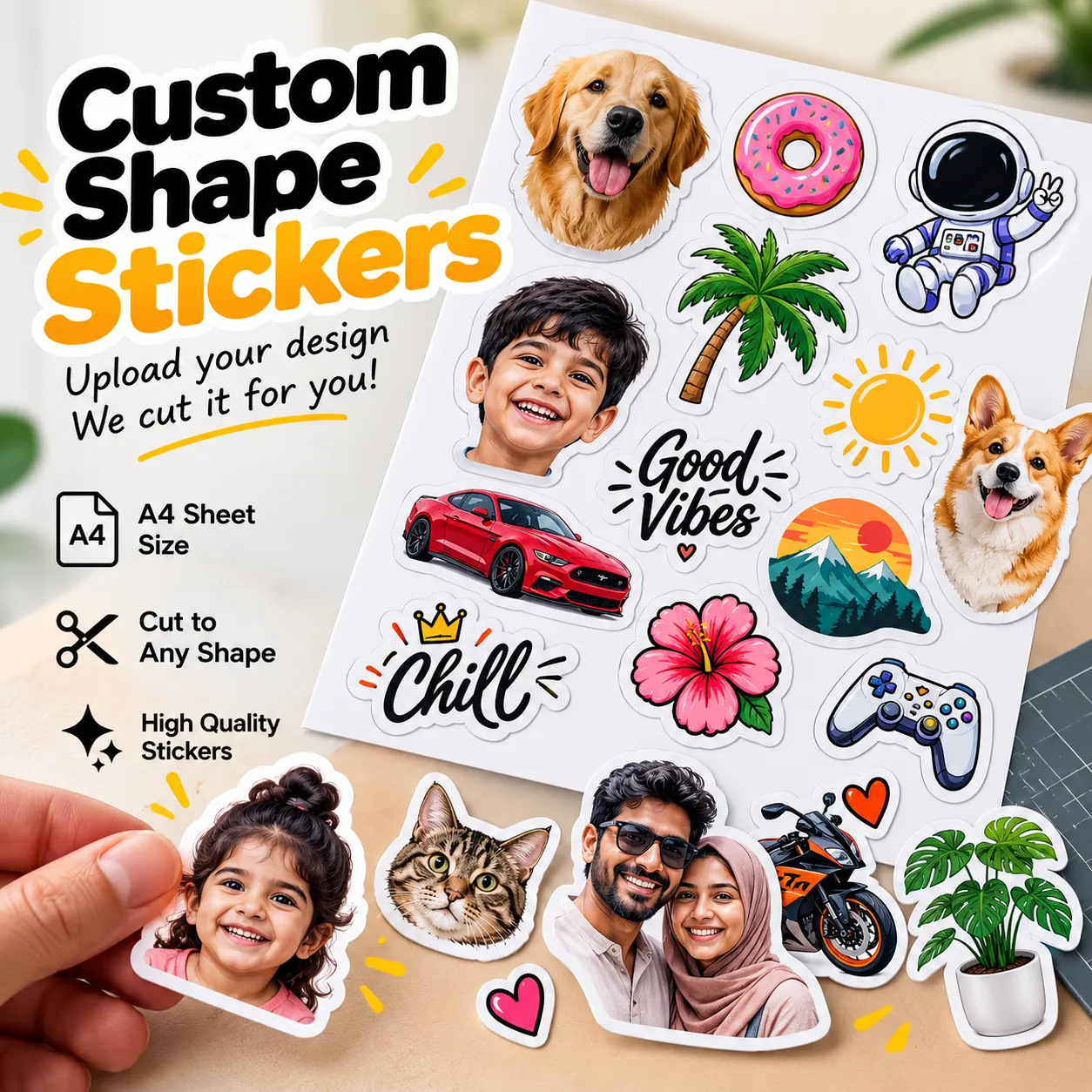
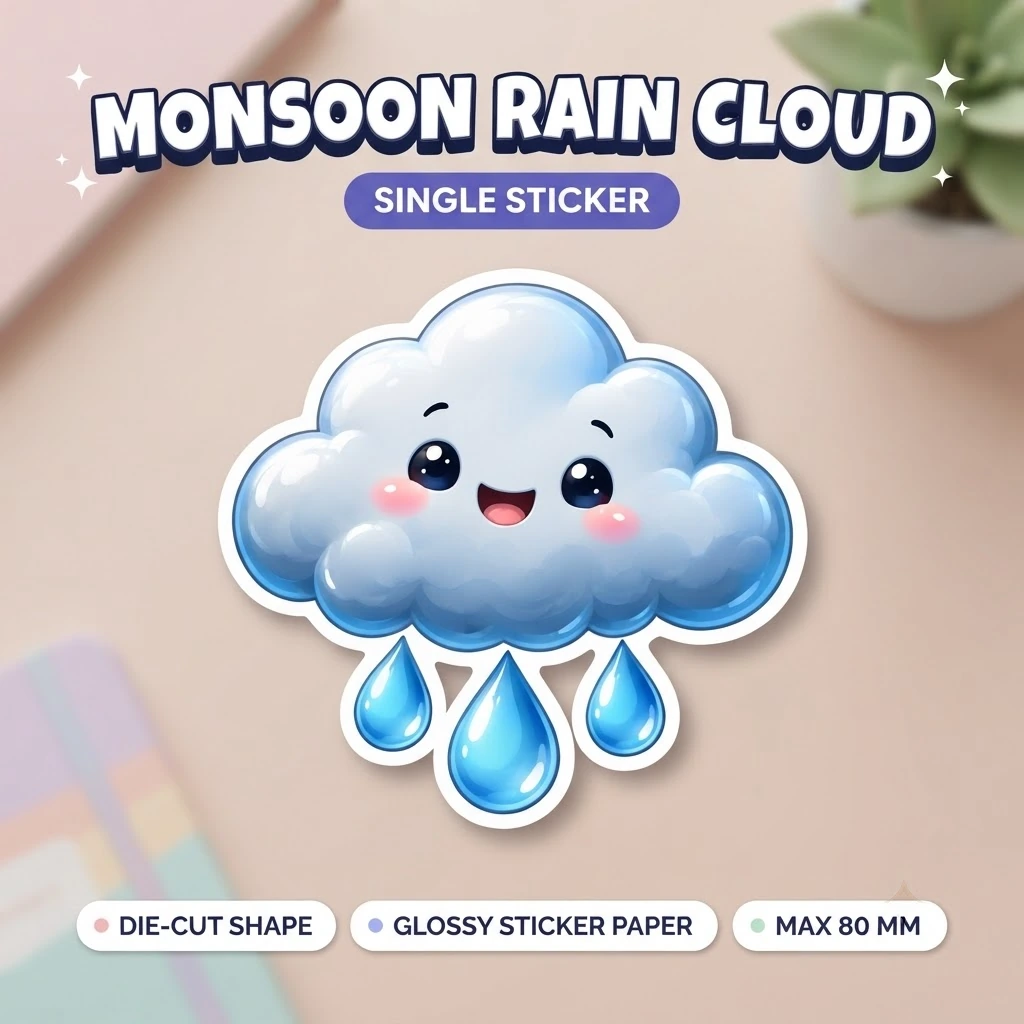
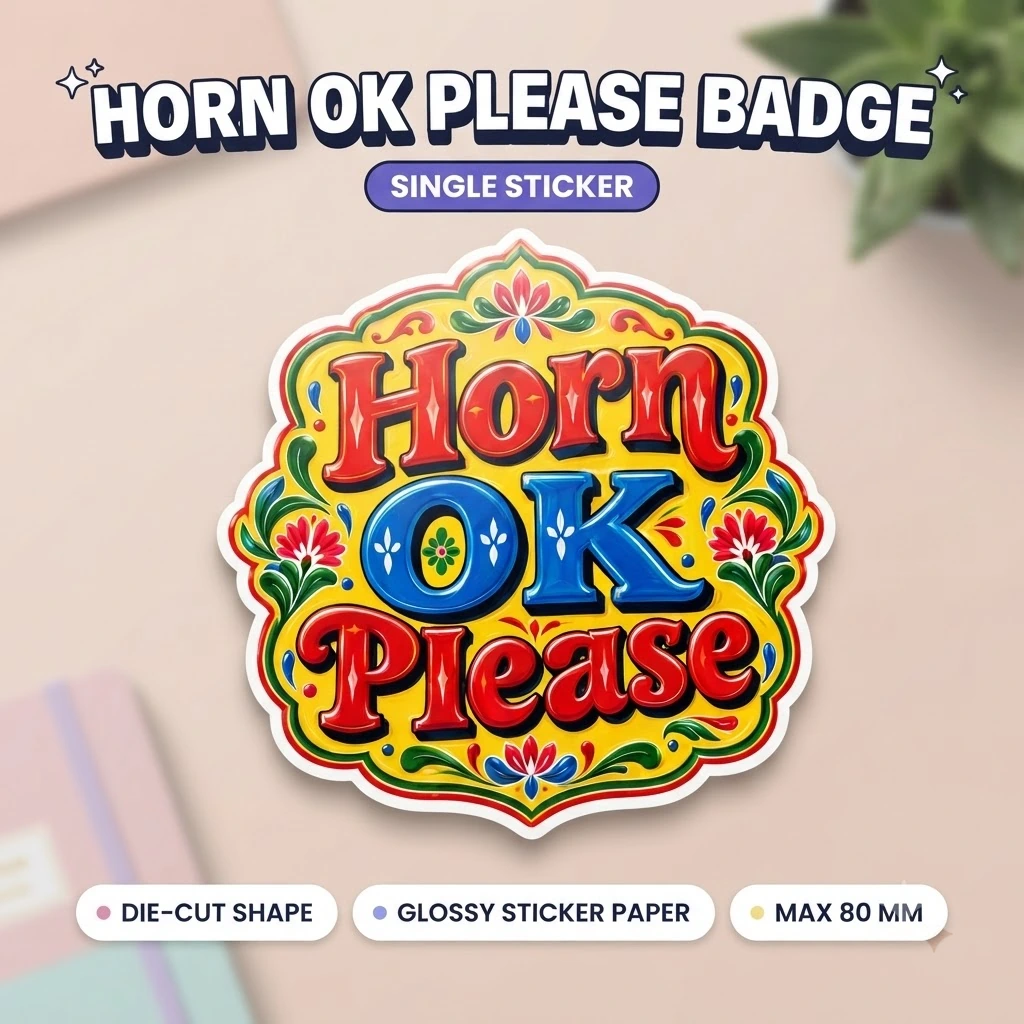
Prices are worth stating plainly. In the Nuho catalogue, a custom shape sticker with your own design is listed at ₹79, and individual die-cut designs such as the Monsoon Rain Cloud sticker and the Horn OK Please badge are listed at ₹15 each, with the finish named in the product title rather than hidden in the checkout.
Finish choice also changes how the artwork should be prepared. For gloss, avoid hairline white details over dark ink, because reflection erases them at an angle, and for matte, lift the midtones so pale greys do not merge into the film. Our guide to glossy vs matte stickers covers that artwork split in detail, and waterproof stickers in India covers what actually survives rain, fuel and sunlight.
Rain exposure is a construction question rather than a finish question: the film face, the protected print and the pressure-sensitive adhesive are the layers that keep water out.
What to Confirm Before Artwork Is Finalised
Nuho India is a digital manufacturing and custom vinyl sticker brand based in Coimbatore, Tamil Nadu, shipping pan-India to around 27,000 serviceable pincodes through Delhivery and Bluedart with automated tracking, with standard orders manufactured in 24 to 48 hours and two to four business days in transit.
The same one-line note works with any printer, including us. Ask for the laminate name and thickness in microns or mil, whether it is applied cold or hot, and whether the cut is made after lamination. "Matte laminate, die-cut to outline, 2 mm bleed supplied" is a complete instruction; "matte look" is not.
If you are ordering shapes rather than a single design, start from the custom shape stickers guide, which covers cut paths, contours and the difference between die-cut and kiss-cut before the finish is settled.
Frequently Asked Questions
What are the main sticker lamination types?
The three named on most quote sheets are gloss, matte and soft touch, with holographic used as a face film that still takes a clear laminate over the print.
Does lamination make a sticker waterproof?
Lamination adds a barrier that helps, but water resistance comes from the film face, the protected print and the pressure-sensitive adhesive together, and typical laminate may not be completely waterproof for the long term.
Is matte laminate worth the extra cost?
Usually the difference is small, and it comes from the laminate rather than the printing, so ask which film is being used before accepting a large gap in the quote.
Can you laminate over a holographic sticker?
Yes. Holographic stickers are printed on iridescent vinyl and then take a clear laminate, and a glossy laminate is normally used because it enhances the reflective nature of the material.
When should you skip lamination?
Skip it for short-lived graphics, for UV-cured prints where the ink is already sealed, and where a thick laminated film would not conform to an uneven surface.
Conclusion and the Next Step
Gloss, matte and holographic are not three grades of the same thing: two are laminates that decide how the sticker survives water, dust and fingerprints, and one is a face film that decides how it catches light. Pick for the surface and the weather first, and for the artwork second.
The next step is to write one line with your artwork: the finish, the film thickness, the cut type and the surface it will live on, then ask your printer to confirm all four before the file is finalised.
Sources
Featured Custom Products
Frequently Asked Questions
More Articles You Might Like
Sticker Mule Alternatives in India: Where to Print Custom Stickers
Sticker Mule prints custom die-cut stickers from ten per design, with a free online proof, free shipping and a four-day turnaround, but its sticker page quotes in dollars and...
Custom Shape Stickers Upload Design: The Pre-Upload Checklist
Short answer: Before you upload your design for custom shape stickers, check five things. The grid layout sets the maximum sticker size, the file should be a PNG with a...

Brand Storytelling for Startups: How a Founder's Story Becomes a Moat
Short answer: Brand storytelling is turning why you started into a story other people can repeat back to you. It holds as a moat because competitors can copy your technology,...