
Holographic Stickers in India: Where They Shine and Where They Peel
Nuho India Team
Nuho Creative Team
Key Takeaways & TL;DR
- A holographic sticker is a metallised PVC film embossed with a diffraction grating, typically 61 microns (2.4 mil) thick — the rainbow is structural, not printed.
- Film makers such as Avery Dennison rate holographic vinyl for indoor use and short-term outdoor signage, not permanent outdoor exposure.
- On a sun-facing car panel in Tamil Nadu, expect three to nine months before the rainbow dulls to flat silver.
- Laser printers fuse toner at fuser temperatures up to 427 °C, so only heat-stabilised holographic sheets are laser-safe.
- Home inkjet printing cannot lay white ink, so dark artwork printed on holographic paper picks up the rainbow underneath.
Holographic stickers in India: the short answer
A holographic sticker is a metallised plastic film embossed with a microscopic pattern that splits light into rainbow bands. It looks premium and holds up well indoors. Outdoors in India, sun, heat and monsoon spray decide everything: a laminated holographic vinyl on a shaded, flat surface can look good for a year or more, while the same sticker on a car bonnet can fail in weeks.
What Makes a Holographic Sticker Holographic?
The rainbow is not printed. It comes from a physical structure stamped into the film — a grid of microscopic ridges acting as a diffraction grating. When white light hits those ridges, different wavelengths leave at different angles, so the surface throws red, green and blue in separate directions. Tilt the sticker and the bands slide across it. That is structural colour, the same mechanism behind a CD's silver sheen, not pigment.
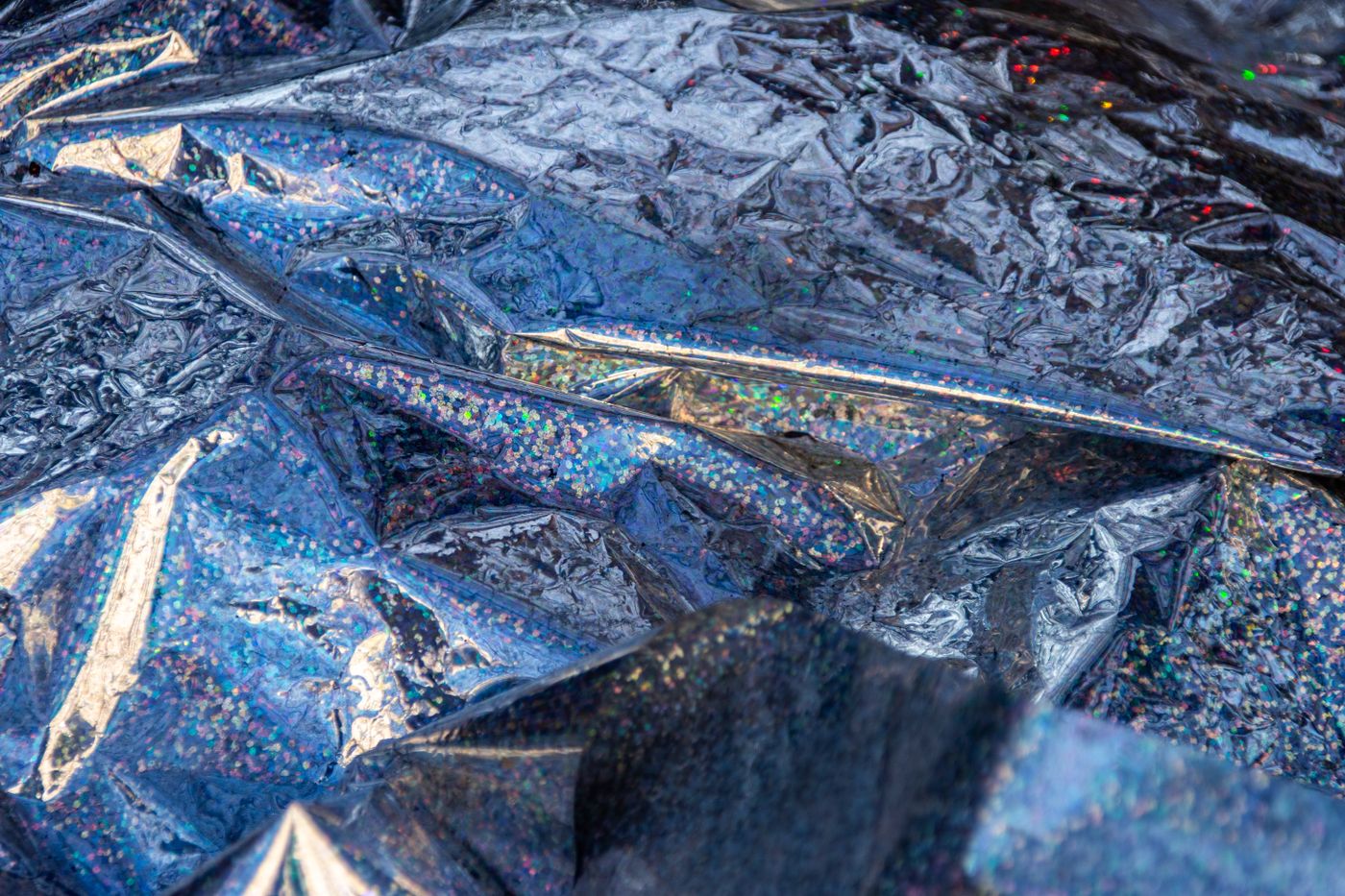 holographic stickers — A close-up view of colorful crumpled metallic foil with reflective and sparkling textures
Photo: wal_ 172619 / Pexels
Because the effect lives in the surface geometry, it is fixed at manufacture: better artwork will not make a cheap hologram shinier. The pattern is already there, and your design either sits on top of it or hides it.
Manufacturers create it by embossing. General Formulations, which makes a 6.0 mil sparkle holographic film, describes the process: metal shims on a rotating cylinder press the pattern into the film, leaving a faint seam every 12 inches. A hairline in a sheet of holographic film is that seam, not a defect.
Are Holographic Stickers Real Holograms?
Mostly no, and the distinction is worth knowing before you pay a premium. Wikipedia's article on the security hologram is blunt: the common hologram on a credit card or SIM is a stack of two or three flat image layers, each visible at a different angle, giving an illusion of depth. It is closer to an old bicycle reflector than to a true hologram, and these stacked images top out around 10 micrometres per optical element.
Real holograms exist, but they are not what a sticker shop sells. A "3D hologram sticker" is usually multi-layer rainbow film with a fixed pattern: fine for decoration, useless as proof of authenticity now that the film is cheap.
What Are Holographic Stickers Actually Made Of?
A holographic sticker is a sandwich, and the layers explain both the shine and the peeling. Avery Dennison's SF 100 series is a useful reference because its data sheet names the construction: a 2.4 mil (61 micron) rigid metallised PVC face, a clear permanent acrylic adhesive, and a kraft liner. It is UV-stabilised and light-diffracting, and Avery positions it for indoor promotional work and short-term outdoor signage.
 holographic stickers — A close-up of vibrant satin fabric in hues of blue and purple, showcasing a colorful ripple effect
Photo: Rafael Minguet Delgado / Pexels
The film maker itself scopes that product to short-term outdoor use; anyone selling holographic stickers as a permanent outdoor solution is overselling the material.
| Layer | Typical spec | What it does | What fails first |
|---|---|---|---|
| Face film | 61 micron metallised PVC, or 150 micron for a 6.0 mil film | Carries the embossed diffraction pattern | Scratches; creases on tight curves |
| Print coating | Thin receptive layer | Holds ink or toner | Inks flake if the coating is cheap |
| Adhesive | Permanent acrylic, clear | Bonds to the surface | Lifts at edges under heat or grit |
| Liner | 78# or 90# kraft | Carries the roll through a printer | Curls in humid storage |
Thickness is the first honest question to ask a supplier. A 61-micron film conforms to curves but dents easily; a 150-micron film lies flat but fights a bottle's shoulder radius. Adhesive chemistry matters as much: acrylic pressure-sensitive adhesives resist oxidation and UV better than rubber-based hot melts, as the pressure-sensitive adhesive literature describes. If a seller cannot name the adhesive, assume the cheapest option.
Where Do Holographic Stickers Shine?
Holographic film earns its price in four situations: gifting and return gifts, where a rainbow seal reads as expensive at arm's length; packaging seals on flat box panels, where it catches shop light; stationery and laptop lids, the film's best-case environment of smooth, indoor, clean-handed surfaces; and indoor event signage, where ceiling light hits it at the right angle.
The common thread is a flat, clean, indoor surface — holographic film only pays off where light hits it at an angle.
Where Do Holographic Stickers Peel?
This is the part listings leave out. In our sticker production in Coimbatore, complaints cluster into seven places.
- Car dashboards and bonnets. A dashboard in direct sun is a heat trap: the film softens, the adhesive shears, edges curl within weeks. On exterior paint, UV dulls the rainbow to grey before the sticker even lifts.
- Curved, low-energy plastics. PP and HDPE bottles, scooter panels and textured trim resist adhesion. The film cannot wet out, so it sits on the peaks and lifts at the valleys.
- Anything that goes through a wash cycle. Laminated holographic vinyl handles a hand rinse. Unlaminated paper-backed holographic sticker paper swells, runs and turns to pulp.
- Fuel filler surrounds and engine-adjacent panels. Petrol and diesel dissolve many adhesives; heat finishes the job.
- Textured or dusty surfaces. Grit under the edge acts like a tiny wedge, and every pressure wash drives it further in.
- Die-cut points and sharp corners. A sharp internal corner concentrates peel stress, so die-cut artwork should avoid needle points.
- Re-stuck stickers. Once lifted, the adhesive transfers to the surface and the film will not lie flat again.
| Surface | Verdict | Why |
|---|---|---|
| Laptop lid, journal cover | Excellent | Flat, indoor, low abrasion |
| Gift box, hamper, invitation | Excellent | Short life, handled gently |
| Water bottle, hand-washed | Fair | Fine if laminated; detergent softens edges |
| Scooter body panel | Poor | Curvature, vibration, monsoon spray |
| Car bonnet or boot lid | Poor | Direct sun and UV |
| Fuel filler surround | No | Solvent attack |
 holographic stickers — A colorful, abstract texture featuring vibrant reflections and holographic patterns. Ideal for creative backgrounds
Photo: Rafael Minguet Delgado / Pexels
Do Holographic Stickers Survive Indian Weather?
Treat lifespan as a range tied to placement, not a warranty. Indoors, on a flat surface out of direct sun, a laminated holographic vinyl sticker can hold its shine for years. Outdoors and vertical, in shade, expect closer to a year. On a sun-facing car panel in Tamil Nadu, three to nine months is realistic before the effect goes flat — the film behaving as specified, not a bad batch.
Humidity slows the adhesive's wet-out, so a sticker applied at 8 a.m. in the monsoon never bonds as well as one applied at 4 p.m. in dry heat. Dust is abrasive too: film on a bike fairing collects grit that grinds the surface every wipe.
The practical test is simple. Tilt the sticker under a tubelight. If the rainbow still moves cleanly, the structure is intact; once it looks like flat silver foil, the grating is gone. If water rather than sun is the worry, the waterproof stickers guide covers film and laminate choices.
Can You Print Holographic Stickers at Home?
Yes, with caveats, and printer type decides most of them.
Inkjet is the friendlier route. Printable holographic sticker paper has a receptive coating for dye or pigment ink, and most home inkjets will feed a sheet. The limitation is opacity: CMYK inks are translucent, so colour printed onto a rainbow film picks up the film underneath. Pale designs survive; a solid dark logo looks muddy. Commercial printing lays white ink first, which home printers cannot do.
Laser printing is riskier. A laser printer fuses toner with heat and pressure, and the laser printing process runs its fuser at temperatures that can reach 427 °C (801 °F) at the roller. Ordinary holographic films are PVC, which softens well below that. Only heat-stabilised sheets rated for laser use should go through, and even then a curled liner is a jam waiting to happen.
Whichever route you take, laminate the result. Clear laminate is what turns a pretty sheet into something that survives a wet hand, and it shields the print from the abrasion that dulls holographic film fastest. Cut with a die, plotter or scissors — but round the corners.
Holographic, Metallic, Glitter or Reflective?
These four finishes get sold interchangeably and behave very differently.
| Finish | How it works | Best for | Weakness |
|---|---|---|---|
| Holographic | Embossed diffraction grating on metallised film | Gifting, packaging, stationery | Dulls outdoors; colour shifts under print |
| Metallic | Smooth metallised or foil layer, no grating | Logos, labels, premium packaging | No rainbow movement; scuffs show |
| Glitter | Suspended flakes in a clear binder | Kids' stickers, party favours | Sheds flakes, thick, hard to laminate cleanly |
| Reflective | Glass beads or microprisms returning light | Helmets, vehicles, safety | Looks grey in daylight; needs a light source |
If the job is visibility at night, reflective stickers are the correct material and holographic film is the wrong one. If the job is a shine that catches shop light, holographic wins and reflective looks dull. And if you are choosing between gloss and matte for the same artwork, the glossy vs matte comparison covers the glare trade-off that holographic film exaggerates.
How Do You Buy Holographic Stickers in India Without Getting Burnt?
Ask six questions before you pay. A supplier who can answer all six is selling film, not adjectives.
- What is the face film, and how thick? Ask for microns or mils, and whether it is PVC or PET.
- What adhesive, and is it permanent? Permanent acrylic is the default for anything lasting; removable adhesive is fine on a gift box, a liability on a laptop lid.
- Is it laminated? Unlaminated holographic film scratches if you look at it wrong.
- How is white handled? If your artwork has pale or solid areas, ask whether a white base layer goes underneath; otherwise expect the rainbow to show through.
- What cut are you getting? Kiss-cut sheets and die-cut singles behave differently in a printer and on a surface. Sharp internal corners peel first.
- What lifespan is intended? A supplier who says "forever, outdoors" has not read the data sheet.
Order a sample and leave it on a windowsill for a week. One week of Indian sun tells you more than any product page.
Where Does Nuho India Fit?
Nuho India prints custom-shape and cartoon stickers in Coimbatore, Tamil Nadu, cutting each design to its own outline rather than trimming a rectangle around it. That matters with holographic finishes because the cut line is where peeling starts: a clean die-cut with rounded corners outlasts a hand-trimmed edge every time. If a holographic finish is what you want, confirm the film and laminate before ordering — the shine is a material choice, not a print setting.
For gifts that must survive a handbag, a keyring pocket or a monsoon commute, a matte material is often the better answer. Our PLA+ keychains are printed at about 215 °C with letters fused to a continuous backing plate, weigh roughly 14–18 g, and cost ₹129–₹149 — no film to dull, no edge to lift, and a personalisation that survives daily use. Both lines are made and despatched within 24–48 hours.
Stickers and keychains solve different problems. Pick the holographic one for the moment someone opens a box; pick the printed one for the years after. One limitation worth stating plainly: holographic film cannot make a sticker waterproof on its own, stop UV, or serve as a security mark, and metallised film is a composite that most Indian municipal streams cannot recycle with paper. Prices and specs change, so verify construction before a large order and judge the result on a windowsill, not in the shop.
Frequently Asked Questions
More Articles You Might Like
Alphabet Keychains: Single-Letter Name Tags in PLA+
Alphabet keychains in India: how single PLA+ letters are printed, which A–Z shapes survive pockets, sizing, and ₹129–₹149 pricing with 24–48 hour despatch.
Vinyl vs Paper Stickers: Which Survives Indian Weather
Vinyl sticker printing versus paper stickers in Indian weather: how monsoon humidity, heat and UV attack each face material, and which one to buy.

Gaming Keychains in India: Controller, Console and Name Designs
Gaming keychains in India: which controller shapes print cleanly, why joysticks snap, and how to size a durable gamertag tag at 50 mm in PLA+.