
Stickers for Water Bottles: What Survives Washing and Ice
Nuho India Team
Nuho Creative Team
Key Takeaways & TL;DR
- Dishwashers spray water at 45-75 °C, which softens the adhesive edge long before the vinyl print fails — hand washing is the only reliable routine.
- A sticker wider than about 70% of the bottle's diameter wraps past the widest point and lifts at both ends; a 70 mm bottle takes a 40-55 mm sticker.
- Pressure-sensitive adhesive bonds by pressure alone, so 30 seconds of burnishing and a 24-hour wait before the first wash roughly decide the sticker's lifespan.
- PP, HDPE and silicone bottle surfaces are low-energy and reject adhesive within days regardless of application technique.
- A PLA+ name keychain on the bottle loop avoids the adhesive problem entirely and despatches from Coimbatore in 24-48 hours.
Do Water Bottle Stickers Survive Washing?
A vinyl sticker that was degreased, pressed hard and left alone for 24 hours survives hand washing, dish soap, ice water and a school bag. It does not survive a dishwasher. Wash water there runs between 45 and 75 °C, the detergent is alkaline, and the adhesive softens at the edge long before the printed film gives up.
The part that fails first is rarely the vinyl — it is the two-millimetre band at the edge where water gets underneath.
Why Do Bottles Destroy Stickers Faster Than Laptops Do?
A laptop lid sees one stress: the occasional hand. A water bottle sees four at once.
- Water sits on the surface for minutes at a time, and detergent lowers its surface tension so it wicks into any gap.
- Thermal cycling — a fridge at roughly 4 °C, a school bag at 30 °C, then a sink of hot water.
- Abrasion against bag lining, a cycle bottle cage, a desk edge.
- Condensation, which in a Coimbatore summer is not an occasional event but a permanent condition.
Pressure-sensitive adhesive holds by contact, not by curing. A pressure-sensitive adhesive forms its bond when pressure is applied, with no solvent, water or heat involved, and the strength of that bond depends on how much pressure actually reached the surface, plus the smoothness, surface energy and cleanliness of that surface.
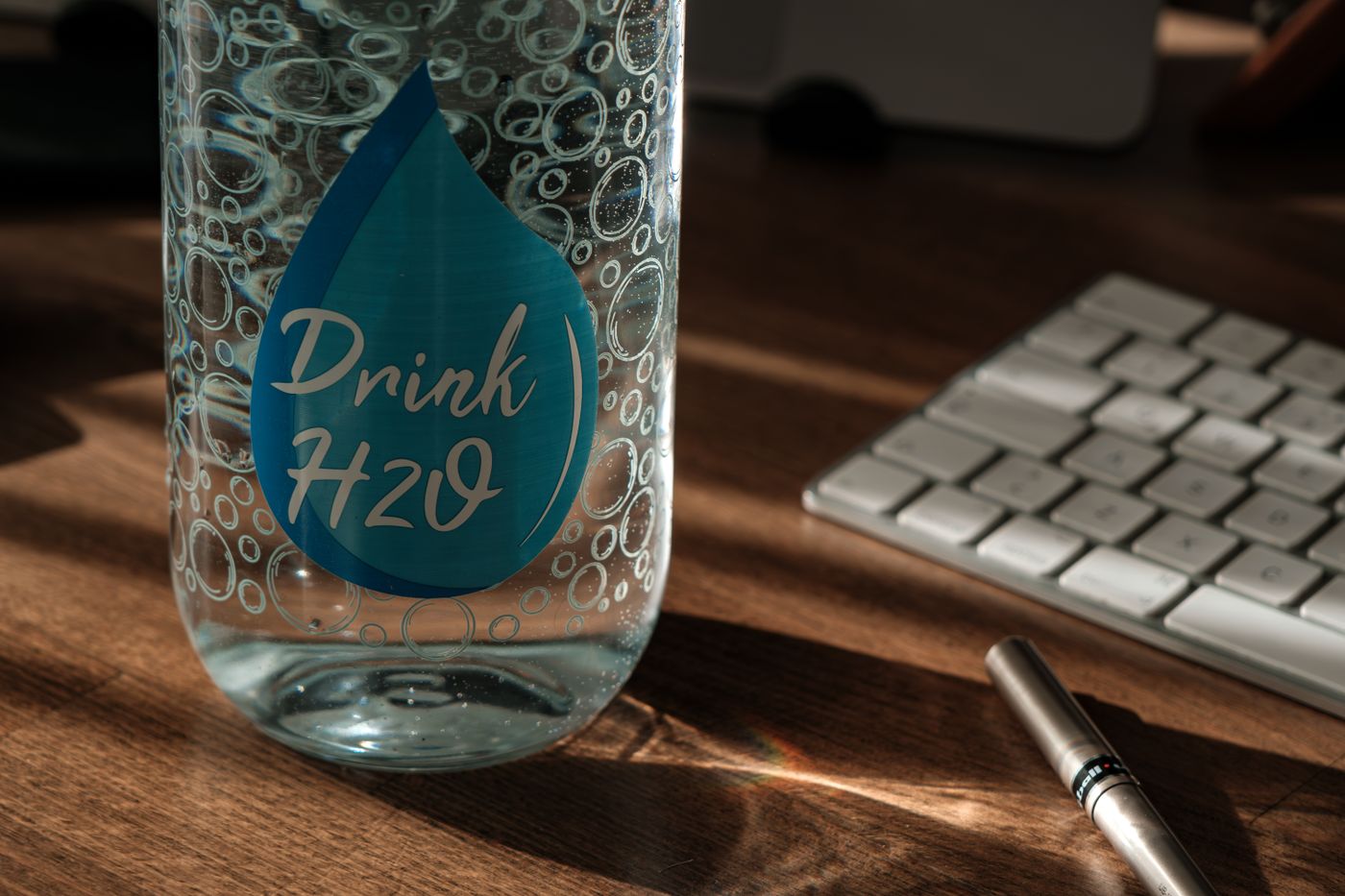 sticker for water bottle — Glass water bottle labeled 'Drink H2O' on an office desk with sunlight and keyboard
Photo: İrfan Simsar / Pexels
That one fact explains most sticker failures. A sticker smoothed for two seconds with a fingertip holds a fraction of what it would hold after 30 seconds of burnishing with a cloth. The first wash finds the difference immediately, and the edge lifts within a week.
The same reference points out that these adhesives reduce tack at low temperatures and lose shear strength at high temperatures. On a bottle that goes from fridge to bag to sink, you hit both ends of that range inside a single day.
Which Bottle Surfaces Hold a Sticker and Which Refuse?
Surface energy decides this. An adhesive has to wet out a surface the way water wets clean glass; on a low-energy plastic it beads and simply rests there.
| Bottle surface | Grip | What actually happens |
|---|---|---|
| Bare brushed stainless steel | Good | Holds for years if degreased; brush grain can trap air if you burnish along it |
| Powder-coated steel | Very good | Slightly textured paint gives the adhesive tooth; avoid sandy, heavily textured finishes |
| Borosilicate glass | Excellent | Smoothest common surface, best wet-out; the risk is chipping, not peeling |
| Tritan and polycarbonate | Good | Works after a dish-soap wash; mould-release oil is what kills new stickers |
| PP and HDPE bottles | Poor | Low surface energy; edges lift within days no matter how hard you press |
| Silicone sleeves and soft-touch coatings | Very poor | Nothing sticks long-term; put the artwork somewhere else |
| Matte painted metal | Fair | Any solvent lifts the paint and the sticker together, so clean gently |
Two practical consequences follow. If the bottle has a removable silicone band, decorate the band's bare bottle underneath rather than the band. And if the bottle is polypropylene — most cheap coloured school bottles and almost every cap — no sticker routine will save you; that is a surface problem, not an application problem.
Do Water Bottle Stickers Survive the Dishwasher?
No, not reliably, and the numbers explain why. A dishwasher sprays water typically between 45 and 75 °C at the load, then runs a heated dry. A pressure-sensitive bond that was designed for room temperature is being asked to hold through a hot, alkaline, high-flow environment six or seven times a week.
 sticker for water bottle — Focused view of three clear plastic bottles with green caps outdoors
Photo: Patrick / Pexels
The failure sequence is predictable:
- The wash water softens the adhesive at the die-cut edge.
- Detergent reduces surface tension, so water wicks into the lifted lip.
- The rinse pushes that water further under the film.
- The dry cycle drives the moisture out and leaves a milky residue on the adhesive.
- Repeat three or four times and the sticker peels off in one clean sheet, taking its adhesive with it.
"Bottle is dishwasher safe" on a product page describes the bottle, not the sticker. If a bottle must go through the machine, top rack with heated dry switched off is the gentlest cycle available, and even then treat each run as borrowed time. Anything printed with a name and a class section should be hand washed.
What Size Sticker Fits a Water Bottle?
Wrap size is arithmetic, not taste. Circumference is π times the diameter, so a 70 mm bottle is about 220 mm around. Diameters below are approximate and measured across the body, not the cap.
| Bottle | Typical body diameter | Circumference | Comfortable sticker width |
|---|---|---|---|
| 500 ml single-wall steel | 65–73 mm | 205–230 mm | 40–55 mm |
| 750 ml insulated steel | 73–80 mm | 230–250 mm | 45–60 mm |
| 1 L insulated steel | 85–90 mm | 265–285 mm | 50–70 mm |
| 500 ml Tritan kids' bottle | 60–65 mm | 190–205 mm | 35–50 mm |
The width column exists because a sticker that spans more than about 70% of the diameter wraps past the widest point of the curve. Once both ends sit on the receding face, they want to spring back, and the first warm wash finishes the job. Keep the design inside that front face and the whole sticker stays in compression against the bottle.
Height matters too. Leave 15–20 mm clear above and below the label zone, away from the shoulder radius and the base fillet, because those areas curve in two directions at once. A 25–30 mm tall name sticker on a 500 ml bottle sits comfortably in that band.
For a school set, the useful size is a 60–80 mm wide strip with the name set at 6–8 mm cap height. Smaller than that and a teacher cannot read it across a classroom; larger and it dominates a bottle that already has a brand print on it.
Ice, Fridge and Freezer: What Cold Actually Does
Cold slows an adhesive rather than destroying it. Tack drops as temperature falls, which is why a sticker applied to a bottle straight out of the fridge never bonds properly and lifts at the first wash.
 sticker for water bottle — Three Pocari Sweat bottles on a stone surface, focus on blue caps
Photo: Airam Dato-on / Pexels
Apply at room temperature, burnish, wait a day, then chill. That sequence costs nothing and doubles the working life of the sticker.
At −18 °C the film stiffens and the adhesive goes glassy, but a bonded sticker survives a freezer as long as no water was trapped underneath. Freeze–thaw cycling with moisture already in the bond line is what damages it.
Condensation is the real enemy in Indian conditions. An insulated bottle's outer wall stays dry while its vacuum holds, but single-wall steel, Tritan and glass sweat heavily when a cold bottle meets humid air. That film of water sits against the sticker edge for hours, so never store a decorated bottle in a wet bag pocket.
What Does "Waterproof Sticker" Mean on an Indian Listing?
The word is used for at least four different products, and only two of them belong on a bottle.
- Paper label with a varnish — water-resistant, not waterproof. One hand wash and the print lifts.
- Unlaminated vinyl — survives splashes and rain, but a long soak lets water creep under the edge and cloud the adhesive.
- Laminated vinyl — vinyl film with a clear overlaminate. This is the grade that survives bottles, lunch boxes and daily hand washing.
- Epoxy dome — thick resin cap over the print. Water beads off beautifully, but the dome yellows in sunlight and the rim is a hard edge that catches on fabric.
Ask three questions before ordering: what film, what laminate, what adhesive. A seller who cannot answer all three is selling you a paper label with a nice photo. Our own guide to waterproof stickers in India covers how each grade behaves under rain, fuel and sunlight.
How to Apply a Sticker So It Survives a School Term
- Wash the bottle with dish soap and warm water, then rinse. Detergent removes the mould-release oil that defeats new stickers.
- Dry it completely — 30 minutes upright in air, not a towel, because a towel leaves lint under the film.
- Degrease the patch with 70% isopropyl alcohol on a cloth, and let it evaporate for two minutes. Test on the base first: alcohol can dull some powder coats and printed lacquers.
- Position with a tape hinge. Tape the sticker's top edge to the bottle, check alignment against the base, then fold it back like a page.
- Peel 20 mm of liner and tack that edge down first.
- Peel and press as you go, working from the centre outward with a thumb, so no air is trapped.
- Burnish for 30 seconds with the peeled liner or a soft cloth, pushing from the middle to the edges.
- Wait 24 hours before the first wash. The bond keeps building for hours after the sticker looks applied.
- Hand wash only, and never scrub directly over the sticker.
How Do You Remove One Without Damaging the Bottle?
Warm the sticker with a hairdryer on low for 20–30 seconds, then peel slowly at a shallow angle, almost parallel to the surface. Steep angles pull paint and leave adhesive behind. Work residue off with vegetable oil on a cloth, then wash with dish soap. Skip the knife and the steel scrubber.
Stickers or a Printed Keychain for a School Bottle?
A name sticker solves identification. It does not solve the loop, the cap or the fact that a six-year-old will chew the corner. That is where a printed tag earns its place: a name keychain for water bottles hangs from the bottle loop with no adhesive at all, so there is nothing to lift, nothing to soak and nothing to peel.
Nuho India prints those tags in PLA+ at about 215 °C, fusing the letters into a continuous backing plate rather than gluing on cut-outs, and despatches from Coimbatore in 24–48 hours. They weigh roughly 14–18 g, survive a full water bottle bath because they are not stuck to anything, and are waterproof in the way a solid object is waterproof rather than the way a coated film is.
For a whole class, the cheaper route is a batch of custom sticker sheets — one sheet per child, names kiss-cut and ready to peel. For the child who loses three bottles a term, Nuho India's personalised keychains do the job the sticker cannot.
The Bottom Line on Water Bottle Stickers
A sticker for a water bottle is a small engineering problem: the right film, the right surface, the right pressure and the right washing routine. Get those four right and a name sticker lasts a school year. Get them wrong and it lasts a fortnight.
The short rules worth remembering: degrease and dry the bottle, burnish for 30 seconds, wait a day before washing, keep the design under 70% of the bottle's diameter, and never put a decorated bottle in a dishwasher. If the bottle is polypropylene or silicone, skip the sticker and hang a tag on the loop instead.
Frequently Asked Questions
More Articles You Might Like

Gaming Keychains in India: Controller, Console and Name Designs
Gaming keychains in India: which controller shapes print cleanly, why joysticks snap, and how to size a durable gamertag tag at 50 mm in PLA+.
Anime Keychains in India: Custom Name Styles That Last
Anime keychains in India last when they are one flat printed piece. Sizing, katakana names, why acrylic chips, and what the law allows — explained.
Custom Sticker Sheets in India: Kiss-Cut Sets That Peel Clean
How to plan a custom sticker sheet in India: A4, A5 and A6 counts, kiss-cut peel mechanics, per-sticker cost maths and artwork rules for mixed designs.