
Custom Sticker Sheets in India: Kiss-Cut Sets That Peel Clean
Nuho India Team
Nuho Creative Team
Key Takeaways & TL;DR
- An A5 sheet with 5 mm margins holds 12-14 shapes at 40 mm once 3 mm gaps are counted.
- Kiss cutting goes through the vinyl and adhesive but not the liner, so shapes stay on one sheet until peeled.
- At an illustrative ₹70 for an A4 with 24 shapes, cost per sticker is about ₹2.92 versus ₹5.00 on a 6-shape A6.
- Keep cut gaps at 3 mm minimum and 5 mm to the sheet edge, or a thumbnail peel lifts neighbouring stickers.
- Nuho India manufactures custom sticker sheets in Coimbatore with a 24-48 hour despatch window.
What Is a Custom Sticker Sheet?
A custom sticker sheet is a single printed page of vinyl stickers, kiss-cut so each shape is cut through the film and the adhesive but not through the backing liner. You order many shapes at once, peel one off when you need it, and the rest stay flat and usable. It is usually the cheapest way to buy a mixed set of designs.
That definition matters because most sticker questions in India are really sheet questions. A school wants 20 characters, ten of each. A shop wants 250 logo labels in three sizes. A wedding wants one sheet per child that survives a return-gift bag. All three are the same order shape: many small cut shapes, one liner, one print run.
How Many Stickers Fit on One Sheet?
Sticker count is set by the sheet size and by how tightly the shapes nest, not by how many files you send. Indian orders mostly use the ISO 216 A-series, whose halving rule keeps every size in the same 1:√2 proportion — A4 is 210 × 297 mm, A5 is 148 × 210 mm and A6 is 105 × 148 mm.
| Sheet | Dimensions | Practical sticker count | Best for |
|---|---|---|---|
| A6 | 105 × 148 mm | 4–8 shapes at 30–40 mm | One-child favour packs, tiny reward sets |
| A5 | 148 × 210 mm | 9–16 shapes at 30–45 mm | Return gifts, notebook and bottle sets |
| A4 | 210 × 297 mm | 14–30 shapes at 25–40 mm | Shop labels, event tables, retail packs |
The arithmetic behind those bands is simple. An A5 sheet with a 5 mm edge margin gives a usable 138 × 200 mm, or 27,600 mm². A 40 mm round sticker occupies a 40 × 40 mm bounding box, and the 3 mm gap you need between neighbours pushes the effective footprint to about 43 × 43 mm, or roughly 1,850 mm². That divides out to about 14 shapes, and a real layout lands between 12 and 14 once odd shapes waste corners.
 custom sticker sheets — Person holding a C# programming language logo sticker outdoors
Photo: RealToughCandy.com / Pexels
Two rules keep that count honest: at least 3 mm between shapes, and at least 5 mm from any shape to the sheet edge. Narrower gaps look efficient on a proof and fail in the hand, because a thumbnail peeling one sticker lifts its neighbour.
Why Does a Kiss-Cut Sheet Peel Cleanly?
Kiss cutting is the controlled-depth version of die cutting: the blade passes through one layer of the laminate and stops against the silicone-coated liner. Kiss cutting is defined as die cutting through just one layer of a laminate, which is exactly what a sticker sheet needs — separated shapes, one intact carrier sheet.
Three things make the peel feel clean rather than fiddly:
- Cut depth. Too shallow and the shape tears its own outline. Too deep and the liner is scored, so the sheet breaks in half in a bag.
- Liner release. The liner is silicone-coated so the adhesive prefers the vinyl face over the paper. A cheap liner releases unevenly, which is why budget sheets curl at the corners before use.
- Border control. A 1.5–2 mm cut-line offset outside the artwork means no white halo around the shape and no bleeding of the print into the cut.
Pressure-sensitive adhesive bonds on contact pressure, with no water, heat or solvent involved, so a sticker that has sat in a drawer for six months still applies the same way as one printed yesterday. The sheet format is built on that behaviour: nothing dries out, nothing needs reactivating.
What Does a Sheet Cost Per Sticker?
Sheet pricing is quoted per page, but the number that decides whether an order is sensible is cost per sticker. Divide the sheet price by the usable count and compare that to a loose die-cut quote.
| Quote | Sheet price | Stickers on sheet | Cost per sticker |
|---|---|---|---|
| A6, 6 shapes | ₹30 | 6 | ₹5.00 |
| A5, 12 shapes | ₹45 | 12 | ₹3.75 |
| A4, 24 shapes | ₹70 | 24 | ₹2.92 |
Those are arithmetic examples, not a rate card — your quote will move with quantity, lamination and how much of each sheet is artwork versus white space. What stays true is the direction: the A4 sheet almost always wins on cost per sticker, while the A6 wins on handling and gifting. Our breakdown of custom sticker prices in India covers the four levers — quantity, size, cut method and finishing — in detail.
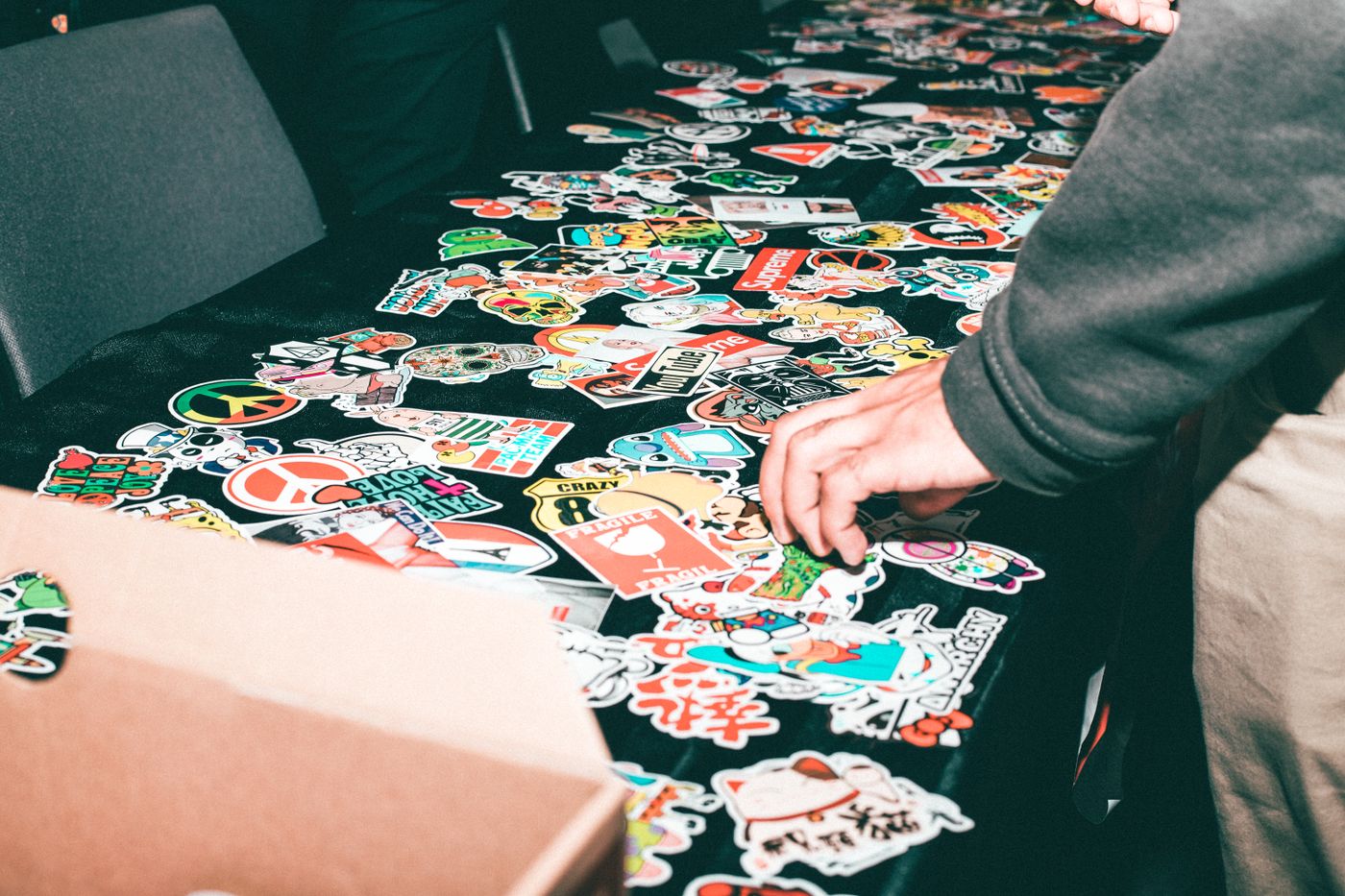 custom sticker sheets — Vibrant assortment of stickers displayed on a table indoors
Photo: Javon Swaby / Pexels
A sheet also hides a cost that loose stickers make visible: cutting. A die-cut order needs a separate cut path and often a physical die per shape, which is why ten designs in a run of ten each is expensive as loose stickers and reasonable as sheets. One shared sheet absorbs the setup across every shape on it.
Which Artwork Rules Keep a Mixed Sheet Looking Intentional?
Sheet design fails in a specific, predictable way: every design arrives from a different source, at a different scale, with a different line weight. The result prints correctly and looks like a scrapbook. Six rules fix it before the file reaches the cutter.
- Set one size ladder. Pick two or three sizes, such as 25 mm, 35 mm and 50 mm, and snap every shape to one of them.
- Match stroke weight. Keep outline strokes at 1 mm or heavier at 40 mm wide; thinner lines vanish at small sizes and tear at the cut.
- Cap the palette. Three to five flat colours across the whole sheet reads as a set. Ten colours reads as leftovers.
- Give every shape a 2 mm bleed and keep text inside a 3 mm safety inset from the cut line.
- Avoid gradients and drop shadows under 30 mm. They band on small formats and muddy the shape edge.
- Keep one visual anchor. A shared border, corner mark or character style ties mixed designs together without extra printing cost.
If your shapes are photographic or full-colour, the same rules apply to contrast rather than line: a busy photo at 25 mm becomes a grey smudge, while a face or a single object still reads.
How Many Sheets Should You Order?
Order quantity is a multiplication, not a guess. Work it out in four steps:
- Count recipients or units: 30 children, 250 products, 120 wedding guests.
- Decide stickers per person or unit: one sheet per child, two labels per product.
- Divide by the stickers on your chosen sheet: 30 A6 sheets for 30 children; 500 labels ÷ 24 per A4 sheet = 21 sheets.
- Add 10–15% spares for peel mistakes, spoilage and the sheet you keep as a reference.
That last step is not padding. Hand-applied stickers lose a few percent to misalignment and fingerprints, and reprinting 20 sheets costs more than adding three. Our guide to bulk custom shape stickers for return gifts runs the same maths for 50 to 500 guests.
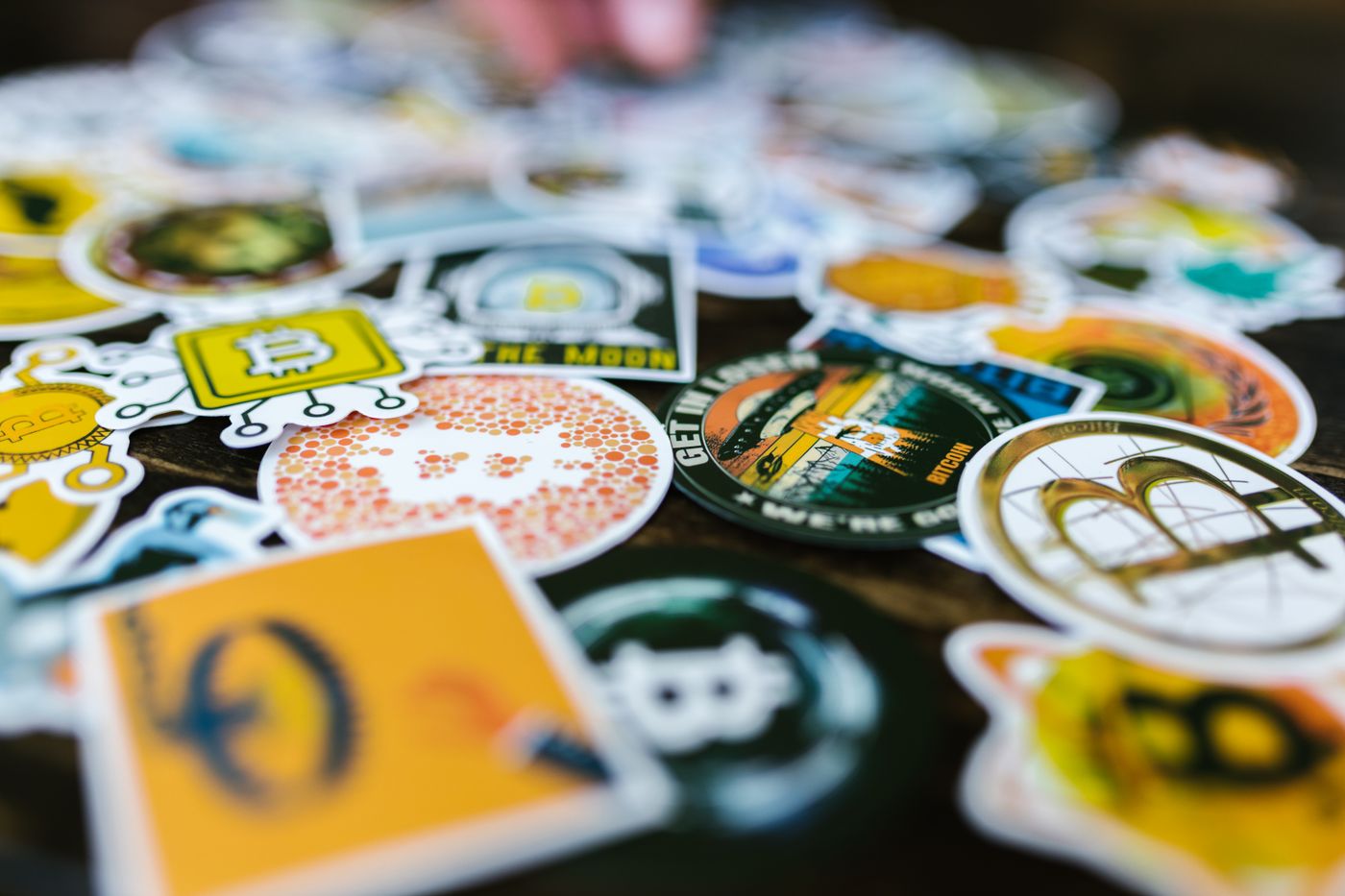 custom sticker sheets — Assorted cryptocurrency-themed stickers featuring Bitcoin and blockchain designs
Photo: RDNE Stock project / Pexels
For a first order, ask for a layout proof before printing. A proof shows the actual nesting, the gaps and how many shapes made it onto the page — the only way to catch a design that quietly dropped off the sheet.
Where Do Sticker Sheets Work Best?
Sheets are the right format whenever the unit you hand over is a set, and the wrong format when it is a single hero object.
- Return gifts and party favours. One A6 sheet per child, named on the sheet, travels flat inside a gift bag without crushing.
- School and tuition rewards. Stars, ticks and house points in identical small shapes, peeled one at a time from a sheet that stays intact for weeks.
- Small-business labels. Product seals, thank-you stickers and packaging labels applied by hand; the intact liner keeps them flat in a drawer.
- Planner and journal packs. The same design in three sizes on one page, which is a format loose die-cuts cannot offer cheaply.
- Scrapbook and card kits. Mixed motifs in a controlled palette, sold or gifted as a themed set.
For single large logos, packaging seals at 80 mm and up, or anything applied by machine, separate die-cut pieces are the better buy. Our kiss-cut custom shape stickers guide covers the cut mechanics if you want the deeper version.
What Actually Breaks a Sticker Sheet?
Honesty is worth more than a durability claim. A sticker sheet fails in five ways, and only two are the printer's fault.
- Unlaminated ink in the sun. A scooter seat, a car dashboard or a shop window in direct afternoon sun will fade an unlaminated print in months. Matte or gloss lamination slows it; nothing stops it permanently.
- Heat above the film's comfort zone. Vinyl softens and adhesive creeps in a parked car in an Indian summer. Sheets stored in a glovebox curl; sheets stored at room temperature do not.
- Water on a paper-faced or unlaminated product. Waterproof vinyl survives a wash cycle; paper-backed sheets do not. Ask which you are buying instead of assuming.
- Liner curl in humidity. Coastal humidity over months can lift a thin liner. Keep sheets flat, in a sealed sleeve, under a book.
- Cut gaps that are too tight. A 1 mm gap looks fine in a PDF and fails when a fingernail crosses it. The fault is in the layout, not the material.
Where another format wins, say so: for a permanent outdoor sign, cut vinyl or acrylic is more appropriate than a printed sticker sheet. For a keychain that has to survive a pocket for years, a 3D printed PLA+ keychain beats any sticker.
How Do You Order Custom Sticker Sheets in India?
The order is a short, ordered process, and each step removes a way the print can go wrong.
- Choose the sheet size from the job: A6 for favours, A5 for mixed gifting, A4 for volume labels.
- List your designs and counts. Ten characters at ten each is 100 shapes, not ten files.
- Fix the size ladder so mixed designs share two or three dimensions.
- Export artwork as vector where possible, with 2 mm bleed and text as outlines or embedded fonts.
- Approve a layout proof showing nesting, gaps and the final count per sheet.
- Print and cut, then check one sheet by hand before the run ships.
At Nuho India, custom sticker sheets and custom-shape stickers are made in Coimbatore, Tamil Nadu, with a 24–48 hour manufacturing and despatch window. A first sheet in hand answers the questions a proof cannot: how the peel feels, whether the liner stays flat, and whether the 3 mm gaps are actually enough for the way people use them.
Frequently Asked Questions
More Articles You Might Like
Bumper Stickers in India: Sizes, Placement and Legal Limits
Bumper stickers in India: the placements that are legal, the sizes that read from a following car, and how to apply one so it survives monsoon and sun.
3D Printed House Name Plates for Indian Homes: Weather and Mounting
3D printed house name plates in PLA+ for Indian homes: where they survive sun and monsoon, how to mount them, and how they compare with acrylic and brass.

Keychain Gifts for Boyfriend: Personalised Ideas That Get Used
Keychain gift for boyfriend ideas he will actually carry: personalised PLA+ tags from ₹129–₹149, 14–18 g, made in Coimbatore in 24–48 hours.