
Bumper Stickers in India: Sizes, Placement and Legal Limits
Nuho India Team
Nuho Creative Team
Key Takeaways & TL;DR
- Bumper stickers are legal in India when they stay off the number plate, out of the driver's forward view and clear of lamps, reflectors and parking sensors.
- A rear bumper sticker reads comfortably at 20-25 cm wide; single words work at 10-12 cm and family figure sets need 25-30 cm.
- The flat face of an Indian hatchback rear bumper is typically 12-15 cm tall, so taller stickers bridge a curve and lift at the ends.
- Adhesive reaches full bond in about 24 hours, so a high-pressure wash in the first day is the most common cause of a lifted edge.
- Commercial advertising on a private car is regulated at state level and can require permission; sectarian slogans and official-looking emblems are the designs most likely to be removed.
Bumper stickers are legal in India as long as they stay off the number plate, out of the driver's forward view and clear of lamps, reflectors and parking sensors. The rear bumper and tailgate are the safe canvas. Anything that changes how the car is identified, signals or sees the road is not a sticker question any more — it is an alteration question.
Four things decide whether a bumper sticker survives a year of Indian traffic: where it goes, its size, how it is applied, and whether the design invites a conversation with an officer.
Are Bumper Stickers Legal in India?
Yes, within boundaries that are narrow and easy to respect.
The registration plate is untouchable. Indian plates are High Security Registration Plates (HSRP), specified nationally and issued through the Regional Transport Office at registration. According to Wikipedia's overview of Indian registration plates, plates are mandatory front and rear, made of aluminium with a chromium hologram, and are specified in detail under the HSRP rules. A bumper sticker that overlaps the plate works against a component designed to be tamper-evident. Keep 5 cm of clear bumper around it.
Glass is regulated separately. Windscreen tint in India is governed by visible light transmission limits — 70% VLT for the front and rear windscreen, 50% for the other windows — and in April 2012 the Supreme Court ordered black films removed from vehicles. Window film rules by country summarise both. An opaque 20 cm sticker on rear glass does not breach a VLT number by itself, but it does reduce the driver's field of view, and that is the argument an officer will use. Rear glass stickers belong in the lower passenger-side corner, never in the wiper arc.
Lamps, reflectors and sensors stay uncovered. A sticker over a tail lamp, fog lamp, reflector or reversing camera changes how the vehicle communicates and how it parks. This is the single most common reason a decorative sticker gets pulled off at a checkpoint.
Structural alteration is a different offence. Altering a registered vehicle is dealt with under Section 52 of the Motor Vehicles Act, 1988. A vinyl decal on a painted panel is not an alteration. A sticker that covers a lamp, plate or mirror is treated as one in practice.
| Placement | Verdict | Practical note |
|---|---|---|
| Rear bumper, flat face | Best | Vertical, shaded, reads well in traffic |
| Tailgate below the glass | Best | Large clean panel on hatchbacks |
| Rear glass, lower left | Workable | Keep out of the wiper arc |
| Fuel flap | Good for small decals | 6–8 cm only |
| Front bumper | Workable | Stone chips and speed-breaker scrapes |
| Bonnet and roof | Poor | Full sun, UV, heat |
| Number plate or its frame | No | HSRP must stay as issued |
| Windscreen, driver's side | No | Sightline |
| Lamp lenses, reflectors, camera | No | Changes signalling |
| Over parking sensors | No | Phantom warnings |
State enforcement varies, and an officer's reading of "obstruction" is wider than a lawyer's. If a placement is arguable, it is not worth the argument.
Where on the Bumper Should a Sticker Go?
The best spot on any Indian car is the flat vertical face of the rear bumper, roughly centred, sitting 15–20 cm above the road-facing lip.
 bumper stickers india — Close-up of diverse, humorous bumper stickers covering a car's rear, showcasing urban creativity
Photo: K / Pexels
That height matters because Indian bumpers meet speed breakers, kerbs and gravel. A sticker applied within 10 cm of the bottom edge spends its life in the grit zone, and grit is what lifts an edge.
Work outwards from the plate. Leave 5 cm clear on each side of the registration mark, then place the sticker in the remaining flat area. On a hatchback that typically means either side of the plate, or the full-width strip above it. On a sedan the rear bumper is shallower, so a 20 cm sticker often fits only on the tailgate.
Three placements to avoid on the bumper itself:
- Over the parking sensors. A sticker across one of the four sensor circles causes intermittent beeps in reverse. Leave 4 cm clearance.
- Over the tow hook cover or reflector cut-outs. Film bridging a removable panel tears the first time the cover comes off.
- Across a panel seam. The bumper-to-fender joint flexes, and a sticker spanning it creases within weeks.
What Size Bumper Sticker Fits an Indian Car?
A rear bumper sticker reads comfortably at 20–25 cm wide; anything under 10 cm is a badge, not a message.
| Purpose | Suggested size | Why |
|---|---|---|
| Single word or short name | 10–12 cm × 4–5 cm | Legible at 2 m |
| Three to four word phrase | 20–25 cm × 6–8 cm | Legible at 5–6 m |
| Family or character set | 25–30 cm wide | Needs width for multiple figures |
| Rear glass statement | 20–25 cm wide | Sits in the lower corner |
| Fuel flap or mirror cap | 6–8 cm | Small curved surface |
| Bike tail panel | 8–12 cm | Narrow panel, curved |
Two constraints set the upper limit. The flat area of an Indian hatchback's rear bumper is usually 60–80 cm wide but only 12–15 cm tall before it curves away, so a taller sticker bridges the curve and lifts at the ends. And a sticker wider than about 30 cm reads as a panel graphic rather than a bumper sticker.
For text, keep the cap height at least 12 mm for a phrase read from a following car. Below that the artwork survives but the words do not.
How Do You Apply a Bumper Sticker So It Survives Monsoon?
Clean, dry, warm and slow. Six steps, about twenty minutes.
- Wash and degrease. Wash the panel, then wipe with isopropyl alcohol and let it flash off. Dust and polish residue are what cause the specks and early lifts.
- Check the panel temperature. Apply in shade, between roughly 20 °C and 35 °C. A bumper that has been in direct Coimbatore sun is too hot; the adhesive grabs before you can reposition.
- Dry-fit and mark. Tape the sticker in place with low-tack tape, step back four metres, and check it is level with the plate line rather than with the ground.
- Peel and squeegee from the centre out. Remove a few centimetres of backing, anchor the edge, then work outward with a felt-edged squeegee. Trapped air escapes at the edges only if you push it there.
- Give the edges a pass. Run the squeegee firmly around the perimeter at 45°, then press the edge down with a thumb through the backing paper.
- Wait 24 hours before washing. Pressure-sensitive adhesive reaches full bond over about a day. A high-pressure jet held close to a fresh edge will lift film that would otherwise last years.
Two mistakes account for most failures. Applying over a wet or waxed surface, and applying in the full sun so the film stretches as it goes down and contracts later, pulling the corners up.
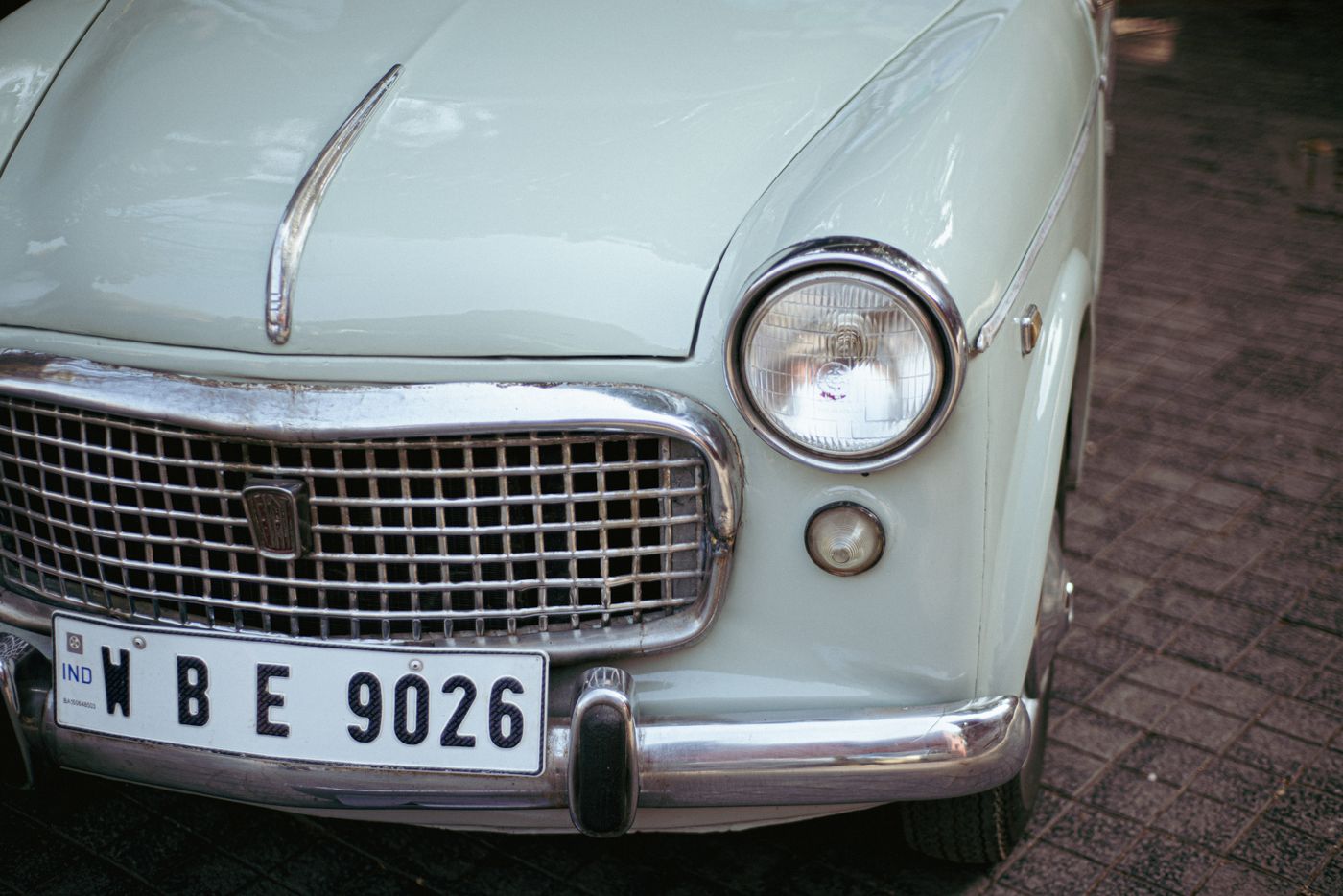 bumper stickers india — Detailed view of a classic vintage Fiat car front focusing on the headlight and grille
Photo: Souvik Dutta / Pexels
Which Bumper Sticker Designs Get You Stopped?
Content rules are enforced far more often than size rules, and they are not uniform across states.
Sectarian, casteist or communal slogans are the clearest category. They can attract action under state police rules and, where they provoke a response, criminal provisions that have nothing to do with motor vehicles.
Impersonation. Anything reading "Police", "Press", "Army", "Government of India" or resembling an official crest invites a stop. The Emblems and Names (Prevention of Improper Use) Act, 1950 restricts the use of specified emblems and names for professional and commercial purposes, and the Flag Code of India, 2002 governs how the tricolour is displayed — respectful display by private individuals is permitted, but the Ashoka Chakra and the national emblem are not decoration.
Obscene or abusive wording. Public obscenity provisions apply to a car as much as to a wall.
Political party stickers. These sit between personal expression and political advertising, which several states regulate. Expect the strictest reading during a poll cycle.
The safe design space is wide: names, initials, family figures, hobbies, native place, a favourite cartoon, a workshop or club mark. Personal, non-official, non-sectarian, legible.
Can You Put an Advertisement Sticker on a Private Car?
Not freely. Display of advertising on vehicles is regulated at state level — RTO and municipal rules govern commercial advertising on private vehicles, and a branded car used as a moving billboard can require permission that a private owner does not have.
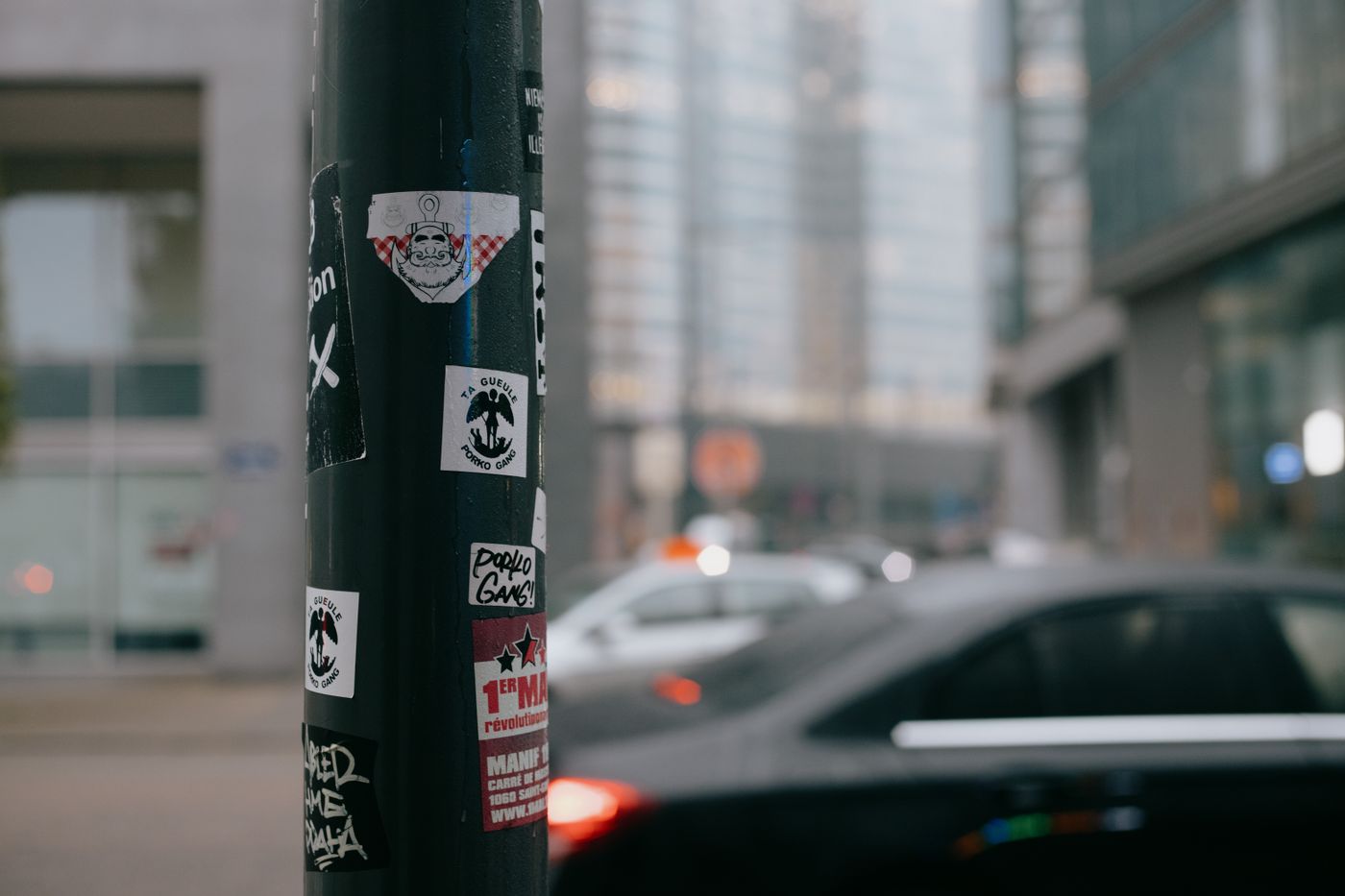 bumper stickers india — Various stickers attached to lamppost near road with different cars in modern city district on overcast day
Photo: Sinitta Leunen / Pexels
A small workshop name or a club mark on your own car is ordinary in practice. A paid advertisement for a third party is a different category, and the rules differ by state and by whether the vehicle is registered as private or commercial. If money changes hands, check the state's motor vehicle rules before the vinyl goes on.
Custom Die-Cut Bumper Stickers: What Nuho Makes
A bumper sticker that lasts is mostly a cutting decision, not a printing one.
At Nuho India, custom shape stickers are die-cut to the artwork outline rather than guillotined to a rectangle. That matters on a bumper because a rectangle has four corners sitting in the wind, while a contour-cut shape has no corner to catch — and thin details like a cartoon limb or a letter's tail are cut with a 2–3 mm border so they do not become the first edge to curl.
The rest is material and process. We print on outdoor-grade vinyl with a laminated face, despatch in 24–48 hours across India from Coimbatore, Tamil Nadu, and cut to whatever outline you supply, from a 6 cm fuel-flap decal to a 30 cm tailgate piece, in matte or gloss.
Ordering a set for a car club or a wedding convoy? The practical limit is the flat area you measured, not the artwork. Measure the panel, subtract the plate and sensor clearances, and order to that number. Browse the custom sticker range for the shapes and finishes we cut.
When Should You Remove a Bumper Sticker?
When the edge lifts, when the message changes, or before you sell the car — and earlier than most people do.
Vinyl left on a panel for three or four years in Indian sun hardens, and hardened film comes off in flakes rather than in one piece. On a car being sold or exchanged, a faded sticker reads as neglect, and a dealer will price it that way.
Removal is a ten-minute job done properly: warm the film with a hair dryer on low while moving constantly, peel at a shallow angle close to the panel, soften the residue with isopropyl alcohol, then wash and wax. Never use a metal scraper, a blade or petrol on modern clear coats.
For context on how different films behave across Indian summers and monsoons, our guide to waterproof stickers in rain, fuel and sunlight covers the material side, and the custom car stickers sizes and placement guide covers full-body graphics. If your design is a character rather than a slogan, the cartoon car stickers placement and legality guide goes deeper on artwork rules.
The Short Version
A bumper sticker is the cheapest personalisation a car can carry and the easiest to get wrong in placement rather than in print. Stay off the plate, off the glass in front of the driver, off the lamps and off the sensors. Measure the flat face of the rear bumper before choosing a size, degrease before applying, and give the adhesive a day to cure.
Prices and regulations change and state enforcement is not uniform — verify current rules with your state transport department before relying on any placement described here.
Frequently Asked Questions
More Articles You Might Like

3D Printed House Name Plates for Indian Homes: Weather and Mounting
3D printed house name plates in PLA+ for Indian homes: where they survive sun and monsoon, how to mount them, and how they compare with acrylic and brass.

Keychain Gifts for Boyfriend: Personalised Ideas That Get Used
Keychain gift for boyfriend ideas he will actually carry: personalised PLA+ tags from ₹129–₹149, 14–18 g, made in Coimbatore in 24–48 hours.

Name Keychain Makers Online: How Your Design Becomes a PLA+ Tag
Ordering from a name keychain maker online? See how your text becomes a tough PLA+ tag in 24-48 hours - the files, the price band and the checks that matter.