
Cartoon Car Stickers in India: Placement and Legality
Nuho India Team
Nuho Creative Team
Key Takeaways & TL;DR
- Indian registration plates are HSRP-specified at 50 x 12 cm on light motor vehicles, 34 x 20 cm on commercial vehicles and 20 x 10 cm at the rear of a two-wheeler, and must stay uncovered.
- Vertical panels such as bumpers, doors and rear quarter glass outlast bonnets and roofs, which take full sun, UV and stone chips.
- Cartoon artwork is best die-cut, with a 2-3 mm border so thin limbs and antennae do not become the first edge to curl.
- Sensible sizes run 6-8 cm on a fuel flap, 12-20 cm on a rear bumper and 25-30 cm for a family of stick figures.
- A pressure-sensitive adhesive bonds with light pressure and needs 24 hours before washing; a high-pressure jet held close to an edge lifts film that is otherwise fine.
Cartoon stickers for car use in India are legal when they stay off the number plate, out of the driver's sightline and clear of lamps, mirrors and reflectors. Decorate body panels and rear glass, keep the registration mark exactly as the RTO issued it, and a cartoon decal is ordinary personalisation — not an alteration.
That covers most of the question. The rest is placement, size, material and the application mistakes that cost you a peeled corner.
Are Cartoon Stickers for Car Use Legal in India?
Yes, with three boundaries that actually get enforced.
The registration plate is untouchable. Indian registration plates are high-security registration plates (HSRP), specified by the Ministry of Road Transport and Highways and issued through the Regional Transport Office at registration. According to Wikipedia's overview of Indian registration plates, a light motor vehicle carries a 50 cm × 12 cm plate, medium and heavy commercial vehicles use 34 cm × 20 cm, and a two-wheeler's rear plate is 20 cm × 10 cm. The plate is aluminium with a chromium hologram, and both front and rear plates are mandatory. A sticker laid over any part of it — even a small cartoon in the corner — works against a specification designed to be tamper-evident. Keep the plate bare.
Windscreen and mirrors stay clear. Indian law restricts alterations to a registered vehicle under Section 52 of the Motor Vehicles Act, 1988, and the Central Motor Vehicles Rules, 1989 set the detail. Enforcement on dark films and obstructed glass has been strict in several states. A cartoon sticker on the passenger side of the rear windscreen is normal; one on the driver's side of the front windscreen is asking for a conversation at a checkpoint.
Lamps, reflectors and safety equipment stay uncovered. A sticker over a tail lamp, reflector or fog lamp changes how the vehicle signals, and that is what a roadworthiness check notices.
| Placement | Verdict | Why |
|---|---|---|
| Rear bumper | Good | Flat, vertical, out of the driver's view |
| Fuel flap | Good | Small area, suits a 6–8 cm decal |
| Rear quarter glass | Good | Away from the wiper arc and the driver's sightline |
| Tailgate, below the glass | Good | Large flat panel for a family set |
| Door panels | Good | Vertical surface, less sun than the bonnet |
| Bonnet and roof | Workable, short-lived | Horizontal, full sun, stone chips |
| Front windscreen | No | Driver's sightline |
| Front side windows | Avoid | Cuts the view to the mirrors |
| Number plate | No | HSRP must stay as issued |
| Headlamps, tail lamps, reflectors | No | Changes the vehicle's signalling |
Enforcement varies by state and officer. The table is the conservative reading — if a placement is arguable, it is not worth the argument.
Where Do Cartoon Car Stickers Belong on an Indian Car?
The best panel is flat, vertical, shaded for part of the day, and untouched by a wiper or a fuel nozzle.
 cartoon stickers for car — Joyful couple in their new car, holding keys in a dealership showroom, smiling warmly
Photo: Antoni Shkraba / Pexels
Rear bumper and tailgate. The largest clean canvas on most hatchbacks and sedans. A 15–20 cm character reads clearly from two car lengths away, the distance that matters in traffic. Keep 3–4 cm clear of parking sensors and reversing cameras; a sticker over a sensor can trigger phantom warnings.
Fuel flap. A 6–8 cm decal fits neatly and is one of the few places a small cartoon does not look lost. The catch is fuel: a splash of petrol or diesel softens many adhesives, and the flap is where splashes happen. Wipe it dry after filling.
Rear quarter glass. Good for a small character or a set of three. Avoid the swept area of the rear wiper — a sticker there gets scrubbed twice a day and lifts at the edge within weeks.
Doors. Vertical, easy to apply and remove. On a white car a bright cartoon shows best; on black, a white outline stops the character dissolving into the paint.
Bonnet and roof. They look great in photos and age fastest in reality — full afternoon sun, the most UV and the most stone chips. Treat a cartoon there as seasonal, not permanent.
What to avoid entirely: the driver's side of the windscreen, the number plate and its frame, any lamp lens, and the area around the airbag covers inside the cabin.
What Are the Stickers on Cars Called — and Which Kind Should You Order?
The words get used loosely, so here is the working vocabulary.
- Sticker — printed adhesive film, usually vinyl or PET, cut to a shape.
- Decal — a design transferred onto the surface, often with a clear carrier film. In Indian usage the words are interchangeable.
- Die-cut sticker — cut exactly around the artwork outline, so the character's silhouette is the edge.
- Kiss-cut sticker — cut through the vinyl but not the backing sheet.
- Vinyl graphic — a larger multi-colour print for panels.
For cartoon work, die-cut is almost always the right choice. A character cut to its own outline looks intentional; the same art on a white rectangle looks like a label. The trade-off is that thin limbs, antennae and tails become narrow strips of film with little adhesive area, and those are the first parts to curl.
Two fixes: ask for a 2–3 mm border around the artwork, which keeps the silhouette intact while giving the edge something to hold, and avoid designs where a character's leg is a 1 mm-wide sliver. Our guide to custom shape stickers covers how cut lines and bleed are prepared for this artwork.
Which Cartoon Sticker Sizes Fit Which Panels?
Size is where most orders go wrong. People order by the size of the image on their phone screen and are surprised when a 20 cm character swallows a fuel flap.
| Panel | Sensible size | Notes |
|---|---|---|
| Fuel flap | 6–8 cm | One small character, no text |
| Mirror housing | 5–6 cm | Curved surface — expect a little stretching |
| Rear quarter glass | 8–12 cm | Keep inside the clean glass area |
| Rear bumper | 12–20 cm | Most popular single-sticker size |
| Tailgate below glass | 20–30 cm | Good for a two-line family set |
| Door panel | 20–35 cm | Centre between the creases |
| Side graphic | 35–45 cm | Two-piece designs need alignment tape |
A family of stick-figure characters, the kind seen on the back of SUVs, needs 25–30 cm of width to stay legible. Narrower turns four figures into a smudge at traffic distance.
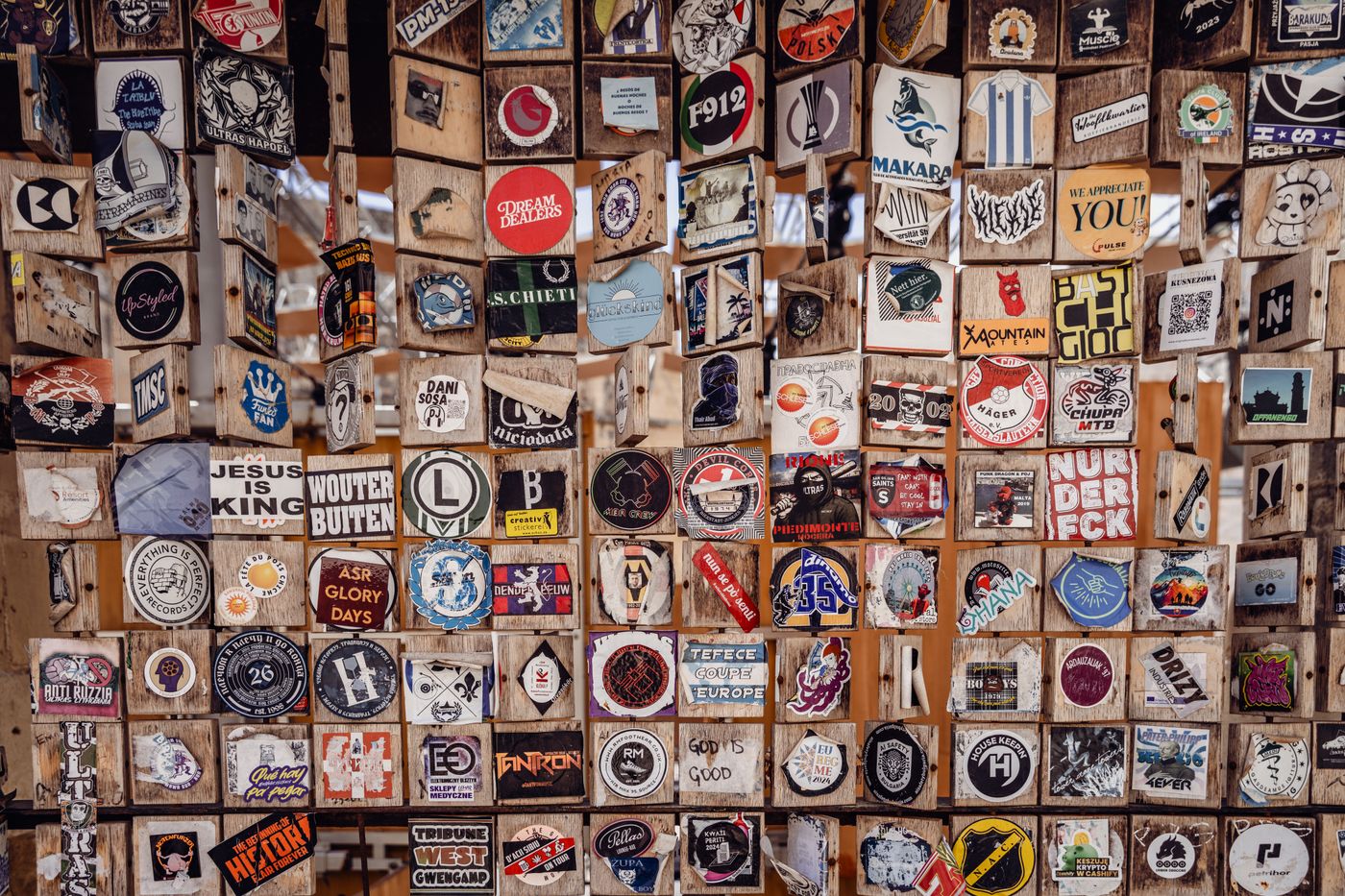 cartoon stickers for car — A vibrant assortment of stickers displayed on wooden panels in Valletta, Malta
Photo: Tobi &Chris / Pexels
Will a Cartoon Sticker Survive Indian Sun, Rain and Fuel?
Monsoon is not the problem. Sun is.
Most printed car stickers use a PVC film with a pressure-sensitive adhesive. PVC is insoluble in water — density around 1.4 g/cm³ and effectively zero water absorption — which is why vinyl survives a Kerala monsoon without dissolving.
Heat and UV are the real enemies. A pressure-sensitive adhesive forms its bond through light pressure, and as the Wikipedia entry on pressure-sensitive adhesives notes, these adhesives lose tack at low temperatures and shear strength at high temperatures. A black bonnet in a Coimbatore summer can get hot enough to soften the adhesive while the PVC film itself gradually loses plasticiser and stiffens. The sequence is predictable: the film hardens, the edge lifts, dust gets under it, and the lift spreads.
Practical expectations, stated honestly:
- Vertical panels under shade — the longest life.
- Rear glass — good, unless it sits in the wiper arc.
- Bonnet, roof, top of the tailgate — the shortest life; plan to replace.
- Fuel flap — adhesive life depends on how often fuel is spilled on it.
Washing matters too. A high-pressure jet held close to an edge will lift film that is otherwise fine. Keep the nozzle 30 cm back and never aim along an edge.
There is a longer treatment of this in our post on where vinyl stickers survive on an Indian car.
How Do You Apply a Cartoon Car Sticker Without Bubbles?
Bubbles come from trapped air and from applying the film before the panel is actually clean. Both are avoidable.
- Wash and dry the panel. Soapy water, then plain water, then a microfibre cloth. Do this in shade, not in direct sun.
- Wipe with isopropyl alcohol. This removes the wax and silicone that car shampoos leave behind. Let it flash off completely.
- Test-fit with masking tape — tape it in place, step back three metres and check height and level.
- Peel only the top 2 cm of backing. Fold the backing down flat so the exposed adhesive never touches itself.
- Anchor the top edge, then squeegee from the centre outwards with a felt-edged card. Short strokes, firm pressure.
- Work downwards slowly, peeling another few centimetres of backing at a time.
- Re-squeegee every edge with your thumb through the backing paper, then leave the car unwashed for 24 hours.
If a bubble does appear, prick it with a pin at its edge and press it out towards the hole. A bubble in the middle of a large cartoon will not vanish on its own.
 cartoon stickers for car — Detailed view of classic car headlights and grille showcasing vintage automotive design
Photo: Alexas Fotos / Pexels
How Much Do Cartoon Car Stickers Cost in India?
Price is driven by five things: size, number of colours, cutting complexity, material and quantity.
A single small die-cut cartoon is the cheapest tier; a multi-colour character with a complex outline costs more in film and cutting time. A run of 50 identical stickers costs far less per unit than 50 different ones.
Compare on cost per unit delivered, not the listed price of one sticker. Ask for the total including shipping and GST, and for the reorder price if you are buying for a club or an event.
When Is a Keychain a Better Keepsake Than a Sticker?
A sticker decorates the car. It does not travel with the owner when the car is sold, nor survive a windscreen replacement.
For a birthday or delivery-day gift, a custom keychain does a different job. Nuho India prints PLA+ at about 215 °C, fusing the letters to a continuous backing plate, and each keychain weighs roughly 14–18 g — light enough to hang off a car fob without dragging the ignition barrel. Manufacturing and despatch run 24–48 hours from Coimbatore, Tamil Nadu, with keychains at ₹129–₹149.
For a car owner, a number plate keychain carrying the registration mark is the more personal object: the plate number follows the owner to the next car, while the sticker stays on the paint. If the car has a cartoon set on the tailgate, matching keychains for each driver complete the joke.
Before ordering, check the plate stays clear, the panel is flat, no detail is under about 2 mm wide, and the film is suited to the surface — cast vinyl conforms to curves, calendared is cheaper and fine on flat panels. Get those right and a cartoon sticker is a low-risk, easily reversed way to personalise a car. Get them wrong and it becomes the thing you notice every time you walk to the door.
Frequently Asked Questions
More Articles You Might Like
Name and Number Plate Keyrings: Sizing for Indian Cars (2026)
Name and number plate keyrings for Indian cars: real plate sizes, 1:5 to 1:9 scale factors, name-plus-number layouts, fob weight limits and PLA+ durability.
Leather vs 3D Printed Car Keychains: Wear, Weight and Cost
Leather vs 3D printed car keychains, compared on grams, monsoon wear and cost per year in India, with honest limitations and real price bands.
Vinyl Stickers for Cars in India: Where They Survive
Vinyl stickers for cars in India survive on flat, clean, cool panels — not textured trim, hot bonnets or number plates. A surface-by-surface guide.