
Mahindra Thar Keychains: Fob Fit, Weight and Plate Styles
Nuho India Team
Nuho Creative Team
Key Takeaways & TL;DR
- A Mahindra Thar keychain should weigh 14-18 g and sit 50-60 mm wide, so it hangs flat off the fob's moulded loop without levering against it.
- The Thar OG is sold in 15 variants across three engines, and car&bike's base D117 sheet lists push-button start and remote engine start but keyless entry as No.
- Cast zinc or brass tags weigh 40-70 g, roughly three to four times a printed PLA+ tag, and that extra mass scuffs the plastic fob shell.
- The Thar OG's 650 mm wading depth is no threat to PLA+, which is insoluble in water; heat is the real limit, because PLA softens at 60-65 C.
- Nuho India prints Thar keychains in PLA+ at about 215 C with letters fused to one backing plate, priced Rs.129-Rs.149 with 24-48 hour despatch from Coimbatore.
What Keychain Actually Fits a Mahindra Thar Key?
A Mahindra Thar keychain should be sized to the fob, not the badge: a flat tag 50–60 mm wide, 3–4 mm thick and 14–18 g, hung from the remote's moulded loop. Anything heavier swings against the plastic shell every time the key comes out of a pocket. Nuho India prints custom Thar number-plate and name tags in PLA+ for ₹129–₹149, with 24–48 hour manufacturing and despatch from Coimbatore, Tamil Nadu.
The Thar is Mahindra's body-on-frame compact SUV, in production since 2010 and in its current W501 generation since 15 August 2020 (Mahindra Thar model history). In October 2025 Mahindra updated the three-door and now sells it as the Thar OG; the five-door is the Thar Roxx. Mahindra lists the Thar OG at ₹10.32–18.99 lakh and the Thar Roxx at ₹12.52–23.52 lakh ex-showroom (Mahindra SUV range). Prices and specs change — verify with the manufacturer before buying.
What Does a Mahindra Thar Key Look Like in 2026?
The Thar OG is sold in 15 variants across three engines — a 1.5-litre diesel (117 bhp, 300 Nm), a 2.2-litre diesel (150 bhp, 330 Nm) and a 2.0-litre turbo-petrol (160 bhp, 330 Nm) — with six-speed manual and automatic gearboxes and rear- or four-wheel drive (car&bike Thar OG specifications). Fifteen variants means fifteen trim sheets, and the key hardware moves between them.
 thar keychain — A detailed view of a classic car's interior featuring a vintage dashboard and steering wheel
Photo: Tim Mossholder / Pexels
Read those sheets carefully. On the base D117 variant, car&bike's feature list marks push-button start as standard and keyless entry as "No", while also listing remote engine start. So the Thar key is a remote fob with an attachment loop, not a bare blade key — but check your own variant sheet rather than assuming the top-spec list applies (car&bike Thar OG features).
Owner behaviour tells the same story. Autocomplete for "thar key" returns thar key cover, thar key cover metal, thar key cover leather and thar roxx key battery — people are wrapping a fob they carry daily. A cover adds material to a key our SUV key-fob guide for SUVs under ₹20 lakh already calls blocky with rubberised sides, and that is when a heavy keychain stops being fun.
Thar OG or Thar Roxx: Does the Keychain Change?
Not in principle — both are W501-family vehicles with remote fobs — but the numbers differ enough to know which one you are buying for.
| Mahindra Thar OG | Mahindra Thar Roxx | |
|---|---|---|
| Body | 3-door, 4 seats | 5-door |
| Length / wheelbase | 3,995 mm / 2,450 mm | Longer, five-door shell |
| Engines | 1.5 D, 2.2 D, 2.0 turbo-petrol | Same engine family |
| Price band (Oct 2026) | ₹10.32 – 18.99 lakh | ₹12.52 – 23.52 lakh |
| Keychain consequence | Short tag, 50–60 mm, hangs clear of the fob | Same tag works; households with two keys often order a pair |
The three-door measures 3,995 mm long, 1,870 mm wide, 1,855 mm tall, on a 2,450 mm wheelbase, with 232 mm of ground clearance and 650 mm wading depth on car&bike's sheet. That last figure matters: the tag lives in a vehicle expected to get wet and dirty.
We do not publish fob measurements for either model, and we will not guess them. Lay your own key flat and measure it; that is the only number that decides whether a tag fits.
Why the Fob, and Not the Badge, Sets the Size
Car accessory shopping starts with the badge and ends with the pocket. A remote fob is a sealed unit, and a keychain can only hang off its moulded loop. That gives three hard constraints:
- Width. Keep the tag at or below the fob's widest point. A tag that sticks out catches on pocket lining and denim seams and levers sideways against the loop.
- Thickness. A flat tag at 3–4 mm slides past a thigh without notice. A domed or layered tag turns every pocket into a slow sander.
- Weight. The loop on a plastic fob is a moulded nub, not a steel eyelet. It is designed to carry a key ring, not a paperweight.
Lay the fob flat on paper, mark its widest point, and choose a tag at or under it. Our fob-fit guide for personalised car keychains walks through the same ritual for other fob shapes, and the Toyota Fortuner keychain guide applies it to another chunky SUV remote.
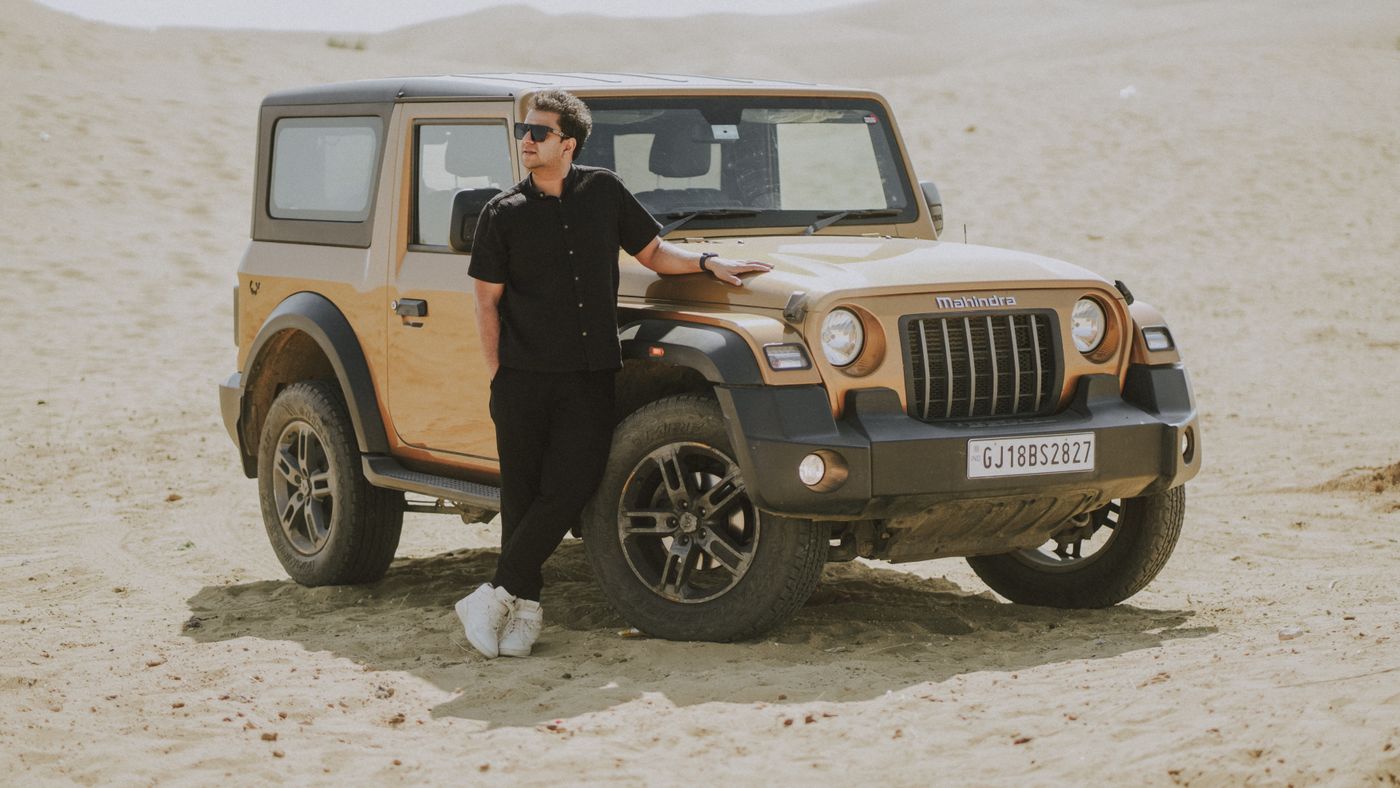 thar keychain — A stylish man in sunglasses leans on a Mahindra Thar SUV amidst a vast desert setting
Photo: Nadim Shaikh / Pexels
How Much Should a Thar Keychain Weigh?
14–18 g is the sweet spot for a printed PLA+ tag. A cast zinc or brass tag of the same footprint typically lands between 40 g and 70 g — three to four times the mass on the same plastic loop.
What that extra mass does is mechanical. It swings wider when you walk, strikes the fob shell harder, rattles in a pocket and slowly polishes the plastic where the two touch. A 14–18 g printed tag generates so little momentum that none of it happens.
| Keychain type | Typical weight | Effect on a Thar fob |
|---|---|---|
| 3D printed PLA+ plate tag | 14–18 g | Rides flat, minimal swing |
| Cut acrylic tag | 10–20 g | Light, but narrow digits chip |
| Cast zinc / brass tag | 40–70 g | Rattles, scuffs the shell, pocket lump |
| Metal plate plus leather fob cover | 60 g+ | Bulk compounds quickly |
If you run a metal fob cover, weigh the combination first: two heavy accessories on one loop is where loops fail.
Which Number Plate Style Suits a Thar?
A standard Indian Light Motor Vehicle plate is 500 mm × 120 mm, a band four times wider than it is tall (vehicle registration plates of India). Scale that proportion down and the keychain designs itself.
| Element | Real plate | Keychain tag |
|---|---|---|
| Width | 500 mm | 50–60 mm |
| Height | 120 mm | 12–15 mm |
| Digit height | ~75 mm | 5–7 mm |
| Ratio | 4:1 | 4:1 |
At 5–7 mm the digits stay readable at arm's length without crowding, which matters because Indian registration numbers are long. A two-face layout works well on a Thar: registration number on one face, name or nickname on the other, so the key identifies itself whichever way it lands.
 thar keychain — Close-up view of hands holding the steering wheel inside a car
Photo: Sachu Zayn / Pexels
One honesty note: a keychain plate is a keepsake, not a legal plate. High-security registration plates are aluminium, hologrammed and fitted through the RTO-authorised process. A pocket tag is a reference to your own number and nothing more.
Does Dust, Mud and 650 mm Wading Hurt a PLA+ Tag?
No. PLA is insoluble in water (0 mg/ml) with a density of 1,210–1,430 kg/m³, so a printed tag does not swell or delaminate from a soaking (polylactic acid properties). The Thar OG is rated to wade 650 mm of water, so a wet key is a normal Tuesday for this vehicle.
The real enemies are two, and neither is water:
- Grit in the layer lines. Fine dust settles into the tiny ridges on a printed surface. Rinse under a tap, scrub with a soft toothbrush, dry with a cloth. Do not pick at it with a fingernail.
- Heat. PLA's glass transition temperature is 60–65 °C. A black dashboard in a Coimbatore summer gets hotter than that. A tag left on the dash can soften and warp; a tag in a pocket, a bag or a door bin will not. This is the one place metal genuinely wins, and it is worth saying plainly.
PLA+ vs Acrylic vs Metal for a Thar Keychain
| Material | Weight on the fob | Narrow digits | Drop onto concrete | Mud and water | Where it wins |
|---|---|---|---|---|---|
| PLA+ (printed) | 14–18 g | Fused to a backing plate, no slivers | Absorbs impact | Unaffected | Everyday carry on a remote fob |
| Acrylic (cut) | 10–20 g | Brittle at 1, 4, 7 strokes | Usually cracks | Fine | Cheapest shelf appeal |
| Cast zinc / brass | 40–70 g | Very tough | Survives, dents the fob | Fine, needs drying | Formal gift in a box |
| Laser-engraved wood | 15–25 g | Holds detail | Splinters at thin sections | Swells with moisture | Desk ornament |
PLA+ holds up at narrow letterforms because every letter is printed fused to a continuous backing plate at about 215 °C — no glued joint, no unsupported sliver to snap off. A registration number is full of narrow vertical strokes, exactly where cut acrylic fails first.
How Is a Custom Thar Keychain Actually Printed?
- Design and scale. Plate proportion is set first, then the registration number and second-face text inside a safe margin.
- Slice. The file is sliced with letter height at 5–7 mm and backing plate at 3–4 mm.
- Print. PLA+ goes down at roughly 215 °C, letters and backing printed as one continuous piece, not assembled afterwards.
- Finish. Edges are cleaned and the split-ring hole checked for burrs that would fray a key ring.
- Check. Digits are read at arm's length against the order; a crowded stroke is reprinted, not shipped.
- Pack and despatch. 24–48 hours from Coimbatore, Tamil Nadu.
What Should You Put on a Thar Keychain?
The best Thar keychains say something the car cannot. A registration number is obvious — unique, yours, readable in a parking lot. Beyond that:
- A name or nickname on the second face.
- "4x4" or a terrain word, if the vehicle actually goes off-road.
- A home town or trip name, which makes it a souvenir.
What we do not print is the manufacturer's logo or badge — those emblems are trademarked, and a registration number identifies your key more precisely anyway.
Will a Thar Keychain Interfere With the Key Fob?
No. A keyless or remote fob communicates by radio, and a small tag sitting beside it does not form a shield around the antenna. Fobs already share pockets with coins, phones and other keys and still work. The trade-off is mechanical: extra weight and extra bulk, not signal loss.
Battery life and placement are separate issues: a dying fob needs to sit close to the start button and inside the cabin. A keychain causes neither, but both are reasons to keep the fob clean.
What Does a Custom Thar Keychain Cost in India?
Nuho India's custom keychains sit at ₹129–₹149, printed in PLA+ with 24–48 hour manufacturing and despatch. Print time drives cost, so a number-plate tag and a name tag land in the same band.
A cast metal tag costs more and weighs three to four times as much; a leather fob cover costs about the same and adds bulk without identity. For a key that lives in a pocket, the printed tag is the cheaper and kinder option. The current range is at nuho.in/products.
For a gift, the Thar is a good target: it is a lifestyle vehicle, the key is the first thing the owner touches each morning, and a registration-number tag is personal without being intimate. Order after the number is allotted, not before — the number is the whole point.
Frequently Asked Questions
More Articles You Might Like
Toyota Fortuner Keychains: Chunky Fobs and Flat Number Plate Tags
A Toyota Fortuner keychain must suit the keyless fob, not the badge: fit, weight and number-plate tag design for every 2026 Fortuner variant explained.
Personalised Keychains for Cars: Fob Fit, Weight and Number Plates
Choosing a personalised keychain for car keys: fob fit, the 20 g weight rule, signal-safety facts and number-plate designs in PLA+ from ₹129.

Cartoon Car Stickers in India: Placement and Legality
Cartoon stickers for car use in India: where they are legal, which panels survive sun and rain, the sizes that fit, and how to apply one without bubbles.