
Personalised Keychains for Cars: Fob Fit, Weight and Number Plates
Nuho India Team
Nuho Creative Team
Key Takeaways & TL;DR
- Modern car keys fall into three groups — mechanical-with-remote, flip and keyless fob — and a personalised tag under 20 g adds no noticeable swing to any of them.
- Nuho India prints PLA+ car keychains at about 215 °C; each tag weighs 14–18 g, sits in the ₹129–₹149 band and is manufactured in 24–48 hours in Coimbatore.
- A keychain neither blocks nor boosts a keyless fob's signal: security comes from the immobiliser's rolling codes, so only fob placement and updates change theft risk.
- PLA has a glass transition of 60–65 °C, so a printed tag belongs off a sun-baked dashboard — pockets, gloveboxes and bags are unaffected.
- Indian car plates follow state code + RTO number + series + number, with letters I and O excluded — the rules that make a number-plate keychain read correctly.
What Is a Personalised Keychain for Car Keys?
A personalised keychain for car keys is a custom tag — printed with your name, initials or your car's registration number — that hangs from a car key or remote fob and makes that key unmistakably yours. The sensible version for a modern car weighs under 20 grams, lies flat against the fob in a pocket, and is made from a material that will not crack the first time it drops on a parking-lot floor. This guide covers fob fit, weight, signal safety and number-plate designs for Indian cars, and what to check before you order one.
What Key Are You Actually Putting It On?
Before choosing a tag, look at the key itself. Modern car keys fall into roughly three groups, and each poses a slightly different problem for a key ring:
| Key type | How it works | What the tag has to clear |
|---|---|---|
| Mechanical key with remote | Cut blade plus rubber buttons on a small head | Narrow ring hole — the tag's hole must not be thicker than the key's |
| Flip (switchblade) key | Blade folds into the fob body and springs out | The blade swings through the ring space — a bulky tag can block the fold |
| Keyless fob / proximity key | No blade; the car detects the fob and unlocks or starts on approach | Extra mass swings on the fob's loop and scuffs its plastic case |
The variety is not marketing imagination. As the overview of car keys notes, keyless entry systems — where a fob or handheld device replaces the toothed key — have become standard on most new cars, while flip keys fold their blade inside the fob for compactness. A tag designed around a twenty-year-old sedan key can look wrong on a 2026 SUV's proximity fob, and the reason is usually the attachment point rather than the artwork.
 personalised keychain for car — A couple exchanging car keys inside a showroom decorated with heart-shaped balloons, celebrating a new car purchase
Photo: Gustavo Fring / Pexels
One practical habit helps before you order anything: hold the key by its ring hole and let the fob hang freely. Where the fob comes to rest — against your knuckles or an inch below them — tells you how much swing a tag will add, and whether a wide plate-style tag will foul the fold of a flip key.
How Heavy Should a Personalised Car Keychain Be?
Weight is the spec most buyers ignore and the one they feel every day. A car key already carries the fob body, a battery, a transponder chip and sometimes a second key; the ring is doing structural work on a loop of plastic that was never designed for a lantern.
The materials split cleanly:
- Cast zinc or brass tags feel substantial and shrug off being sat on, but they are the heaviest option on the ring. On a keyless fob that already weighs a fair bit, a metal tag swings hard, and that swing scuffs the fob's plastic casing over months.
- Acrylic tags are light and photogenic, but brittle — and brittleness concentrates at narrow strokes, which is exactly where initials and registration digits live.
- Leather fobs feel premium and age gracefully, but they absorb moisture and soften at the hole.
- A printed PLA+ tag lands in the middle on feel and wins on mass: at Nuho India each tag weighs 14–18 g, with every letter fused to a continuous backing plate at about 215 °C rather than glued on as a separate cut-out, so there is no joint to snap.
Under about 20 grams is the comfortable zone: heavy enough that the key does not spring out of a shirt pocket, light enough that you stop noticing it. Above that, the tag starts dictating how the fob sits — and how it lands on a paintwork-adjacent surface like a fuel lid or scuttle panel.
Does a Keychain Affect Keyless Entry or Signal Safety?
No — and this is worth stating plainly because it is marketed otherwise. A plastic or metal tag on the ring neither blocks nor amplifies the fob's signal. Keyless-entry security lives in the vehicle's electronics: as the immobiliser explainer describes, modern systems use rolling codes or advanced cryptography so that a captured code cannot simply be replayed, and the engine ECU refuses to start without a valid coded key.
 personalised keychain for car — Detailed close-up of a vintage car's shiny headlight and grille, reflecting its classic design
Photo: Engin Akyurt / Pexels
Relay attacks on keyless cars work by stretching the range of the fob's own transmission — one box near the car re-transmits what it hears to a second box near the fob inside your hallway. A keychain changes none of those physics. What actually helps is keeping the fob away from the front door at night, using a signal-blocking pouch if your street has a rash of such thefts, and checking whether your manufacturer has issued a fob software update; some older cipher systems, including KeeLoq and Megamos Crypto, have been demonstrated vulnerable to cryptanalytic attacks.
Honest limitation: no keychain seller — us included — can promise theft prevention. What a personalised tag does is identification. A fob that ends up on a service desk, in a valet's tray or in a mall lost-and-found returns to you because the plate number on the tag says exactly whose key it is.
PLA+ vs Acrylic vs Metal vs Leather: An Honest Comparison
| Material | Where it wins | Where it loses |
|---|---|---|
| PLA+ (3D printed) | Light (14–18 g), fused letters, waterproof, cheap to customise | Softens above its glass transition; not a heat-proof material |
| Acrylic | Sharp edges, glossy look, very low cost | Brittle at narrow strokes; chips on tile drops |
| Cast zinc/brass | Nearly indestructible as an object | Heavy; scratches the fob it hangs on; cold in winter |
| Leather | Warm feel, ages well | Absorbs moisture; hole stretches; not crisp for text |
Where another material genuinely wins, say so: if your key lives loose in a work bag with tools, a metal tag will outlast everything. For the normal pocket-and-ignition life of a car key, a fused PLA+ tag gives you the crisp text of acrylic without the brittleness and a fraction of the metal's mass. We compared the two everyday contenders at length in our leather vs 3d printed car keychain breakdown.
Number Plate Designs: What Actually Looks Right on a Car Key
The number-plate tag is the signature car-keychain design in India, and it works because the source object is already a clean piece of information design. Indian registration plates follow a structured format — a two-letter state code, a two-digit RTO number, a series of one to three letters, and a unique number — and, per the registration plate rules, the letters I and O are excluded from series so they cannot be confused with 1 and 0.
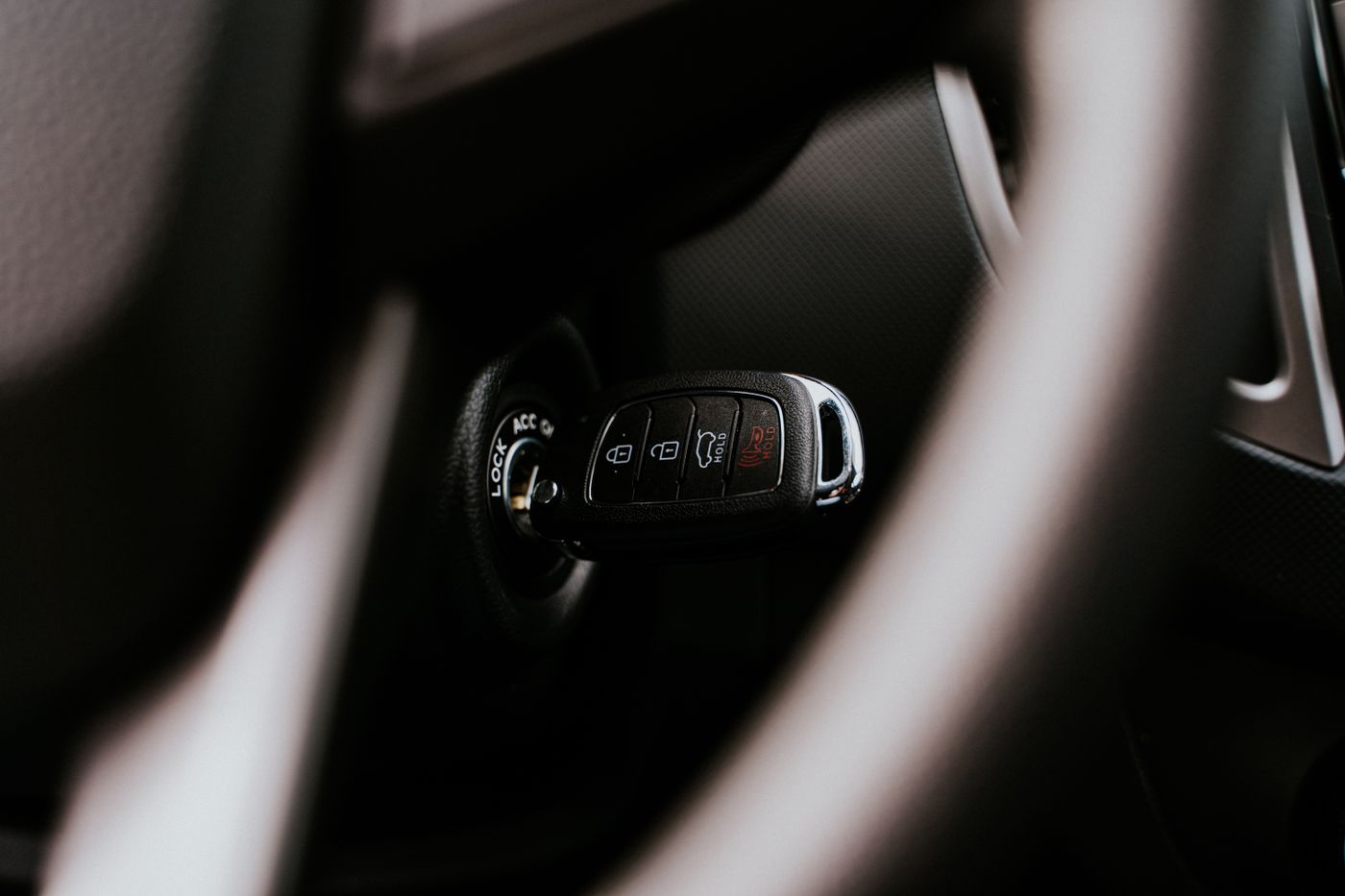 personalised keychain for car — A close-up view of a car key placed in the ignition inside a vehicle, highlighting automotive detail
Photo: Daniel Andraski / Pexels
Two design consequences follow:
- Keep the proportions, not the size. A car (LMV) plate is 500 × 120 mm, roughly 4:1, so the tag reads best as a slim horizontal bar about 50–60 mm wide with 5–7 mm lettering. A squashed square "plate" reads as a fridge magnet.
- Use both faces. Registration number on the front, name or initials on the back. Both text blocks keep full width, and the tag stays legible to anyone who picks it up.
A keychain is a keepsake, not a legal plate — HSRP aluminium plates with holograms stay riveted to the vehicle, and a tag on your key ring is not a substitute for them. For plate sizing, fonts and layout detail, our car keychain with number plate and name guide goes deeper, and our wider best car keychain india roundup matches tag shapes to different car types.
How to Order a Personalised Keychain for Your Car
- Identify your key type — mechanical-with-remote, flip, or keyless fob — and check the ring hole is clear of the fold on a flip key.
- Choose the layout — plate number front plus name back is the default that suits cars; initials-only is the compact alternative for small fobs.
- Send the text exactly as written on your plate — state code, RTO number, series and number, minus spaces if you prefer a tight fit. If your plate legitimately contains an I or an O from an older series, write what you want printed; we set it as given.
- Approve the proof before printing. Spelling on a keychain is permanent in a way a chat message is not.
- Expect manufacture in 24–48 hours in Coimbatore, Tamil Nadu, and the ₹129–₹149 price band that our custom keychain range sits in. Prices and specs change — re-check the store page when you order.
Will a PLA+ Tag Survive a Hot Indian Dashboard?
This is the one honest weakness of the material, and it deserves a straight answer. PLA has a glass transition of roughly 60–65 °C and melts in the 130–180 °C range, according to the material data summarised for polylactic acid. Nuho India prints in PLA+ at around 215 °C, and the finished tag spends its life far below that range — the risk zone is a dashboard baking in direct sun, not a pocket or a glovebox.
A parked car with the dash in direct afternoon sun can sit well above the point where PLA softens. Keep the ring on the seat, in the glovebox or in your pocket rather than spread on the dashboard, and the tag will hold its shape indefinitely — the same rule you would follow for a photo or a chocolate in that same car. Inside the cabin out of direct sun, in a bag, or on a shop counter, temperature is a non-issue.
The verdict is simple: match the tag to the key you actually carry, keep it light, keep it off sun-baked plastic, and let it do the one job a keychain has always done — making sure a lost key finds its way home.
Frequently Asked Questions
More Articles You Might Like
Cartoon Car Stickers in India: Placement and Legality
Cartoon stickers for car use in India: where they are legal, which panels survive sun and rain, the sizes that fit, and how to apply one without bubbles.
Name and Number Plate Keyrings: Sizing for Indian Cars (2026)
Name and number plate keyrings for Indian cars: real plate sizes, 1:5 to 1:9 scale factors, name-plus-number layouts, fob weight limits and PLA+ durability.
Leather vs 3D Printed Car Keychains: Wear, Weight and Cost
Leather vs 3D printed car keychains, compared on grams, monsoon wear and cost per year in India, with honest limitations and real price bands.