
Keychains for Car Keys That Don't Scratch the Fob
Nuho India Team
Nuho Creative Team
Key Takeaways & TL;DR
- A keychain scratches a fob when a hard tag above roughly 40 g swings against the plastic shell; a 14-18 g PLA+ tag on a 20-25 mm ring avoids that.
- Cast zinc tags typically weigh 40-60 g for the same face area as a 15 g PLA+ tag, and put a hard, sometimes sharp edge against the fob.
- Nuho India prints PLA+ at 215 C with letters fused into a continuous backing plate, so there are no glued chips to work loose and scratch the shell.
- PLA softens above its comfort range in a closed car on an Indian summer day, so keep the tag on your key in a pocket, not on the dashboard.
- Keychains run Rs 129-149, made in Coimbatore, Tamil Nadu, with a 24-48 hour manufacturing and despatch window.
Do keychains for car keys really scratch the fob?
A keychain scratches a car key fob when a hard, heavy tag rubs against the fob's plastic shell in a pocket. The fix is not a silicone cover — it is a lighter tag with rounded edges. A 14–18 g PLA+ keychain on a 20–25 mm ring sits flat, has no sharp metal corners, and cannot act like a small hammer against the fob face.
That answer is short because the mechanism is simple. What takes longer is working out which part of your current key ring is doing the damage, and which materials are quietly the wrong choice for a fob that costs several thousand rupees to replace.
What actually scratches a car key fob?
Most fobs are a two-part plastic shell — usually a hard ABS or polycarbonate blend — with a painted or textured face, rubber buttons, and a metal blade or a slot for one. The shell is tough, but it is not scratch-proof. Three different things wear it down:
- Abrasion. A harder object sliding across the shell removes the texture. Metal keys, a cast zinc tag, a coin, or the serrated edge of a second key will all do it.
- Impact. A heavy tag swinging on a ring hits the fob every time you pull the keys out of a pocket. The damage shows up first as a polished patch, then as a scuff, then as a crack at the loop.
- Chemistry. Chrome plating that flakes, brass that tarnishes, and cheap painted metal can transfer a stain or a grey smear onto light-coloured plastic.
There is also a detail people forget: the fob is not just a handle. A modern remote contains a short-range radio transmitter that talks to the car — commonly within 5–20 metres — and the shell protects that electronics and the battery inside. Once a shell cracks at the loop, the fob starts separating every time it hangs. The remote keyless system article is a useful plain-language primer on what is actually inside the plastic.
 keychain for car keys — Detailed image of a yellow sports car engine area with reflective surfaces and sleek design
Photo: Loïc Manegarium / Pexels
So the question is not "which keychain looks best on a car key". It is "which keychain is soft enough, light enough, and blunt enough to live against that shell for two years".
Which keychain materials scratch a fob — and which do not?
Here is the honest comparison, using the materials people actually buy in India. Weights are for a tag roughly the size of a two-rupee coin, which is the size most people order.
| Material | Typical weight | Edge hardness | Scratch risk on a fob | The catch |
|---|---|---|---|---|
| 3D printed PLA+ | 14–18 g | Low to medium | Low | Softens if left on a hot dashboard |
| Cast zinc alloy | 40–60 g | High | High | Plating flakes; heavy on the fob loop |
| Brass | 45–70 g | High | High | Patinas, leaves a smell on hands |
| Acrylic | 8–15 g | Medium, brittle | Medium | Chips at narrow letterforms |
| Leather | 10–20 g | Very low | Very low | Stretches, stains, absorbs sweat |
| Laser-cut wood | 10–18 g | Medium | Medium | Swells and warps in monsoon humidity |
Two rows deserve a caveat.
Leather is genuinely the gentlest option. If your only criterion is "never mark the fob", a leather strap wins, full stop. It is softer than any printed plastic. What it does not do is hold a shape: a leather tag stretches at the rivet, darkens with sweat, and looks tired in about a year. It also cannot carry a clean registration number, which is usually why people buy a vehicle keychain in the first place.
Metal wins on feel and loses on contact. A cast zinc or brass tag feels substantial, and plenty of buyers want exactly that. But a 50 g metal tag on the same ring as a plastic fob is a weight problem before it is a scratch problem: it pulls the fob sideways in a pocket, it swings harder, and it puts a hard, sometimes sharp, edge against the shell. If you love the metal look, keep it on a separate ring and detach it before the keys go in your pocket.
Acrylic sits in an awkward middle. It is light and it takes colour well, but it is brittle at narrow letterforms — exactly the shape a name or number plate uses. A thin acrylic letter chips, and the chip leaves a sharp corner that then scratches the fob. That brittleness at narrow cuts is the specific reason we print in PLA+ instead.
How much should a keychain for car keys weigh?
For a tag that shares a ring with a car fob, 14–18 g is the working band. Our PLA+ name tags land inside it, depending on name length and plate size, and the range is deliberate: heavy enough to feel like a real object in the hand, light enough that the fob still sits flat in a pocket.
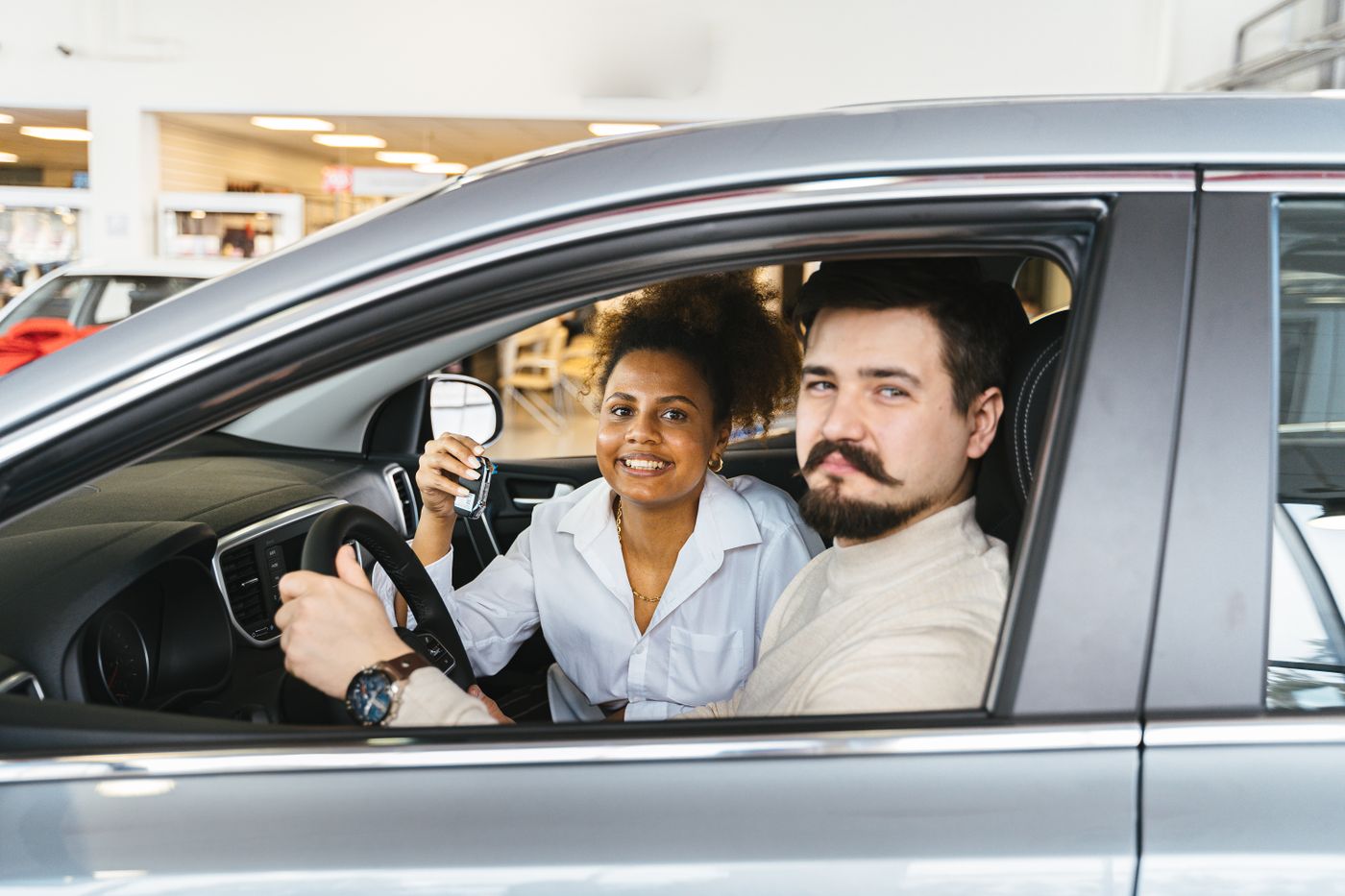 keychain for car keys — A smiling couple sitting inside a new car, holding the key and looking pleased
Photo: Antoni Shkraba / Pexels
Above roughly 40 g, the tag stops being decoration and becomes a pendulum. On a keyless fob that weighs maybe 50–70 g with the battery, adding 50 g of brass nearly doubles what your pocket carries, and every swing puts that extra mass against the fob loop. The loop is the weakest point of the whole assembly.
Ring geometry matters as much as weight:
- 25 mm split ring — the default for a conventional blade key with a drilled bow.
- 20 mm ring or a flat snap hook — better for a keyless fob, so the tag hangs flat instead of sitting at an angle and pressing a corner into the shell.
- Detachable second ring — the right home for any metal tag you want to keep for looks.
We went through the ring and fit question in more detail in the personalised keychain for car fob fit guide, including how to measure a fob loop before ordering.
How do you set up a key ring that does not scuff the fob?
Five steps, in the order that actually removes the damage:
- Empty the ring and inspect. Lay every item on a table. Look for sharp edges, flaking plating, and any key whose serrated side faces the fob.
- Find the polished patch on the fob. That shiny area is where something is rubbing. It tells you which item is the culprit far more reliably than guesswork.
- Drop the heaviest item. If a metal tag is on the same ring as the fob, move it to a second, detachable ring.
- Turn every key so the cut edges face outward, away from the fob face. A serrated key edge will mark plastic faster than any keychain.
- Add a soft buffer only if you still see contact — a small leather washer between the fob and the tag costs almost nothing and works.
None of this requires buying anything, and it is worth doing before you spend money on a tag.
Do keyless fobs need a different keychain?
Yes, and the difference is not cosmetic. On a keyless or smart-key car, the fob usually stays in a pocket or bag and the car detects it — you press a button on the door handle, or simply walk up. That means the fob shares space with coins, a phone, and whatever else lives in that pocket, and it is handled far less carefully than a key you insert into an ignition.
 keychain for car keys — Detailed close-up of a vintage black car door featuring chrome trim and handle, capturing elegant design
Photo: Vitali Adutskevich / Pexels
Two consequences follow. First, the fob face carries the lock, unlock and boot buttons, and those legends are painted or moulded into the plastic — abrasion polishes them away. Second, because the fob never leaves the pocket, whatever hangs on it is in constant contact with the shell. A flat, light, round-edged tag is the correct shape; a chunky cast tag is the wrong one.
We covered the keyless case at length in the EV car keychain and keyless fob guide. The summary: on keyless cars, weight and edge radius matter more than design, and a detachable ring is your friend.
Does a 3D printed PLA+ keychain hold up on car keys?
For daily pocket and ignition use, yes. PLA+ is a tough, stiff thermoplastic with a density of about 1.21–1.43 g/cm³ and a melting point around 150–160 °C, which is why a 15 g tag feels solid rather than hollow. It is also not water-soluble at room temperature — the PLA reference lists water solubility as effectively zero — so rain, wet hands and a damp monsoon pocket are not a problem.
The real limitation is heat, and it is worth stating plainly. PLA has poor heat resistance unless annealed, so an unannealed print left on a dashboard or inside a closed glovebox on a 40 °C afternoon can soften and deform. That is a genuine weakness, not a marketing footnote. The practical rule: keep the tag on the key in your pocket or bag, not in the car as a stored object.
At Nuho India we print at 215 °C and fuse the letters into a continuous backing plate rather than gluing individual cut-outs on. That construction matters for this specific job: a glued letter is a small hard chip waiting to come off and become the thing that scratches the fob. A fused plate has no separate pieces and no sharp internal corners. Tags are made in Coimbatore, Tamil Nadu, with a 24–48 hour manufacturing and despatch window, and the keychain band runs ₹129–₹149.
What should you check before buying a keychain for car keys?
A short checklist, in order of how much it affects the fob:
- Weight first. Ask for it in grams. Anything above 40 g on the fob ring is a design choice you should make knowingly.
- Edge radius. Run a thumb along the edge. A chamfer or a rounded profile will not mark plastic; a square cut will.
- Ring type. Split ring for a blade key, snap hook for a keyless fob.
- Letter construction. Fused or moulded letters hold; glued-on letters eventually lift.
- Material honesty. If a listing cannot say what the plastic is, assume the cheapest option.
- Plate size. A number plate with ten characters needs a wider tag than a name; an oversized plate on a small fob is the most common fit mistake.
If you want a tag that ticks all six, the Nuho India keychain range is built around exactly this use case: custom name and registration number in PLA+, 14–18 g, with a rounded edge and a plate that fits a standard fob ring. For a broader look at how the materials compare over a couple of years of use, the car keychain holders comparison covers leather, metal and printed tags side by side.
One last honest note: no tag can protect a fob from a bunch of loose keys in the same pocket. If your fob is already scuffed, the damage is from the whole ring, not from the accessory alone. Fix the ring, then choose the tag.
Frequently Asked Questions
More Articles You Might Like
Maruti Swift Keychains: Small Fobs, Flat Tags and Plate Styling
A Maruti Swift keychain has to match a small fob, not a badge: key types by variant, 14-18 g PLA+ tags and number plate sizing for Indian Swift owners.
Scooter Keychains in India: Activa, Jupiter and Keyless Fobs
Scooter keychains in India have a harder job than car tags: keyless Activa and Jupiter fobs, 14-18 g PLA+ tags, and the heat limits nobody mentions.
EV Car Keychain India: What Keyless Fobs Mean for Your Keys (2026)
EV car keychain India guide: what keyless fobs mean for weight, fit and durability — plus the 14–18 g PLA+ tag that suits an electric car key.