
EV Car Keychain India: What Keyless Fobs Mean for Your Keys (2026)
Nuho India Team
Nuho Creative Team
Key Takeaways & TL;DR
- India's EV keychains hang on the same remote keyless hardware as petrol cars: most systems transmit at 433.92 MHz and work from roughly 5–20 metres.
- A PLA+ keychain weighs 14–18 g, against several times that for a cast zinc or brass tag of the same 50–60 mm footprint.
- Nuho India prints keychains in PLA+ at about 215 °C, prices them at ₹129–₹149, and manufactures and despatches in 24–48 hours from Coimbatore, Tamil Nadu.
- PLA starts to soften near 60 °C, so an EV keychain left on a dashboard in an Indian summer can deform even though it handles rain and sweat.
- The Tata Nexon has been sold as an EV since late 2019, and like most electric cars in India its key is a battery fob with a hidden backup blade rather than an ignition key.
What does an EV car keychain need to get right in India?
Answer first: An EV car keychain in India needs to be light, flat and hung from the fob's own loop, because electric cars here ship with a battery-powered keyless remote rather than a blade key. A 14–18 g PLA+ tag adds almost nothing to a pocket, while a cast-metal tag swings against a glossy fob every time you pull the key out.
That is the short version. The longer version is about the key you actually carry in 2026. An EV key is not a smaller version of a petrol key — it is a sealed plastic case holding a coin cell, a transponder and a radio transmitter, and it usually never leaves your pocket. The keyring therefore stops being a functional part and becomes the part you see, touch and fidget with. Weight, shape and where the tag sits are the whole game.
Do electric cars in India actually have keys?
Yes. The EVs on sale in India are sold with remote keyless entry and push-button start, the same architecture as a modern petrol car. The Tata Nexon gained a battery-electric version in late 2019 and has been sold as the Nexon EV since, and every generation of it ships with a keyless fob rather than a bare blade (Tata Nexon model history).
 ev car keychain india — Detailed close-up of a luxury car wheel covered in soap suds during a professional car wash
Photo: Luke Miller / Pexels
The technology behind that fob is well documented. A remote keyless system is a short-range radio transmitter, typically with a working range of about 5–20 metres, and most systems on Asian, Japanese and European cars transmit at 433.92 MHz (remote keyless system). Press a button and the car unlocks; walk up with the fob in your bag and a passive-entry system unlocks the door for you.
Two details matter to a keychain buyer:
- The fob is sealed and battery-fed. You do not open it to start the car, so you rarely open it at all — until the coin cell dies.
- There is usually a mechanical backup. Smart-key cars ship with a hidden spare blade, often behind a cover on the door handle, for the day the battery is flat (smart key and passive entry).
Some newer EVs go further and support phone-as-a-key, where the car recognises your phone instead of a fob. That changes what you carry, but not the physics of a keyring: something still hangs off it, and that something still has to be light.
What is different about an EV key fob compared with a petrol car key?
Less than the marketing suggests, and more than most owners expect. The electronics are the same family; the differences are in how often you touch the key and what happens around charging stops.
| Traditional blade key | Keyless fob (petrol or EV) | Phone-as-a-key | |
|---|---|---|---|
| What you carry | Cut metal key, often with a transponder head | Sealed plastic remote with a battery | Phone, fob optional |
| How you start | Turn the barrel | Push button, fob inside the cabin | Push button, phone authenticated |
| Battery inside | None (passive transponder only) | Coin cell, typically 2–3 years | Phone battery |
| What wears out first | Key teeth, ignition barrel | Fob shell, buttons, ring loop | Phone case, app pairing |
| Keychain load that suits it | Moderate — the blade takes the wear | Light: 14–18 g | Lightest of all, but the fob still exists |
The practical difference for an EV owner is the routine around charging. You plug in, unplug, walk away, come back. On many EVs the car locks itself when you walk off and unlocks on approach, which means the fob spends its life in a pocket or bag rather than in your hand. A keychain that looked fine on an ignition key — heavy, jangling, with a sharp cast edge — becomes a small stone in your pocket when the key never leaves it.
There is also the delivery-day reality: a personalised tag is one of the few EV accessories that does not touch the warranty, the software or the paint, which is why name and number-plate tags get bought in the first week.
How much weight should a keychain add to an EV fob?
Aim for grams, not tens of grams. Nuho India prints its keychains in PLA+ at around 215 °C, and a finished tag weighs roughly 14–18 g — about the same as two house keys. A cast zinc or brass tag of the same footprint is several times heavier and has hard, plated edges that act like a file against a plastic fob shell.
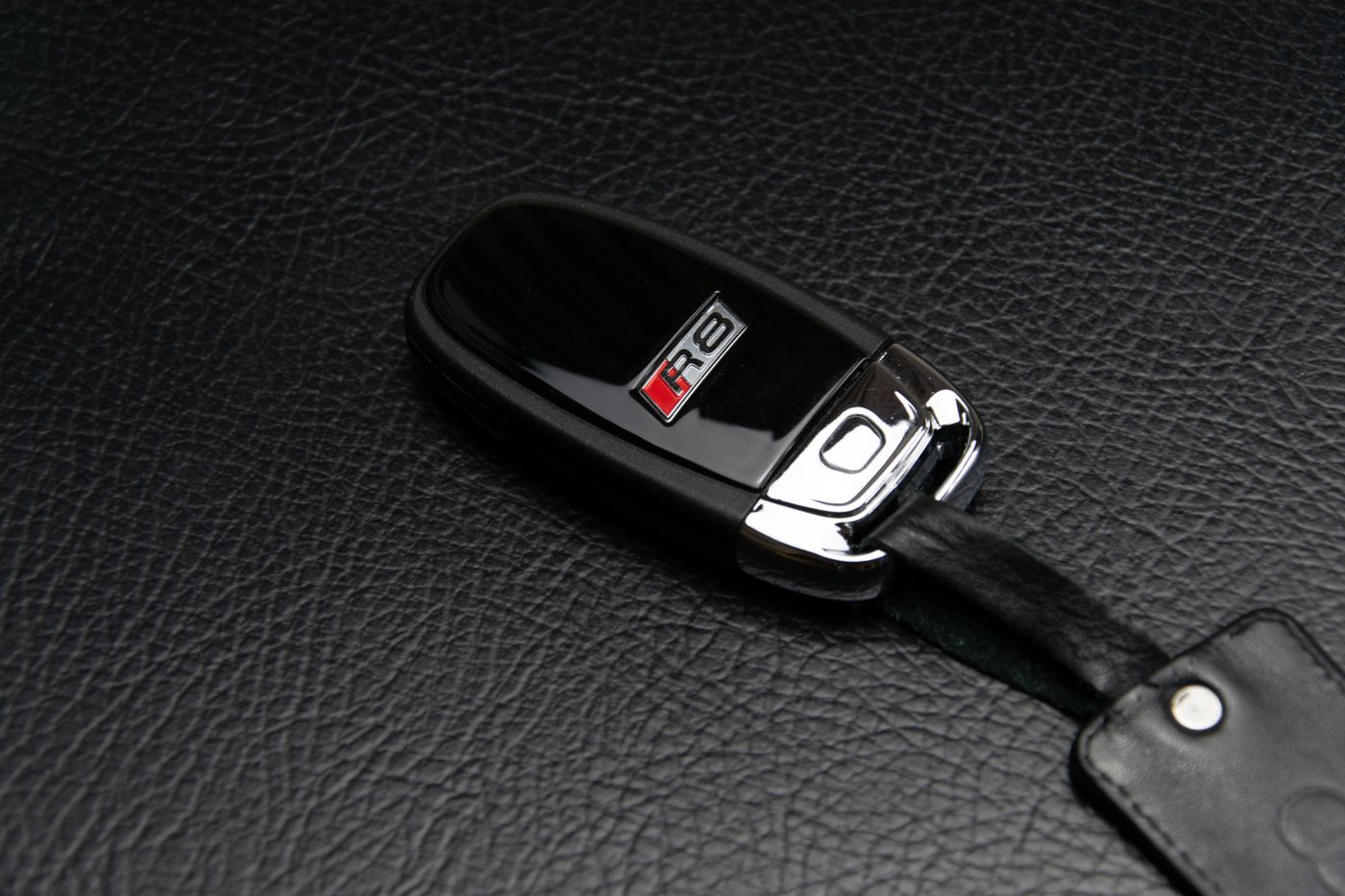 ev car keychain india — Close-up of a luxury car key fob resting on a textured leather surface, symbolizing elegance
Photo: Alexander Pöllinger / Pexels
Weight is not the only issue; leverage is. A short loop keeps the tag against the fob and quiet, while a long chain swings like a pendulum against the fob's corner with every step. Keep the connection short and the mass low and the tag survives a year in a pocket.
The material argument is covered in our PLA+ versus acrylic, metal and wood comparison, including where metal genuinely wins. Metal looks more expensive; plastic wins on weight, cost and the fact that it does not corrode in a coastal city like Coimbatore.
Which keychain design suits an EV key fob?
The fob is small, rounded and glossy, so flat designs sit best. Here is how the three common styles behave on an EV key:
| Design | Best for | Why it works on an EV fob |
|---|---|---|
| Custom number plate | Car owners who want the registration on the ring | Flat rectangle, 50–60 mm wide, sits against the fob without bulk |
| Name keychain | Gifts, family cars, second keys | Personal, readable, and printed as one fused piece so letters do not snap off |
| Model or silhouette tag | Enthusiasts | Thin outline, low mass, no hard edges |
A custom number-plate tag suits an EV key best: flat, light, and legible when you hand the key to a valet. Our number plate keychain guide for cars and bikes covers plate formats, spacing and the state-wise rules that decide whether a stylised plate is legal to display on the car — the keychain is not a registration plate, and it should not pretend to be one.
For a broader shortlist by vehicle type, the best car keychain guide for India compares fob shapes across hatchbacks, SUVs and EVs.
Can a keychain block keyless entry or damage the fob's signal?
A PLA+ tag will not block a 433.92 MHz signal. The fob's antenna and transponder sit inside the plastic housing, and a 3–4 mm printed plate hanging beside the case does not wrap the antenna, so it cannot shield it in any meaningful way.
 ev car keychain india — A detailed view of a classic car's interior with vibrant red and white accents
Photo: athul santhosh / Pexels
Two sensible habits still apply:
- Hang the tag from the ring, not across the fob body. A metal tag taped or pressed flat over the fob is a different situation — metal near an antenna is exactly what shielding looks like — and it also covers the buttons.
- Do not stack the fob against your phone and a metal tag in one tight pocket. Passive-entry systems work on proximity, and a fob buried under a metal object can feel sluggish to the car's antennas even when the battery is fine.
If your car ever fails to detect the fob, the first suspect is the coin cell, not the keychain. Replace the cell, then test again before blaming accessories.
How do you attach a keychain to an EV key without damaging it?
Follow the order below and the fob stays scuff-free:
- Find the fob's own loop. Most keyless remotes have a moulded plastic or metal loop at one end. Use it. Never drill, glue or clamp anything onto the fob shell.
- Match the split ring to the loop. A ring that is too thick stresses the plastic loop; a thin stainless ring of 25–30 mm diameter is enough for a 14–18 g tag.
- Keep the tag on the far side of the ring. The fob's buttons should face outwards and stay uncovered.
- Check the battery door. On many fobs the coin-cell cover is on the back; make sure the ring does not sit over the seam, or you will fight it every two years.
- Keep it off the dashboard. PLA begins to soften around 60 °C (polylactic acid properties), and a closed car in an Indian summer gets far hotter than that. A keychain left on the dash can deform; one in a pocket or a bag will not.
- Wipe it with a damp cloth. PLA+ is waterproof for everyday purposes — rain, sweat, a spilled bottle — but it is not dishwasher-safe and it does not like sustained heat.
None of this is EV-specific, but EV owners notice it more: the fob is the only key they carry, with no second metal key to absorb the abuse.
What does a custom EV keychain cost in India in 2026?
Nuho India prints custom 3D keychains in PLA+ at roughly 215 °C, with letters fused to a continuous backing plate rather than glued on as brittle cut-outs. Prices sit at ₹129–₹149 per keychain, and manufacturing plus despatch takes 24–48 hours from Coimbatore, Tamil Nadu.
For that price you get:
- A tag weighing 14–18 g, light enough to live on a keyless fob without drag.
- A waterproof printed body that will not corrode, flake plating or leave green marks on your palm.
- Free personalisation — a name, a registration number, a short word — printed as part of the object, not stuck on afterwards.
What you do not get is a metal-look luxury keyring, a brand logo, or a weatherproof claim beyond normal use. PLA+ is tough for a keychain, but it is still a polymer: it softens with heat, it can be scratched, and it will show pocket wear over a couple of years. That is the honest trade for a ₹129 tag that weighs less than your car's spare blade.
You can see the current designs and order at nuho.in/products. Because every tag is printed to order, a name or plate format that is unusual — a long surname, a BH-series registration, a two-line format — is worth checking with support on +91 90808 85390 before ordering, so the first print is the right one.
What should you check before you order an EV keychain?
Four things, in this order: the fob's loop type, the weight of the tag, the size of the text, and the heat it will live in. A keyless EV fob is a sealed electronic object that costs real money to replace, and the keychain is the only part of the bundle you can change cheaply.
Get those four right and the tag disappears into daily use. Get them wrong and you will feel it every time you reach for the key — a heavy tag swinging against a plastic case, or lettering too small to read at arm's length. The fix is not a more expensive keychain; it is a lighter, flatter one sized to the key you actually carry.
Prices, specifications and feature lists change between model years and variants. Confirm keyless entry, phone-as-a-key support and fob type on the exact variant sheet before you buy, and verify current pricing with the manufacturer or dealer.
Frequently Asked Questions
More Articles You Might Like
Mahindra Thar Keychains: Fob Fit, Weight and Plate Styles
A Mahindra Thar keychain has to clear a chunky remote fob, dust and 650 mm wading. Fob fit, 14-18 g weight and number-plate styling for Thar OG and Roxx.
Toyota Fortuner Keychains: Chunky Fobs and Flat Number Plate Tags
A Toyota Fortuner keychain must suit the keyless fob, not the badge: fit, weight and number-plate tag design for every 2026 Fortuner variant explained.
Personalised Keychains for Cars: Fob Fit, Weight and Number Plates
Choosing a personalised keychain for car keys: fob fit, the 20 g weight rule, signal-safety facts and number-plate designs in PLA+ from ₹129.