
Alphabet Keychains: Single-Letter Name Tags in PLA+
Nuho India Team
Nuho Creative Team
Key Takeaways & TL;DR
- An alphabet keychain is one capital letter fused to a continuous PLA+ backing plate printed at ~215 °C — no glued-on letter to peel away.
- Single-letter tags weigh 14–18 g and cost ₹129–₹149 at Nuho India, with a 24–48 hour manufacturing window in Coimbatore, Tamil Nadu.
- I, L and T look simplest but fail first when their bars are drawn thin; keep every bar at 4 mm or more and thicken diagonal junctions on M, N, W and K.
- A 30–35 mm capital letter with a 4 mm ring hole and a 20–25 mm split ring is the size that survives a pocket without swinging against a car fob.
- PLA+ is waterproof (water solubility 0 mg/ml) but softens near its 60–65 °C glass transition, so keep printed tags off a sun-baked dashboard.
What is an alphabet keychain?
An alphabet keychain is one letter of the alphabet printed as a standalone tag — a single initial fused onto a continuous PLA+ backing plate and hung on a split ring. Nuho India prints alphabet keychains at about 215 °C in Coimbatore, Tamil Nadu. Each tag weighs 14–18 g, costs ₹129–₹149, and leaves the workshop within 24–48 hours.
The phrase covers more than one product, though. Search for it and most results are resin casts, crochet letters, pipe-cleaner crafts and silicone moulds. This guide is about the rigid version: a 3D printed capital letter you can hang on a school bag, a bike key or a set of house keys and then stop thinking about for two years.
Why order a letter instead of a full name?
A single letter is the lightest, toughest and cheapest form of personalisation, and there are four situations where it beats a full name outright:
- One letter per child. A parent ordering for three children does not want three different name layouts; three initials in three colours do the job in one pass.
- Party favours and return gifts. A set of 26 letters covers a classroom or a birthday group without asking anyone to spell anything.
- Classroom and nursery sets. Teachers use one letter a week, and a bag of A–Z tags turns that into something children can physically hold.
- Couples and shared homes. Two letters on one ring read as a pair without turning into a novelty plaque.
The honest counterpoint: a full name says more. If the point of the gift is that the name is visible, order a name tag — the single-letter initial keychain guide explains where a lone initial wins and where it does not. The letter wins on weight, cost per piece and the number of thin features that can fail.
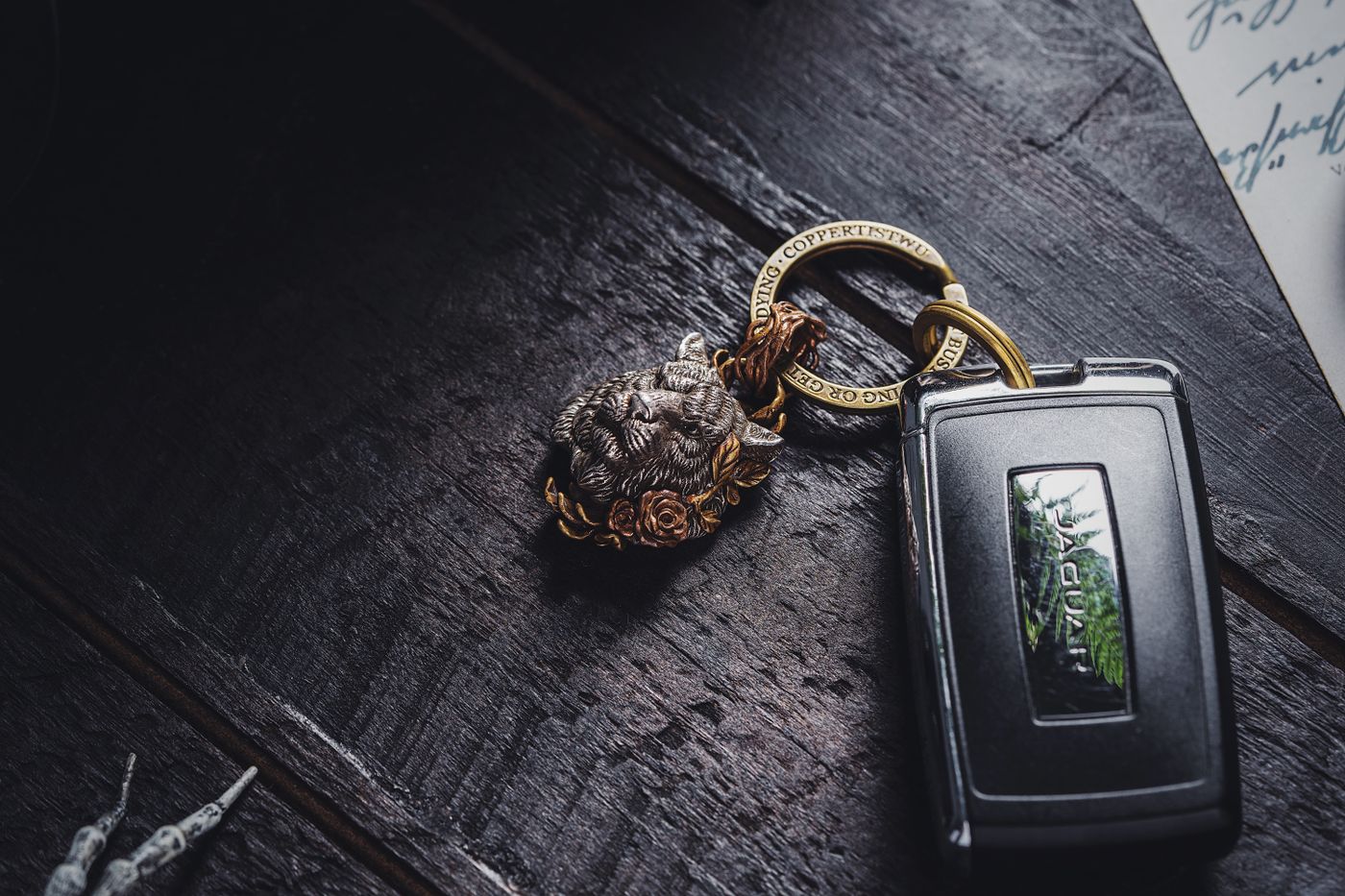 alphabet keychain — Elegant silver lion keychain paired with a luxury car key on a dark wooden surface
Photo: COPPERTIST WU / Pexels
Which letters make the toughest keychain?
Not all 26 letters are equal in a pocket. A keychain fails at its narrowest feature under load: the waist of a letter, the junction where a diagonal meets a stem, the loop around the ring hole. A capital letter can be printed thick, so the material does the work instead of the geometry — but only if the outline gives it somewhere to be thick.
| Letter group | Letters | What the shape does under load | Design fix |
|---|---|---|---|
| Broad closed forms | A, B, D, O, P, Q, R | Wide stroke area spreads load well; the counters are the weak spots | Keep internal openings at 3 mm or more |
| Straight-stroke letters | E, F, H, I, L, T | Very legible, but thin horizontal bars are the first thing to snap | Hold bars at 4 mm minimum |
| Diagonal letters | M, N, V, W, X, Y, Z, K | Load runs along one diagonal line rather than across a face | Thicken the junction nodes, not the whole letter |
| Curved open letters | C, G, J, S, U | A single curve acts like a spring and flexes at the tips | Blend the tips into the backing plate |
| Lowercase letters | a, e, i, j, l, r | Dots, tittles and thin ascenders are too small to print tough | Avoid lowercase below 25 mm cap height |
The letters that surprise people are I, L and T. They look simple, so they get drawn with thin bars, and those bars are exactly where an FDM part delaminates. The letters that look difficult — M, W, A — are usually fine, because a designer naturally gives their diagonals some bulk.
How big should a single-letter tag be?
For a keyring, a capital letter between 30 mm and 35 mm tall is the sweet spot. At that size the letter reads from across a room, the stroke can be 5–7 mm wide, and the finished tag still sits flat in a jeans pocket without jabbing a thigh.
 alphabet keychain — Two people holding beautifully wrapped gift boxes with bows, perfect for celebrations
Photo: RDNE Stock project / Pexels
Four dimensions matter more than the rest:
- Thickness: ask for at least 2.5–3 mm. Below 2 mm the tag flexes at the ring hole and the layers start to separate.
- Ring hole: 4 mm clears every common split ring without binding.
- Split ring: 20–25 mm diameter fits a car fob, a bike key and a bag clip.
- Weight: 14–18 g finished. Heavier than that and the tag starts swinging against a key fob; lighter and it feels like a token.
The trap is scaling. Take a five-letter name 55 mm wide and each letter is only about 8–10 mm tall — smaller than the nozzle path can render cleanly at a 0.2 mm layer height. A single letter at 30 mm has roughly fifteen layers through a 3 mm thickness and a continuous outline, which is why it survives where a cramped name does not. If you need a name, order a name; if you need durability, take the letter.
Are 3D printed alphabet keychains waterproof?
Yes for rain, sweat and washing-up water. PLA is listed with a water solubility of 0 mg/ml, meaning it does not dissolve or swell in water the way paper, wood or unsealed plaster does — the property is recorded on the material's reference page. A monsoon-soaked tag dries on a hook and carries on.
Heat is the real limit. PLA's glass transition sits at 60–65 °C, so a tag left on a sun-baked car dashboard in a Coimbatore summer can soften and droop. The same reference notes that heat-resistant PLA grades exist, but a standard printed tag is not one of them. Keep it off the dashboard and out of a parked car's direct sun and it will outlast the key it hangs from.
Layer lines do trap grime. A toothbrush and a drop of dish soap once a month restores the finish; nothing harsher is needed, and solvent will dull the surface.
How Nuho India prints an A–Z letter
The process is deliberately short, because every extra joint is a future failure point:
- Vectorise the letter. The outline is redrawn as a closed shape with no hairline gaps that would print as weak threads.
- Set minimum stroke width. Bars, diagonals and counter walls are widened until they clear the nozzle's reliable resolution — small letters are redrawn, not just scaled down.
- Fuse letter to backing plate. The letter and its plate print as one object. Nothing is glued or clipped on afterwards, so there is no adhesive line to peel apart.
- Print at ~215 °C. Hot enough for each layer to bond to the one beneath, which is what turns a stack of slices into a single solid part. PLA+ is chosen over standard PLA for its better impact behaviour.
- Finish and ring. Support marks are cleaned, edges dressed, and the split ring fitted before the 24–48 hour despatch window closes.
PLA's density is 1.21–1.43 g/cm³, which is why a compact tag with roughly 12 cm³ of material lands in the 14–18 g band rather than feeling like a plastic token. The Simplify3D materials guide is a useful plain-language summary of PLA's trade-offs: stiff, dimensionally accurate, inexpensive — and low in heat resistance.
 alphabet keychain — Two people exchanging gifts, highlighting the festive spirit with colorful presents
Photo: https://kaboompics.com/ / Pexels
PLA+ vs acrylic vs resin vs metal for a single letter
| Material | Weight | Best at | Where it loses |
|---|---|---|---|
| 3D printed PLA+ | 14–18 g | Thick, fused letterforms that bend instead of cracking; opaque colour range | Matte finish only; softens near 60 °C |
| Laser-cut acrylic | 8–14 g | Crisp glossy edges and cheap flat shapes in bulk | Cracks at narrow letter necks and screw holes; no real relief |
| Cast zinc or brass | 30–60 g | Premium weight and shine | Heavy on an ignition barrel, scuffs the fob, costs several times more |
| Cast resin | 10–20 g | Fine detail, transparency, glitter effects | Hard and brittle; chips on a hard floor rather than flexing |
| Crochet or pipe cleaner | 3–6 g | Craft-project charm, near-zero cost | Not rigid, absorbs sweat and dirt, frays |
There is no universal winner. Metal feels best in the hand and worst against a plastic fob. Resin renders the prettiest single letter and is the most likely to chip when a child drops a bag. PLA+ is the compromise that survives daily keyring life, which is the job.
Can you make an alphabet keychain at home?
Yes, in three different ways, and each has a real cost:
- Resin moulds. A silicone alphabet mould plus UV resin gives glossy letters in an afternoon. The mould and resin cost more than a few finished tags, and cast resin letters chip.
- Crochet and pipe cleaners. Cheap, fast, and genuinely charming — but the result is soft, so it is jewellery rather than a keyring.
- A 3D printer. The filament for one 15 g letter costs a few rupees. The printer, the design time, the failed first prints and the sanding are the expensive parts. For a single tag, ordering is cheaper; for a hundred, a printer starts to make sense.
If the goal is a craft afternoon with children, the mould route is the right one. If the goal is 30 tags for a class before Friday, it is not.
How do you order an A–Z set without mismatched letters?
Write the order as a list, not a sentence. Six fields settle almost every ambiguity:
- Letters and quantities — "A, A, B, C, D…" with counts, not "a few of each".
- Case — uppercase unless you have checked that the lowercase will be at least 25 mm tall.
- Font style — block, rounded or serif. Block survives best; serif hairlines need widening.
- Colour per letter, if the set is for different children.
- Plate shape — rounded rectangle, circle or tag. Rounded corners wear better in a pocket.
- Ring size and quantity, especially for a set that will be handed out.
Bulk pricing is per piece and depends on the mix; the name keychain bulk pricing explainer covers how quantities change the number. For a single gift, the full Nuho India keychain range is the place to pick a letter, colour and plate shape. Prices and lead times move — confirm before a large run.
What an alphabet keychain cannot do
A printed letter is one colour per print. Multi-colour letters mean separate parts or a filament swap, and both add cost. It will never imitate chrome, and its matte surface shows fingerprints less than gloss but scuffs more visibly on dark colours. Fine serifs and thin scripts get widened until they are no longer fine. And a split ring is a small metal part, so a tag is not a toy for a child under three.
Those limits are worth knowing before ordering, because the alternative is disappointment at the wrong end of a 24–48 hour wait. Within them, a single PLA+ letter is the most durable personalised keychain Nuho India makes — light enough to forget, bold enough to find by feel, and printed as one piece so there is no joint to come apart.
Frequently Asked Questions
More Articles You Might Like
Vinyl vs Paper Stickers: Which Survives Indian Weather
Vinyl sticker printing versus paper stickers in Indian weather: how monsoon humidity, heat and UV attack each face material, and which one to buy.
Gaming Keychains in India: Controller, Console and Name Designs
Gaming keychains in India: which controller shapes print cleanly, why joysticks snap, and how to size a durable gamertag tag at 50 mm in PLA+.
Stickers for Water Bottles: What Survives Washing and Ice
Water bottle stickers that survive hand washing, ice and school bags: surface tests, size maths, the dishwasher truth and better options for school names.