
What to Do With Failed PLA Prints and 3D Printing Scraps
Nuho AI-assisted editorial
Nuho Creative Team
Key Takeaways & TL;DR
- Keep known PLA scraps separate from other materials and label uncertain items.
- Ask a local recycler about accepted materials before putting prints in a recycling stream.
- A material being PLA does not mean a finished print belongs in home compost.
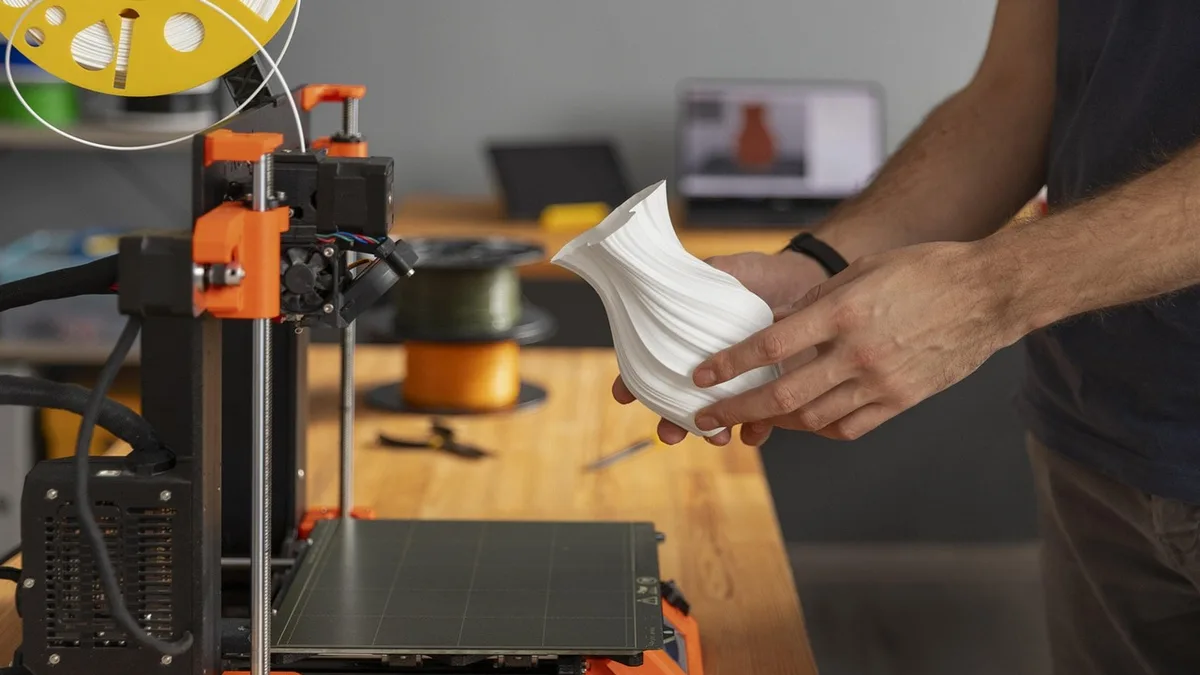
Hands holding a white printed object beside a 3D printer and filament spools
Photo by vexmatech on Pixabay.
What to Do With Failed PLA Prints and 3D Printing Scraps
Cover image: illustrative stock photograph, not a Nuho workshop or product.
Short answer: Separate known PLA scraps from other materials, label what you are unsure about, and ask a local collector or specialist whether they accept those particular prints before recycling them. Do not assume that a PLA label makes an item suitable for home compost or your ordinary recycling bin.[2][3]
A failed print, support structure or short filament offcut need not be treated as the same thing as an empty spool. Each can have a different material and a different route. This guide is for solid filament-printing scraps, not uncured resin or resin-contaminated waste.
First: sort what you actually know
Keep a labelled container for known PLA and separate containers for other known materials. If you cannot identify a print's material, keep it apart rather than guessing. Record the filament brand and type where possible, including whether it contains glitter, fibre or other additives. Ask the intended recycler whether it accepts those formulations before combining them.
For example, Université de Montréal's FilUM project recovers additive-free PLA; the team says it does not currently use glitter-containing PLA or carbon-fibre PLA.[2] That is one programme's rule, not a universal acceptance list.
Keep the scraps clean and free of attached hardware or other materials, subject to the receiving recycler's instructions. Don't shred or melt plastic just to make it fit a bin: check whether a collector wants whole pieces and what preparation it requires.
Find out what your local service accepts
A material that can be processed in a specialised system is not necessarily accepted by your local household collection. For example, the North London Waste Authority says its household service and recycling centres do not accept 3D-printer material such as PLA or PETG.[3] That is a UK example, not a disposal rule for India.
In India, ask your municipal waste service, authorised local waste collector, maker space or filament supplier these specific questions:
- Do you accept solid 3D-printed PLA parts, loose filament and support material?
- Are blends, coloured prints or filled filaments accepted?
- Must pieces be clean, sorted by colour or delivered separately from spools?
- What should I do with unknown materials and non-accepted items under local rules?
Confirm the answer for your location and the actual material before dropping anything off. If nobody accepts it, follow your local authority's instructions for residual waste; do not put it in a recycling stream hoping someone else can sort it.
Is PLA safe for a home compost bin?
Do not assume it is. The Montréal project explains that PLA requires specific conditions to degrade and discusses industrial composting facilities rather than ordinary environmental conditions.[2] Even where an industrial facility exists, confirm it accepts the specific finished item; a filament's name is not proof that a printed object meets that facility's requirements. Recycling and composting are different routes.
Can scraps become new filament?
It is possible in a controlled system, but it is not simply a matter of warming a pile of prints. FilUM sorts PLA scraps, shreds them into granules and extrudes them into filament. Its team notes the equipment, labour and expertise involved and says its recycled material is not suitable for every application.[2]
If a shared workshop wants to explore this, start by identifying an actual processor and its accepted feedstock, then agree on collection, sorting and quality checks. Do not assume a reused spool or recycled filament will have the same performance as the original material. Consult the equipment manufacturer's instructions and use suitable controls; see Nuho's filament printer ventilation checklist.
Reduce future scraps before they happen
- Check the model orientation and support preview before committing to a long print.
- When a design is uncertain, print a small representative section first rather than repeating the whole part.
- Keep notes on the machine, material and settings when investigating a failed print.
- Reuse a suitable failed piece as a fit or finish sample when practical, rather than printing another sample solely for that purpose.
For troubleshooting, see common 3D printing problems. If you prefer a finished gift or sticker to producing one yourself, browse Nuho's product catalogue.
Frequently asked questions
Can I mix PLA and PETG scraps?
Keep them separate unless the receiving processor explicitly tells you otherwise. Ask about additives and unknown pieces as well.
Do empty filament spools go with the scraps?
Not automatically. A spool and the filament on it may need different handling. Check the spool's material marking and ask your local collector or supplier.
Is a UK or Canadian recycling programme available in India?
Not necessarily. The overseas examples explain possible processes and local restrictions; they are not evidence of an Indian collection service. Verify local availability directly.
This AI-assisted guide summarises the linked sources; it does not claim first-hand testing or a local waste-service inspection.
Sources
[2] https://nouvelles.umontreal.ca/en/article/2026/10/13/3d-printer-waste-gets-a-second-life [3] https://www.nlwa.gov.uk/whatcanwerecycle/3d-printer-material
Frequently Asked Questions
More Articles You Might Like
Desktop 3D Printer Ventilation: A Practical Filament Safety Checklist
A practical starting checklist for managing particles and vapours from desktop filament 3D printers.
Inkjet vs Laser Printers: Real Cost Per Page in India
Inkjet vs laser printers in India, compared on real cost per page: ink tank, cartridge and toner maths, five-year totals, and the costs adverts skip.

Filament Drying and Storage in Indian Humidity
Dry PLA at 40–50 °C, keep every spool under 20% relative humidity, and stop stringing, popping and brittle prints through the Indian monsoon season.