
3D Printed Jewellery in India: PLA+ Limits and What Works
Nuho India Team
Nuho Creative Team
Key Takeaways & TL;DR
- PLA+ has a glass transition of 60-65 °C, so a printed jewellery piece left in a parked car can soften and deform.
- Professional jewellery 3D printing uses printed parts as lost-wax casting patterns or try-on models, not as the final metal piece.
- Autocomplete demand for "3d printed jewellery" in India is dominated by boxes, organisers, stands and trays rather than wearable earrings.
- Nuho India prints PLA+ at 215 °C in Coimbatore, fusing letters into a continuous backing plate, with 24-48 hour despatch.
- Custom 3D printed keychains are priced at ₹129-₹149; material is only a few rupees of that, with machine time and finishing dominating.
Can You 3D Print Jewellery in India? The Honest Answer
Yes, but not the way a jeweller does. A desktop FDM printer lays down PLA+ at about 215 °C and produces lightweight, waterproof, brightly coloured plastic pieces: statement earrings, brooches, bag charms, jewellery trays, ring holders and boxes. It does not produce fine gold or silver jewellery. That still needs metal casting.
What PLA+ Can and Cannot Do as Wearable Jewellery
PLA+ is a modified polylactic acid — a thermoplastic polyester made from fermented plant starch. Wikipedia's entry on polylactic acid gives the numbers that decide everything about how a printed piece behaves on a body: a glass transition temperature of 60–65 °C, a melting range of 130–180 °C, and a density of 1.21–1.43 g/cm³. The same entry notes PLA is the most widely used FDM filament because of its low melting point, high strength, low thermal expansion and good layer adhesion — and that it has poor heat resistance unless annealed.
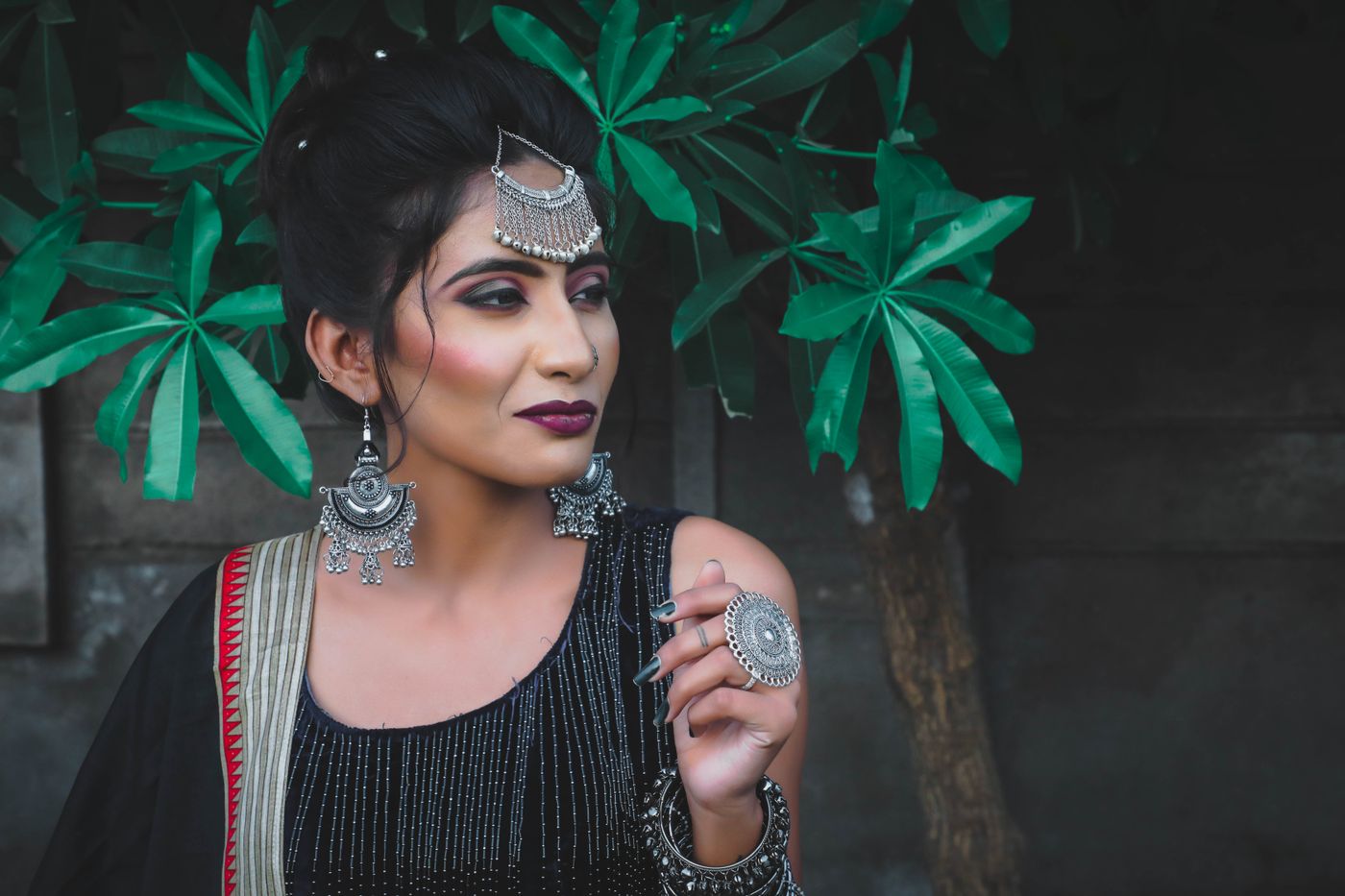 3d printed jewellery — Portrait of an elegant Indian woman wearing traditional jewelry and attire outdoors
Photo: The Wedding Fog / Pexels
That single sentence explains most of what a printed jewellery piece can and cannot be.
| Property | What the number is | What it means in a jewellery context |
|---|---|---|
| Glass transition | 60–65 °C | A piece left on a car dashboard in an Indian summer can soften and sag |
| Melting range | 130–180 °C | Safe near a stove, not safe against a hot iron or hair straightener |
| Density | 1.21–1.43 g/cm³ | A 3 cm pendant weighs a couple of grams, not twenty |
| Water | Insoluble, effectively non-absorbing | Rain, sweat and hand-washing do not swell it, unlike wood |
| Layer adhesion | Good for PLA, best printed hot | A piece is strongest along its layers, weakest between them |
| Detail floor | About 0.4 mm nozzle width | Fine filigree and 0.5 mm prongs are simply not printable |
Why Almost Nobody Wears a Bare Printed Earring Post
Here is the part most "3D printed jewellery" pages skip. The reason professional jewellery printing exists is not to wear plastic. Formlabs' jewellery guide describes the real industrial workflow: a piece is designed in CAD, printed, then used as a pattern for lost-wax casting in gold, silver or another precious metal — or printed cheaply as a try-on model so a customer can hold the design before committing.
So printed plastic is either a prototype or the final cheap object. When it is the final object, three limits show up fast:
- Posts and ear wires. A printed post is thicker and less stiff than a steel or titanium one, and the layer lines give bacteria somewhere to sit. Use metal findings and print only the decorative front.
- Skin contact over hours. PLA+ is not a medical or skin-contact-certified material, and we make no hypoallergenic claim for it. For anyone who reacts to cheap fashion jewellery, a metal back and a printed face is the safer combination.
- Colour wear. A metallic-finish PLA+ surface scuffs to a duller tone at the high points within months of daily pocket or handbag life. Solid colours hide this; foil-look finishes do not.
None of that makes printed jewellery bad. It makes it a different product from a gold chain, and worth buying only when you understand which one you are getting.
Where 3D Printed Jewellery Genuinely Wins: Trays, Boxes and Holders
Look at what people actually type into Google. The autocomplete list for "3d printed jewellery" in India is dominated not by earrings but by jewellery box, jewellery organiser, jewellery holder, jewellery stand, jewellery display and jewellery tray. That is the honest commercial centre of this niche: printed objects that hold jewellery, not objects worn as jewellery.
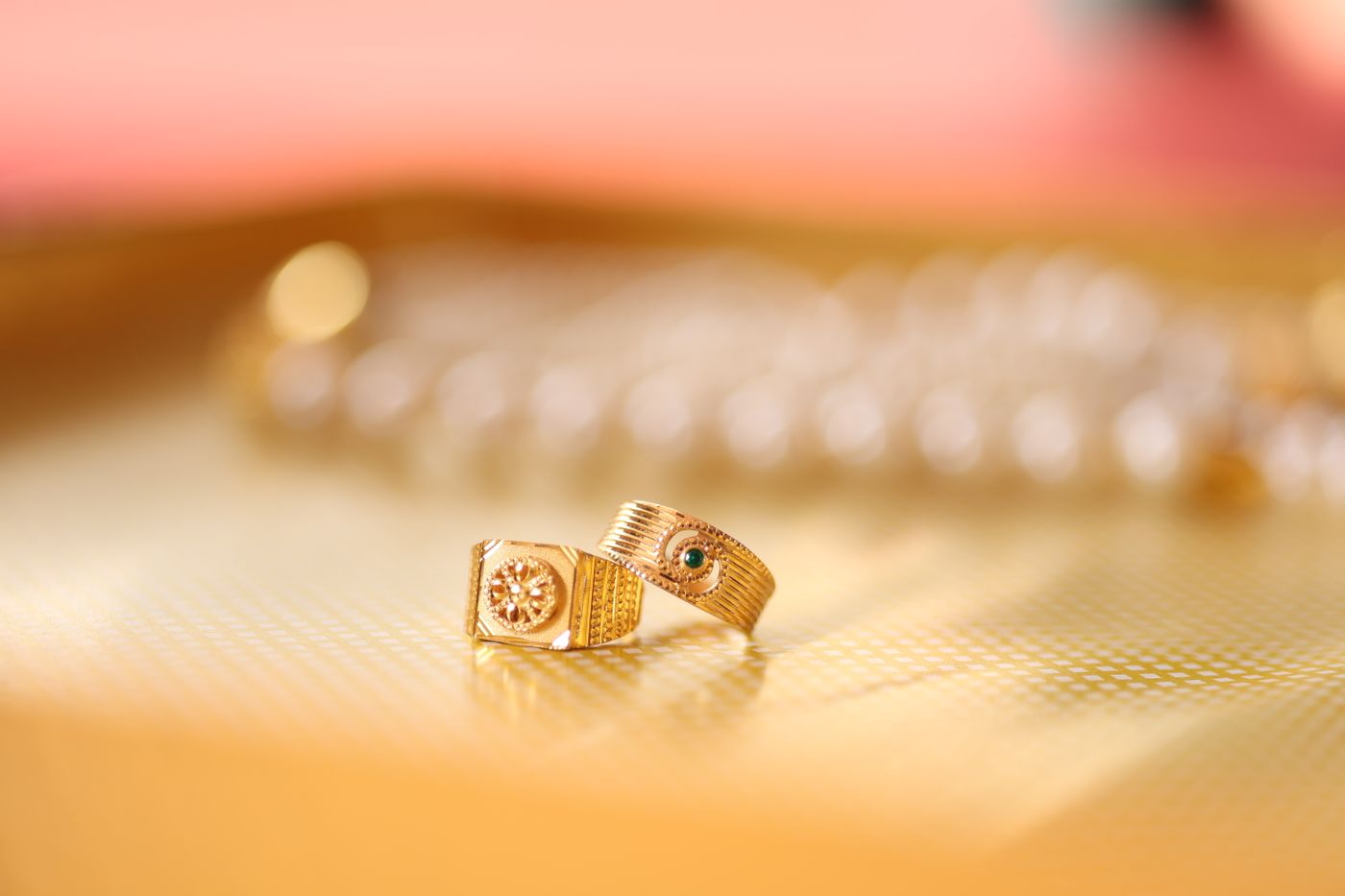 3d printed jewellery — Close-up of gold rings on a textured surface, capturing elegance and sophistication
Photo: Rohit Piple / Pexels
It makes sense. A ring dish or a two-tier earring stand is a large, simple, low-detail object with no skin-contact requirement and no flex fatigue. PLA+ is genuinely good at it: rigid at 2.5–3 mm walls, light enough to move around, and printable in any colour a bedroom or a boutique shelf needs. A tray that would cost several hundred rupees in brass can be printed in an afternoon.
This is also the corner of the category that overlaps with what a small Indian print shop already does well: personalised, low-volume, named objects. Our own 3D printed gift boxes and card holders sit in exactly that family — a lidded box with a name fused into the top is a jewellery box and a gift in one object.
How a PLA+ Jewellery Piece Is Actually Made
The process is the same whether the output is a ring holder or a named keychain, and knowing it tells you what to check before ordering.
- Artwork. Text and shapes are converted to vectors, then extruded to a solid. Curves under about 1 mm collapse at this stage, so a design is simplified before it is printed.
- Slicing. A 0.4 mm nozzle at 0.2 mm layers is the standard trade-off: roughly 0.8 mm of wall per two passes, with a surface fine enough that layer lines read as texture rather than error.
- Printing at 215 °C. PLA+ runs hotter than plain PLA to improve layer bonding. That is the whole reason a printed letter survives a fall instead of snapping at the base.
- Fusion, not glue. Letters and motifs are printed into a continuous backing plate. Nothing is stuck on afterwards, which is why the piece has no weak glued joint to fail.
- Cooling and finishing. Supports are removed, edges are dressed, and hardware — a split ring, a chain, a metal ear wire — is added.
- Despatch. Nuho India prints in Coimbatore, Tamil Nadu and dispatches in 24–48 hours.
A 10 g decorative piece typically occupies a printer for something in the region of one and a half to three hours at those settings. Treat that as an approximate planning figure rather than a quote; it moves with infill, height and how much of the bed the model covers.
Design Rules That Decide Whether a Printed Piece Survives
Most failed printed jewellery fails at design, not at the printer. The rules that matter:
- Nothing thinner than about 1.2 mm. A 0.8 mm petal will print and will also snap.
- Round every inside corner. Sharp internal corners are where cracks start, because the nozzle turns a corner and leaves a stress riser.
- Print flat, show the top. The face against the bed is smooth; the top carries the detail. Orient the piece so the visible face is up and the flat back sits on the plate.
- Keep layer lines across the bend. A hook or loop printed with its layers running along the pull direction delaminates; printed across it, the same loop holds.
- Design for a metal finding. A printed loop that accepts a 4–5 mm split ring or a standard ear wire outlasts a printed hook.
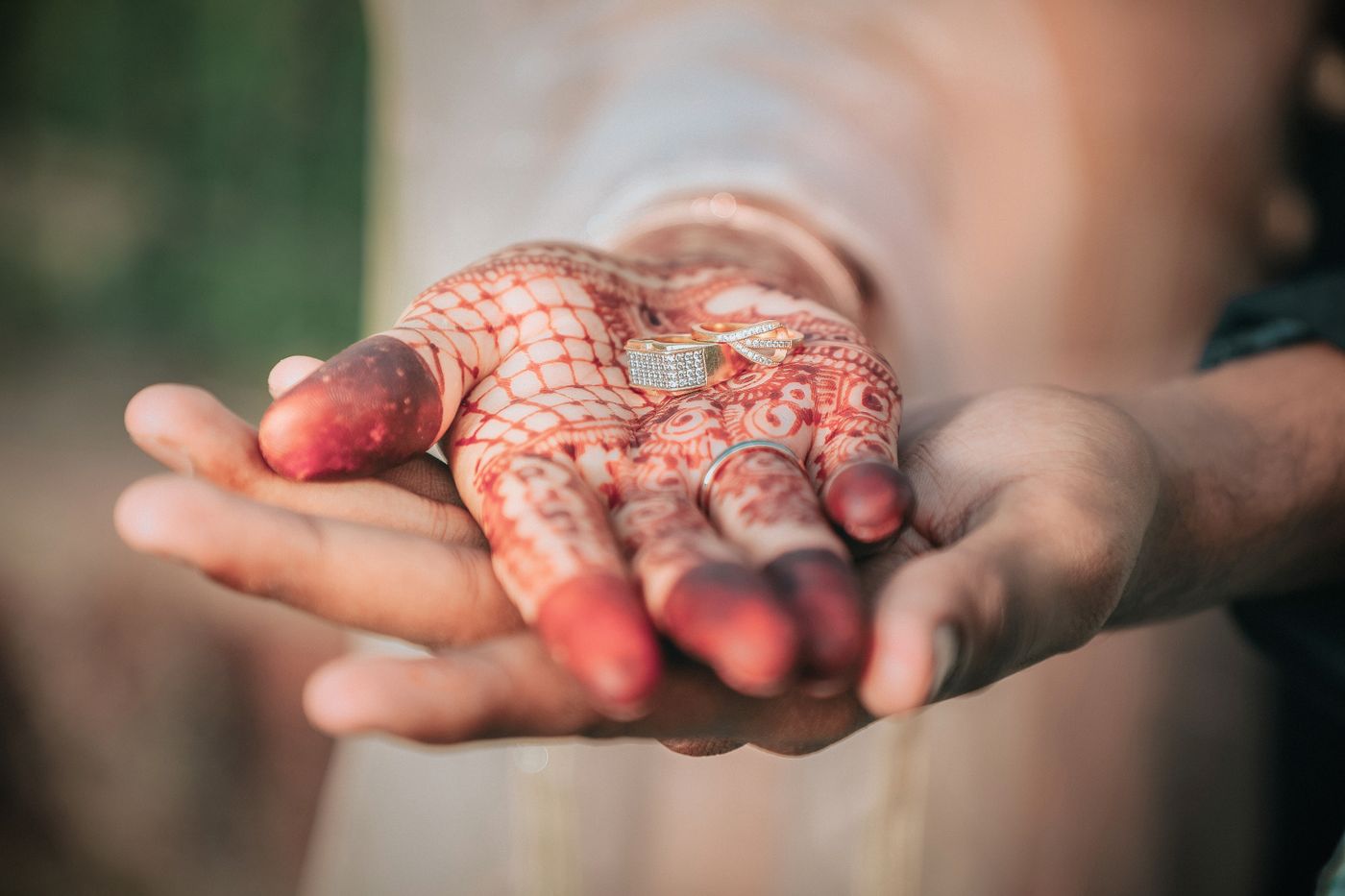 3d printed jewellery — Close-up of hands with mehndi designs holding wedding rings, symbolizing engagement in India
Photo: Milan Vekariya / Pexels
3D Printed Jewellery vs Resin, Metal and Acrylic
| Method | Detail floor | Feel and weight | Honest verdict |
|---|---|---|---|
| FDM in PLA+ | ~0.4 mm features | Light, slightly textured, matte to satin | Best value for large, simple, colourful pieces; trays, boxes, charms |
| Resin (SLA) | ~0.05 mm features | Smooth, dense, glassy | Better for fine detail and small scale; resin is brittle and needs washing and curing |
| Cast metal | Sub-0.1 mm | Heavy, cold, permanent | The only real answer for something worn daily for decades, and priced accordingly |
| Laser-cut acrylic | ~0.2 mm, flat only | Flat, glossy, brittle at narrow letters | Cheap and fast for flat shapes; narrow strokes chip |
The pattern is consistent: the more detail and the longer the wear time, the further you move from FDM. The bigger and simpler the object, the more FDM wins on cost per unit.
What a Printed Piece Costs in India, and Why
Material is the smallest part of the price. A 10 g piece uses roughly 12–14 cm³ of filament at typical infill, which is a few rupees of plastic at Indian filament prices. What you are actually paying for is machine time, design work, finishing and hardware — which is why a large, simple tray and a small, intricate pendant can land at similar prices.
For reference, our custom 3D printed keychains sit at ₹129–₹149. A jewellery tray or a named box is in the same broad band or a little above, driven by mass and print time rather than by any precious material. Anyone quoting printed jewellery at metal prices is not selling you printed jewellery.
Heat, Sunscreen and the Indian Summer
The 60–65 °C glass transition is not a theoretical warning. A closed car in direct sun routinely exceeds it, and a printed piece left on the dashboard can go soft enough to deform under its own weight or a stacked pair of sunglasses. The fixes are simple:
- Keep printed pieces out of parked cars and off window sills.
- Never iron, tumble-dry or hair-dryer a printed piece to "straighten" it.
- Wipe with mild soap and water. Solvent-heavy cleaners and long sunscreen contact will dull a painted or metallic surface and can stain pale filament.
Solid-colour PLA+ handles Indian humidity without swelling — unlike laser-engraved wood, which is the usual alternative at this price — and a piece that gets wet simply dries.
Which Gifting Scenarios Actually Suit a Printed Piece
Printed jewellery and jewellery-adjacent objects work best where the personalisation is the gift, not the metal:
- Return gifts and event favours. Small, named, colour-matched, and identical across 50 pieces without a mould.
- Bridesmaid and sibling sets. Same design, different name or initial, which is exactly where tooling-based manufacturing becomes uneconomic.
- Kids. Light, no sharp metal edges, and cheap enough to be replaced when it is lost — the same reasoning behind our 3D printed name keychains for kids.
- Desk and dressing-table decor. Trays, ring holders and stands, which is the category most "3d printed jewellery" searches are really about.
Where it does not suit: an engagement ring, an heirloom, anything worn against the skin all day, and anything where the word "gold" is part of the promise.
Ordering Custom Printed Pieces in India
If what you want is a printed name piece you can wear, the honest route is a keychain rather than a pendant: a flat PLA+ tag with the name fused into a backing plate, light enough at 14–18 g that it does not drag a key ring down, and tough enough for a bag or a bike key. Our comparison of keychain materials explains why that shape works in PLA+ where a thin earring does not.
The full range of custom printed keychains, decor and stickers is on the Nuho India products page, printed in Coimbatore and dispatched in 24–48 hours. If a design needs metal hardware, we will say so rather than print a hook that fails in a month.
For the tray-and-box side of the category — the part the searches are actually about — start with 3D printed home decor in India and work backwards from the shelf space you have.
Frequently Asked Questions
More Articles You Might Like
3D Printed Headphone Stands in India: Weight, Grip and Desk Fit
A 3D printed headphone stand only works if the hook is thick and the load is spread. Real weights, PLA+ creep, desk fit and the numbers to measure.
3D Printed Cake Toppers in India: Food Contact and Cleanup
3D printed cake toppers in India: why PLA+ is decor and not food contact, how layer lines trap icing, and the cleanup routine that keeps a print usable.
Is PLA Waterproof? What Water Actually Does to PLA+ Prints
PLA is water resistant, not waterproof. What rain, humidity, hot water and layer-line porosity really do to PLA+ prints — and how to seal a 3D print.