
3D Printed Headphone Stands in India: Weight, Grip and Desk Fit
Nuho India Team
Nuho Creative Team
Key Takeaways & TL;DR
- A printed PLA+ stand holds 250–400 g indefinitely only if the hook is an 8–12 mm solid section, not a thin cantilever.
- Apple lists AirPods Max at 386.2 g, so a 400 g design target covers essentially every over-ear headphone on an Indian desk.
- PLA's glass transition is 60–65 °C, which is why direct sun and car dashboards soften a stand that a 35 °C room never touches.
- Saddle width of 30–45 mm spreads headband load and prevents the foam crease that narrow hooks leave behind.
- Nuho India prints decor in PLA+ at about 215 °C in Coimbatore, Tamil Nadu, despatching personalised pieces in 24–48 hours.
Do 3D printed headphone stands hold up on a desk?
Yes, if the hook is thick enough and the load is spread. A printed stand in PLA+ carries a 250–400 g headphone indefinitely as long as the hook is a solid 8–12 mm section rather than a thin cantilever, the saddle is at least 30 mm wide, and the base is heavy enough not to tip. Thin, pretty stands fail; chunky ones do not.
The failures people actually report are not dramatic. Nothing snaps. The hook slowly bends a few degrees over months, the base tips when a headband is dropped on one side, or the top edge leaves a crease in the headband padding. All three are geometry problems, and all three are fixable before anything is printed.
What a printed stand is actually made of
A desk headphone stand is a simple object: a base plate, a vertical post, and a hook or saddle at the top. At Nuho India we print that kind of desk object in PLA+ at about 215 °C on a 0.4 mm nozzle, the same setup used for our decor and gifting pieces in Coimbatore, Tamil Nadu. A full-size stand typically uses 3 walls, 15–25% infill in the post, and a base that is deliberately heavier — often 250–350 g of filament before any weight is added underneath.
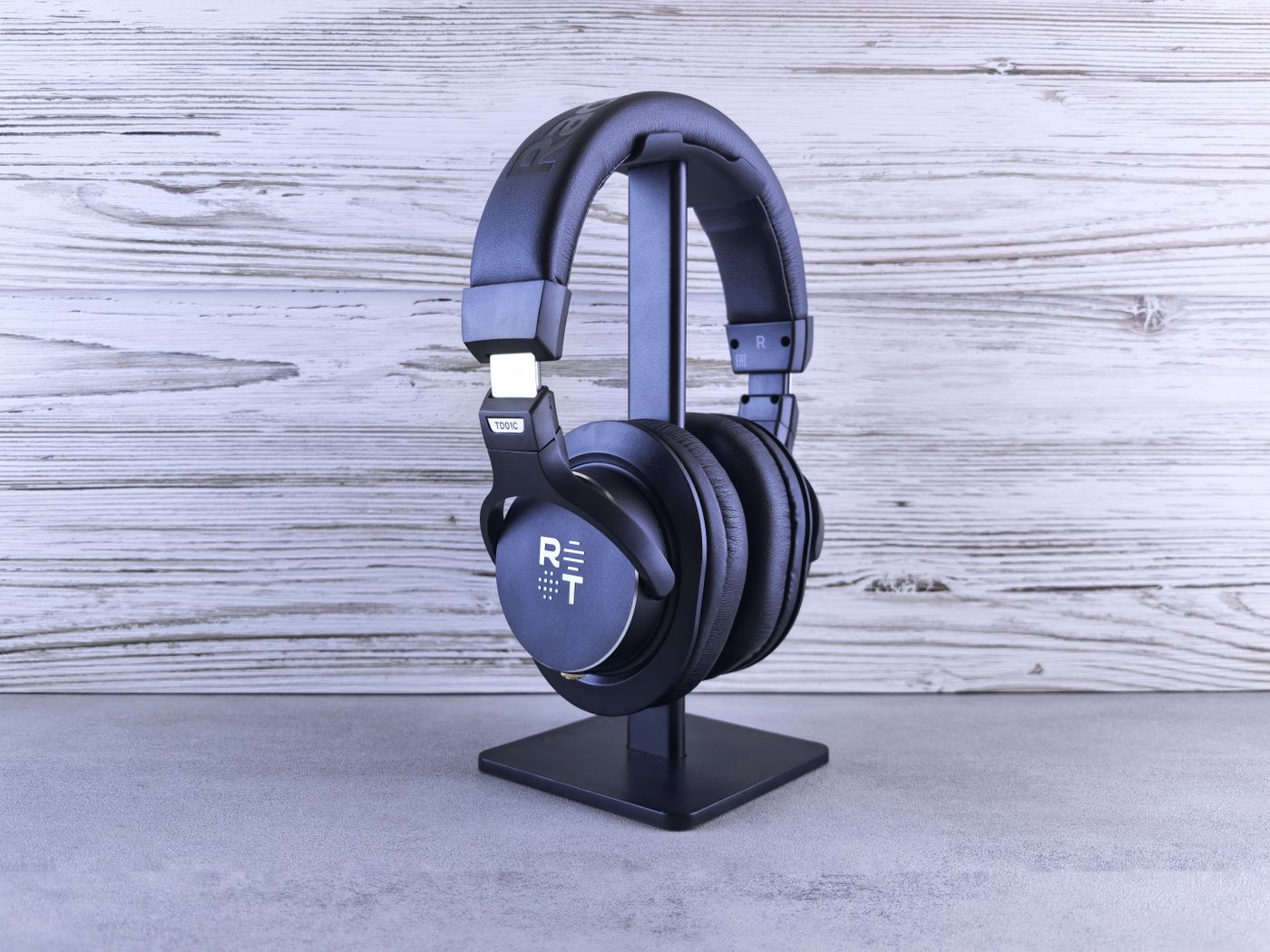 3d printed headphone stand — Stylish black headphones on a stand with wooden texture background
Photo: Andrey Matveev / Pexels
The material detail that matters most is not strength in the abstract. PLA has a glass transition temperature of 60–65 °C and a melting range of roughly 130–180 °C, with a density between 1.21 and 1.43 g/cm³ (Wikipedia: polylactic acid). A 3 mm-thick PLA rib is stiff at room temperature. At 50 °C it is noticeably softer. That gap is where most stand designs live or die.
How much weight does a headphone stand carry?
More than most people assume. Apple lists the AirPods Max at 386.2 g (13.6 oz) (Apple: AirPods Max specifications), and that is the heavy end of mainstream over-ear headphones rather than an outlier. A stand designed around 400 g covers essentially everything on a desk in India, including a headset with a boom mic.
Weight alone is not the test, though. What a stand feels is force per square centimetre at the contact patch. A 350 g headphone hanging from a 10 mm-wide hook puts its load into a narrow strip of headband foam. Hang the same headphone from a 40 mm saddle and the same load is spread over four times the area. The foam recovers, the headband does not take a permanent set, and the stand looks the same after a year.
Three numbers worth holding onto when you design or buy:
- Hook section: 8–12 mm thick, printed solid (4+ walls), not a 4 mm decorative curve.
- Saddle width: 30–45 mm, with a slight crown so the headband rests on a curve, not an edge.
- Base footprint: at least 90 × 90 mm, or a smaller base with a steel washer or sand-filled cavity to lower the centre of gravity.
Why PLA+ sags under a load that never comes off
A headphone stand is a creep test you run by accident. The load is constant, it is applied for months, and it is applied at whatever the room temperature happens to be. PLA is stiff but it is not creep-free: printed PLA parts deform slowly under sustained stress, and published work on printed PLA creep focuses on annealing precisely because the as-printed structure relaxes over time. A stand that holds its shape for a week can still bow by the end of a Coimbatore summer.
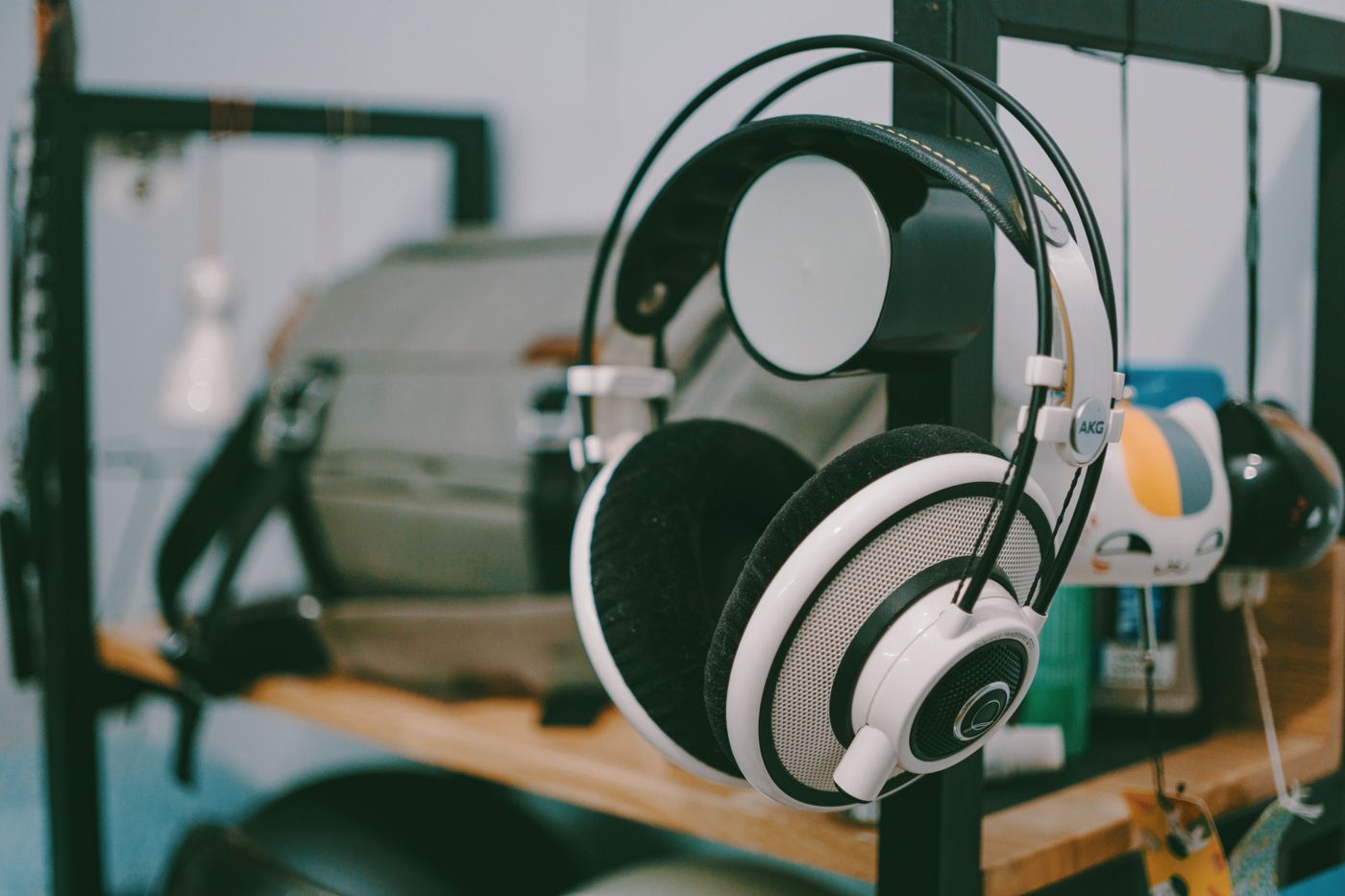 3d printed headphone stand — Close-up of AKG headphones hanging on a shelf in an indoor setting
Photo: FOX ^.ᆽ.^= ∫ / Pexels
The fix is structural, not a different colour of filament:
- Never cantilever the hook. Put the hook directly over the post, or brace it with a triangular gusset that carries load in compression.
- Print the hook solid. Infill in a 10 mm hook is just a hollow tube with a skin. Four to six perimeters, 100% infill in the top 40 mm.
- Orient the layers along the load. A hook printed flat on its side delaminates at the bend; printed upright with the layer lines running down the post, the load is carried along the extrusion rather than across the bonds.
- Add a real foot. A 3 mm felt or cork pad under the base stops the slide and hides the elephant-foot squash at the bottom layers.
If the stand will sit in a car, near a window with afternoon sun, or in a workshop that hits 40 °C, PETG is the more sensible filament. It creeps too, but its glass transition is higher. Our PETG print settings guide covers the temperature and speed numbers, and the trade-off is stringier prints and a slightly gummier surface finish.
Desk stand, clamp or wall hook: which fits your setup?
Three mounting styles solve three different desks. The table below is the honest comparison, including where a printed stand is the wrong answer.
| Style | Desk space used | Load limit (practical) | Best for | Weak point |
|---|---|---|---|---|
| Free-standing desk stand | 90–140 mm circle | 400–600 g | Small desks, shared desks, gifting | Tips if the base is light |
| Desk-edge clamp | Zero footprint on the surface | 500 g+ if the clamp is metal | Deep monitors, cable-tidy setups | Printed clamps crack at the screw boss |
| Wall or under-desk hook | None | 300–500 g, depends on the fixing | Tight rooms, studio corners | Cable strain; dust on the pads |
A printed clamp is the one I would avoid in PLA+. The screw boss takes a point load, the clamp jaw is a thin section, and both are exactly the geometry where layer adhesion decides the outcome. If you want a clamp, print the body and buy a metal C-clamp or use a metal insert. For everything else, a free-standing stand with a heavy base is the safer build.
Does an Indian desk in summer soften a PLA+ stand?
Only at the extremes, and usually because of sunlight rather than air temperature. A room at 35 °C is comfortably below PLA's 60–65 °C glass transition. A black stand on a window sill in direct afternoon sun is a different story: surface temperatures on dark plastic in Indian sun routinely climb well past ambient, and that is when a thin hook starts to lean.
Practical rules that hold up:
- Keep the stand out of direct sun and away from car dashboards. A car interior parked in the sun is the single worst place for any PLA object.
- A desk under a fan or air-conditioning is a non-issue. Airflow keeps the surface near ambient.
- If the stand must live by a window, choose a light colour — cream, white, pale grey — because it absorbs less solar heat than black.
- PLA and humidity are a smaller problem than heat; PLA resists water rather than being waterproof, and a stand never sees standing water anyway.
What to measure before you print or order one
Five minutes with a ruler saves a failed print. Do this in order:
- Headband width at the crown. Measure the padded band where it will rest, not the ear cups. Most over-ear models land between 30 and 45 mm; a saddle narrower than the band leaves a visible line in the foam.
- Ear cup depth and splay. Cups hang below the band, so the hook needs 70–90 mm of clear height under the saddle or the cups will touch the desk.
- Folded vs open. If the headphones fold flat, measure the folded height instead — a stand for a folded pair is a different, shorter object.
- Desk depth and cable route. The stand needs 90–140 mm behind the keyboard, and the charging cable should exit towards the wall rather than across the desk.
- Base clearance. Check the base does not sit on a desk mat edge or a monitor riser foot, which is how stands end up wobbling.
Print quality matters as much as dimensions here. A stand with stringing inside the hook or a warp at the base corner will not sit flat, and a rocking base concentrates load on one edge. Our round-up of common 3D printing problems covers the warp and stringing fixes in detail.
Where the personalisation fits
A headphone stand is a desk object, and desk objects are where personalised gifting gets interesting. The same print that holds a headset can carry a name, a role, a short team name or a small icon fused into the base plate — not a sticker, not a printed label, but the same continuous-plate construction we use on name plates and decor. That is the difference between an accessory and a gift someone keeps on a work desk for years.
Our custom 3D printed decor and gifts are made in PLA+ at about 215 °C, letters fused to a continuous backing plate rather than glued on as brittle cut-outs, and despatched in 24–48 hours across India. A personalised base plate for a stand follows exactly that pattern. What we would not do is promise a stand that fits every headphone — the measurements above are yours to take, because the fit is decided by the headband, not by the print.
How to care for a printed stand
Almost nothing is required, which is part of the appeal.
- Wipe with a dry or barely damp cloth. Solvents and abrasive cleaners dull the surface and can attack the pigment.
- Keep the felt pad clean. A gritty pad scratches a desk finish; replace it with a self-adhesive furniture pad when it flattens.
- Re-tighten nothing. A printed stand has no fasteners to work loose unless you added a metal insert.
- Store it flat if you move house. A stand packed under heavy boxes in an Indian summer van is the one scenario where a hook can take a permanent set.
What to ask before buying a printed stand
If you are buying rather than printing, four questions separate a good seller from a hopeful one. Ask what the hook section thickness is in millimetres. Ask whether the hook is printed solid or infilled. Ask what the base weight is, and whether it has a non-slip pad. Ask which filament is used, because "3D printed" says nothing about whether the part is PLA, PLA+ or PETG.
A seller who can answer those four numbers has actually designed the object. A seller who answers with adjectives has not.
Frequently Asked Questions
More Articles You Might Like

3D Printed Cake Toppers in India: Food Contact and Cleanup
3D printed cake toppers in India: why PLA+ is decor and not food contact, how layer lines trap icing, and the cleanup routine that keeps a print usable.
Is PLA Waterproof? What Water Actually Does to PLA+ Prints
PLA is water resistant, not waterproof. What rain, humidity, hot water and layer-line porosity really do to PLA+ prints — and how to seal a 3D print.
Common 3D Printing Problems: Warping, Stringing and Layer Shift
Warping, stringing and layer shifting cause most failed 3D prints. Here is what each one looks like, why it happens, and the exact order to fix it.