
3D Printed Cake Toppers in India: Food Contact and Cleanup
Nuho India Team
Nuho Creative Team
Key Takeaways & TL;DR
- A 3D printed cake topper is a decorative object: PLA+ has no food-contact certification, so keep the print out of icing and sleeve the stem.
- PLA's glass transition is 60–65 °C, so a topper survives a buttercream cake but not a parked car dashboard in an Indian summer.
- A 2026 Polymers study on FDM PETG found higher infill density generally reduced bacterial attachment, so print toppers at 60–100% infill with three perimeters.
- Wash a printed topper under 40 °C with a soft brush along the layer lines; a dishwasher or boiling water warps it past repair.
- A 25 g topper uses about ₹30 of PLA+ filament, but 2–4 hours of machine time is what a studio is really charging for.
Are 3D printed cake toppers safe to put in a cake?
A 3D printed cake topper is safe as decoration, not as food contact. PLA+ is not a certified food-contact material, printed layer lines trap icing and moisture, and no generic Indian filament spool ships with a migration certificate. Use the print as a name plate on a stem, keep it out of the icing, and clean it the same day.
What a 3D printed cake topper actually is
A topper is a flat name plate on a stick: a 60–120 mm span of letters, 2–4 mm thick, fused to a continuous backing plate, with a 30–50 mm stem. At Nuho India we print that geometry in PLA+ at about 215 °C on a 0.4 mm nozzle, the same construction used for the desk name plates and decor we make in Coimbatore, Tamil Nadu. A short-name topper usually lands between 15 g and 30 g.
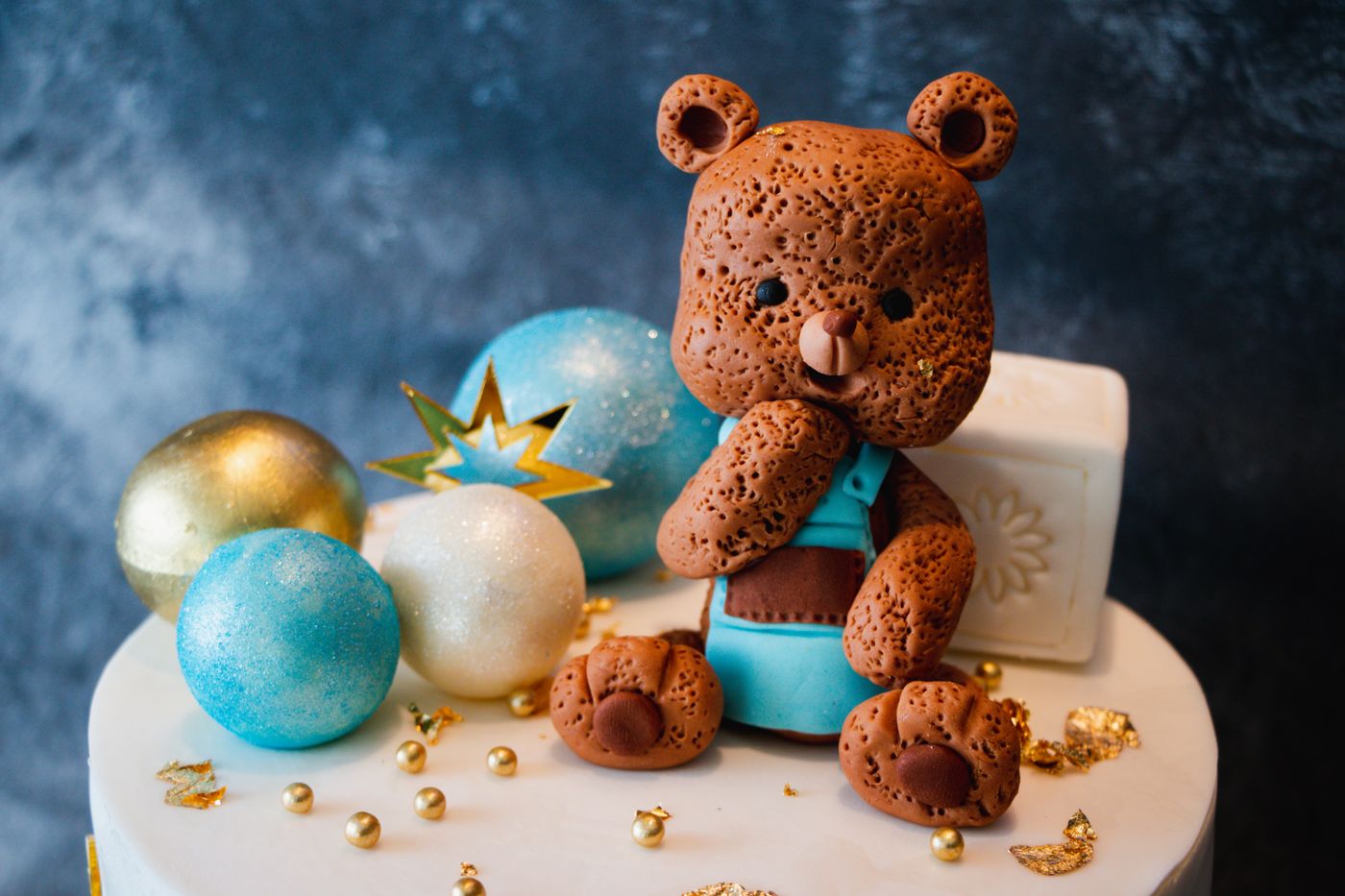 3d printed cake topper — Adorable teddy bear cake topper surrounded by glittery spheres and a festive design, perfect for celebrations
Photo: Rahib Yaqubov / Pexels
The backing plate matters mechanically: letters printed as separate cut-outs snap at the joins, and a topper gets moved from kitchen to table to photograph and back. Fused letters on one continuous plate bend instead of separating.
Is PLA+ food safe enough to touch icing?
PLA starts from lactic acid and is widely used in compostable food packaging, the source of the "PLA is food safe" line in blog posts. The honest version is narrower. A food-contact article is a finished product tested as a finished product — in the EU that means overall and specific migration testing against Regulation (EU) No 10/2011, which is the basis on which published work on PLA food-contact films reports compliance (Biomolecules, 2026). A decorative print is not that article. It is a spool of filament of unknown additive package, pushed through a hot end that has printed who-knows-what, and never tested for what leaches into cream at 4 °C.
In India, anything sold as food or food packaging falls under the FSSAI. A topper sold as decor is not in that category, and nothing here is a certification claim. Treat any seller who says "food grade PLA" without a test report as marketing rather than fact.
The working rule: the print may touch the cake board, the stand or a sleeve. It should not sit in icing, cream or ganache for hours. Where the stem enters the cake, the print is in contact with food whether you intended it or not — plan for that.
Why layer lines matter more than the plastic
Printed surfaces are not smooth. Every layer leaves a ridge, and the ridges meet at the wall to form a groove roughly 0.1–0.2 mm wide. Icing, cream and crumb get into those grooves, and a groove is a place a brush cannot reliably reach.
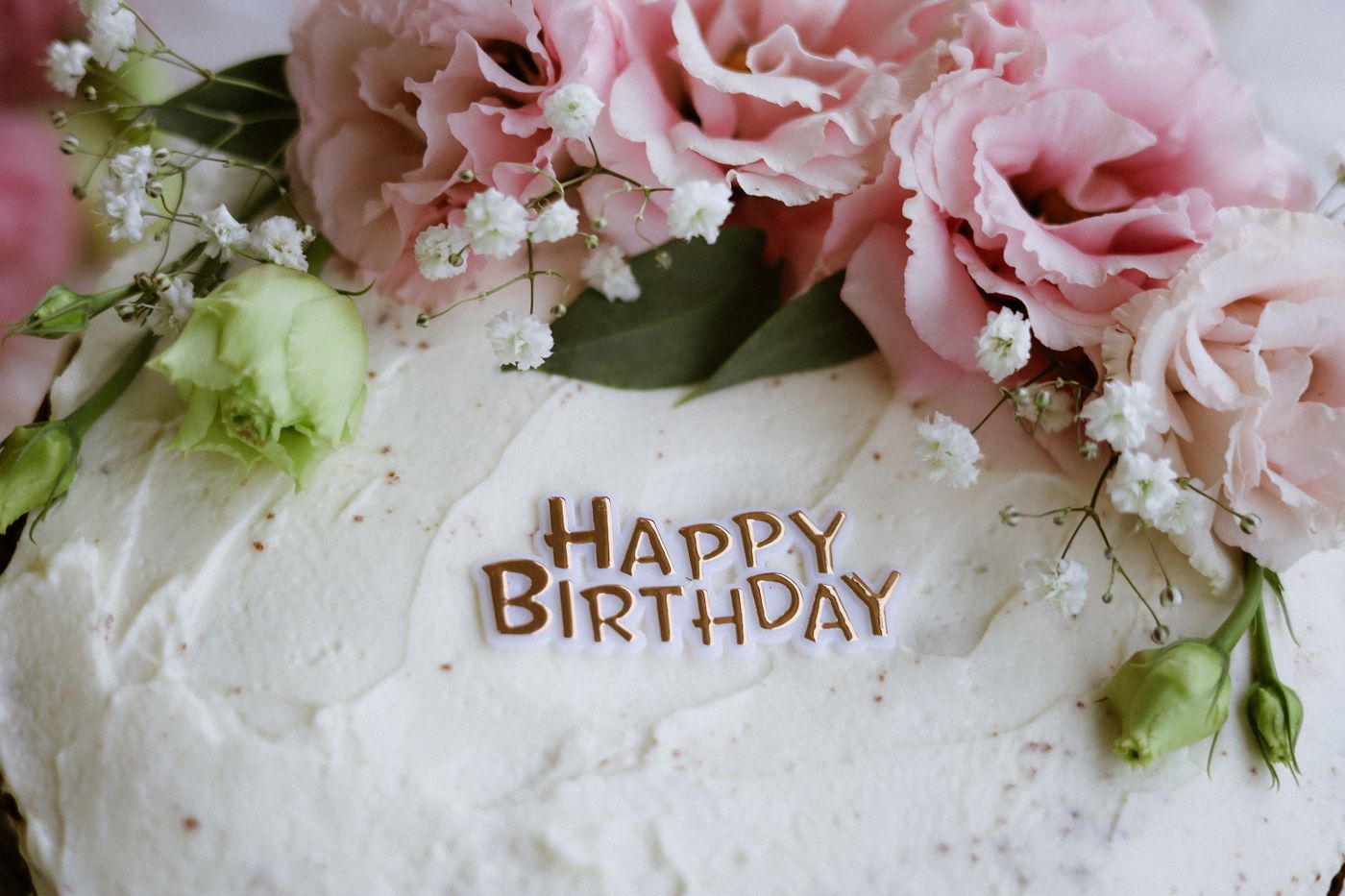 3d printed cake topper — Close-up of a birthday cake decorated with pink flowers and 'Happy Birthday' text
Photo: Nati / Pexels
There is direct experimental evidence on how much the printed interior matters. A 2026 study in Polymers printed PETG scaffolds at five infill densities from 20% to 100% and measured bacterial attachment against E. coli, P. aeruginosa, S. aureus, S. epidermidis and S. typhimurium. Higher infill density was generally associated with reduced attachment and metabolic activity for P. aeruginosa, S. epidermidis and S. typhimurium, and the authors concluded that controlling infill architecture is central to limiting colonisation (Polymers 2026, 18(18):2299). The effect was species-dependent and the study is on PETG, not PLA+, so read it as mechanism rather than guarantee: open, porous printed structures hold more bacteria than dense ones.
Two consequences for a topper. Print it dense — 60–100% infill on the plate, three or more perimeters, no hollow pockets behind the letters. And accept that even a dense print is a decorative object: easier to wipe clean, not sterile, not certified for food contact. The same porosity logic is why a topper that sat in fresh cream should not be reused for a second cake. Retire it, or keep it as a shelf keepsake.
Do 3D printed cake toppers melt in Indian heat?
Not on a cake, usually. PLA's glass transition temperature is 60–65 °C, with a melting range of roughly 130–180 °C depending on grade (Wikipedia: polylactic acid). Buttercream at room temperature is nowhere near that. Failures happen elsewhere:
- A parked car. A dashboard in an Indian summer crosses 60 °C easily. A topper left in the car can droop before it reaches the table.
- Candle heat. Keep 100 mm of clearance between candles and a printed plate; the heat is local and slow.
- Hot caramel, sugar syrup or a hot pan. Do not rest the print on the stove-side counter.
- Load plus warmth. PLA+ creeps under sustained load as it approaches its glass transition, so a heavy topper on a thin stem leans overnight in a warm room.
Cold is the lesser problem: a fridge at 4 °C will not damage PLA+, though condensation on a wet print softens the icing it touches.
Three ways to keep the print and the cake apart
The barrier method costs almost nothing:
- Sleeve the stem. Push the stem into a paper straw, a rolled card tube or a food-grade paper sleeve, then push the sleeve into the cake. The print never touches crumb, the topper stands straighter, and cleanup is a wipe rather than a scrub.
- Mount it behind the cake. Tape the print to a card or acrylic disc sitting on the cake board, behind the top tier. This is the standard approach for tiered cakes where a stem would pierce the icing.
- Wrap the stem in cling film. Food-grade film over the lower 40 mm gives a removable barrier, best for home cakes rather than a photographed centrepiece.
| Situation | Printed topper? | Why |
|---|---|---|
| Buttercream cake, room temperature, 2–3 hours | Yes, stem sleeved | No sustained moisture, no heat load |
| Fresh cream cake at an outdoor party | Yes, but shade it and cut within 2 hours | Cream and heat are the risk, not the print |
| Direct contact with ganache or caramel | No | Sticky, oily contact in every layer groove |
| Tiered wedding cake on display for 6+ hours | Prefer sugar paste or card | Long display, repeated handling, photographs |
| Kids' party where the topper gets handled | Prefer an edible or paper topper | Mouth contact is likely, and PLA+ is not food |
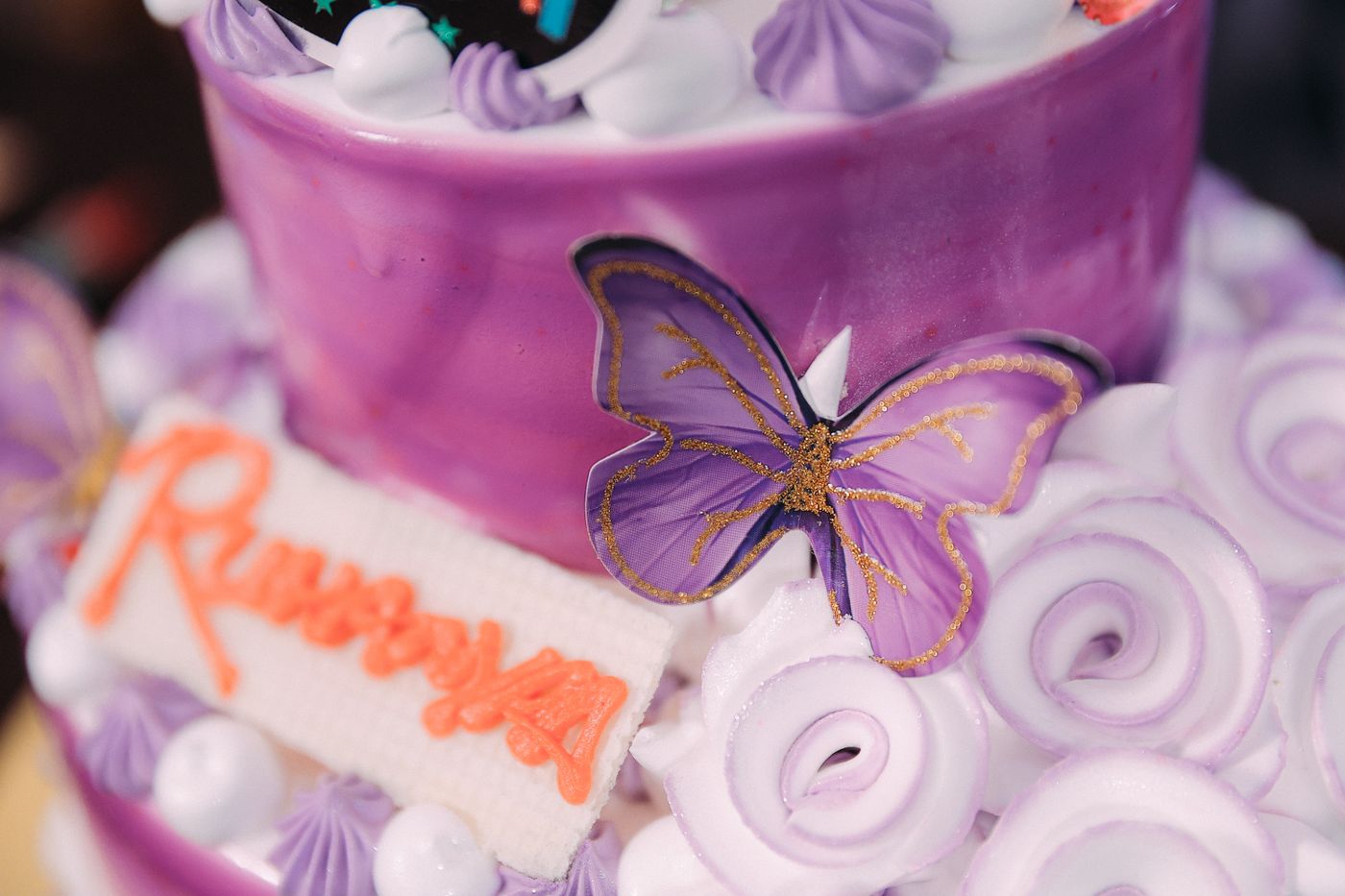 3d printed cake topper — Close-up of a purple birthday cake featuring a butterfly decoration and custom text topper
Photo: Suresh Photography / Pexels
How do you clean a 3D printed cake topper?
Clean it the same day, in the sink, with nothing hotter than your hand can stand:
- Scrape first, don't soak. Lift icing off with a silicone spatula. Soaking drives moisture into the layer grooves.
- Wash in lukewarm water under about 40 °C with one drop of dish soap.
- Brush along the layer lines, not across them, with a soft toothbrush. This is the only step that reaches the grooves.
- Rinse, blot, and stand upright to air dry for at least 30 minutes. Water trapped behind a letter is how you get a milky bloom.
- Store flat in a paper sleeve or rigid box, not loose in a drawer with keys.
Three things ruin a topper faster than any cake: a dishwasher, boiling water to "sterilise" it, and a microwave. All three sit at or above the glass transition temperature, and a warped topper cannot be straightened. If icing has gone into a crevice you cannot brush out, retire the piece — a decorative object is not worth serving cream off a surface you cannot clean.
Design rules that make a topper cleanable
If you are ordering one, or printing your own, these choices decide whether it wipes clean or becomes disposable:
- One solid piece. No glued letters, no snap-fit stems. Glue lines are where moisture sits.
- No hollow pockets or open infill on the visible face. Ask for 60–100% infill and three perimeters, so the plate is effectively solid at the surface.
- 0.12–0.2 mm layers. Finer layers mean shallower grooves and a cleaner wipe, at the cost of print time.
- No supports on the front face. Support scars are rough patches where icing sticks.
- A chamfered bottom edge so there is no sharp lip to catch cream, and a 4 mm stem rather than 2.5 mm — thin stems flex and crack at the plate join.
What does a 3D printed cake topper cost in India?
A 25 g topper uses about 25 g of PLA+, which at a typical Indian spool price is roughly ₹30 of filament — check our guide to PLA filament price per kg in India for current numbers. Machine time is the real cost: a 100 mm name at 0.16 mm layers runs about 2–4 hours on a 0.4 mm nozzle, before anyone designs the lettering.
Small studios in India typically quote roughly ₹300–₹900 for a one-off custom topper; re-check that locally rather than treating it as a market rate. Ask for the weight, layer height and print time, not just the price — those three numbers separate a dense, cleanable plate from a hollow shell.
When a printed topper is the wrong call
Choose sugar paste, wafer paper or card when the cake will be on display for more than about four hours, when the icing is fresh cream in a warm room, when children will handle and mouth the topper, when someone needs a genuinely food-contact-safe article, or when the design is fine, thin script a 0.4 mm nozzle cannot render cleanly.
A laser-cut acrylic topper wipes cleaner than a printed one, but it is still not a food-contact article and it chips at thin strokes. Sugar paste wins on food safety and loses on reusability.
The safer version of the same personalisation
What most people actually want from a cake topper is a name in a shape they chose, at a size that reads across a room. That is exactly the job a custom name keychain does, minus the food question. Ours are PLA+ with letters fused to a continuous backing plate, weigh about 14–18 g, run ₹129–₹149, and are made and despatched in 24–48 hours from Coimbatore. They survive pockets, rain and school bags, and nobody has to wonder what is in the icing. The range is at nuho.in/products.
For a shelf rather than a cake, 3D printed home decor in India covers the same name-plate geometry at desk scale, 3D printed gifts in India under ₹500 maps party-favour pricing, and is PLA waterproof answers the wash question: PLA+ handles water, not heat.
How to order a custom topper or name plate
Send five things and the job goes faster:
- The exact spelling and capitalisation — "AARAV" and "Aarav" are different prints.
- The width in millimetres, not "medium". A 90 mm name fits a 6-inch top tier; 150 mm needs an 8-inch cake.
- Stem length and position, and whether it will sit in a sleeve.
- Colour, and whether the back needs a different colour for photographs.
- The date you need it, working back from a 24–48 hour production window plus courier time.
Ask for a proof image before printing anything with a custom font, and check the letter joins in the proof — that is where a topper fails first.
Prices and courier timelines change, so verify current figures before you commit. And whatever you order, sleeve the stem: a topper that never touches icing lasts for years, and one that sat in cream for six hours goes in the bin.
Frequently Asked Questions
More Articles You Might Like
Is PLA Waterproof? What Water Actually Does to PLA+ Prints
PLA is water resistant, not waterproof. What rain, humidity, hot water and layer-line porosity really do to PLA+ prints — and how to seal a 3D print.
Common 3D Printing Problems: Warping, Stringing and Layer Shift
Warping, stringing and layer shifting cause most failed 3D prints. Here is what each one looks like, why it happens, and the exact order to fix it.
PETG Print Settings: Temperature, Speed and Bed Adhesion
PETG print settings that actually work: 240 °C nozzle, 80 °C bed, 50 mm/s, and the adhesion fixes that stop stringing, warping and wrecked beds.