
Backpack Name Tag Keychain: Sizing, Clips & Wear
Nuho India Team
Nuho Creative Team
Key Takeaways & TL;DR
- A backpack name tag works best at 50–70 mm wide and 3–4 mm thick, which lands around 12–18 g in PLA+ — heavy enough to read, light enough not to drag a zip pull.
- A 4 mm ring hole with at least 3 mm of material around it is the minimum that resists tear-out under daily bag use.
- At Nuho India, letters are fused to a continuous PLA+ backing plate at about 215 °C, so there is no glued letter set to peel off.
- PLA+ has poor heat resistance unless annealed, so a printed tag should never be stored on a car dashboard or in a hot boot.
- Tags cost ₹129–₹149 with 24–48 hour manufacturing and despatch from Coimbatore, Tamil Nadu.
What is a name tag keychain for a backpack?
A name tag keychain for a backpack is a small personalised tag — typically 55–70 mm wide and 14–18 g in PLA+ — hung from a zip pull, daisy chain or strap loop so the bag can be identified at a glance. The tag carries the name, not the bag, and it can be moved between bags in seconds.
That last point is why these tags sell steadily in India. A school bag changes every year, a cabin trolley is borrowed — but the name stays the same. A tag that clips on is far more practical than a bag with a name printed permanently on the fabric.
A backpack is a rougher host than a key ring. The tag swings in the open, scrapes door frames and gets dropped on bus floors. Sizing it like a pocket keychain is the most common mistake.
Why a backpack tag is not just a bigger keychain
Four forces act on a bag tag that a pocket keychain rarely sees.
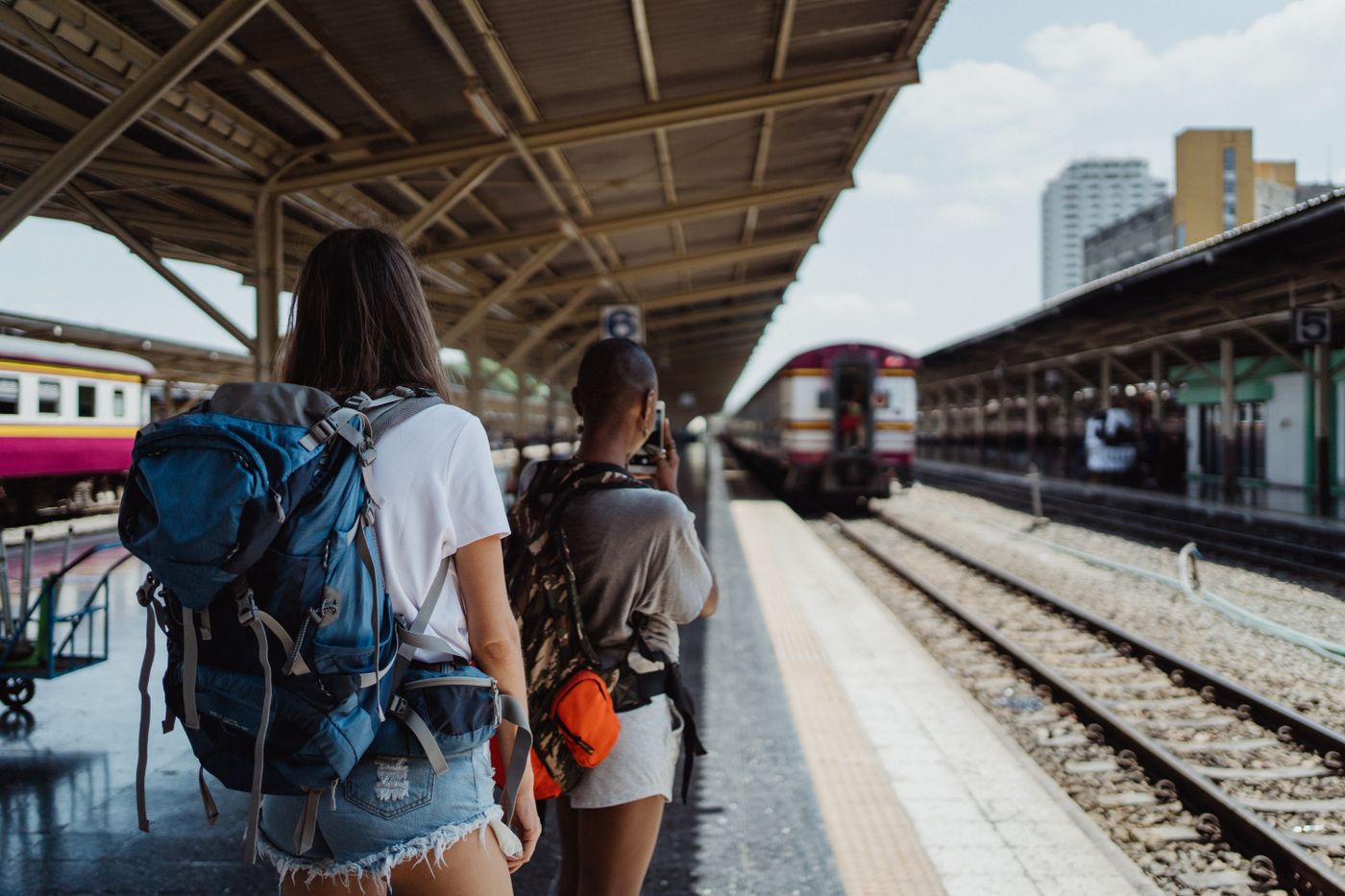 name tag keychain for backpack — Two backpackers waiting at a railway station, ready for their travel adventure
Photo: Ketut Subiyanto / Pexels
Snag load. A tag hanging off a zip pull catches on turnstiles, chair arms and car doors. When it catches, the force goes into the weakest point in the chain: the loop, the ring or the zipper slider. A rigid, well-attached tag can transfer that load into the slider and damage the zip. A lighter tag with a small loop is safer, because the loop gives way first and the bag survives.
Abrasion. Webbing straps and zip tape are abrasive. A tag that rubs a strap for eight months shows polished corners, and proud lettering takes the worst of it. Recessing the letters slightly, or keeping them flush inside a raised border, keeps the name readable for longer.
Weather and grime. A bag tag sees rain, dust, chalk and spilled drinks. PLA+ does not swell like wood or rust like metal, but it is not sealed: moisture can sit in layer lines. A dry wipe and a rinse are enough; a dishwasher is not.
Reading distance. A pocket keychain is read at 30 cm. A bag tag has to be legible at one to two metres in bad light, often while moving. That pushes letter height up and pushes detail — borders, icons, flourishes — down.
What size should a backpack name tag be?
There is no single correct size: a school bag and an 80-litre trekking pack differ. These are the working ranges we use at Nuho India.
| Use | Tag width | Thickness | Typical weight | Letter height |
|---|---|---|---|---|
| Kids' school bag | 50–60 mm | 3 mm | 12–15 g | 10–12 mm |
| College / office backpack | 60–70 mm | 3–4 mm | 15–18 g | 8–10 mm |
| Cabin or checked luggage | 70–85 mm | 4 mm | 18–24 g | 10–14 mm |
| Zip-pull tag only | 35–45 mm | 3 mm | 8–11 g | 6–8 mm |
A tag wider than about 85 mm stops being a name tag and becomes a luggage board: it catches more, weighs more and looks outsized on a school bag. For a long name, reduce letter height and tighten tracking rather than widening the tag.
Thickness matters. At 3 mm a PLA+ tag resists a bend but is light enough not to drag a zip pull open. At 5 mm it becomes a lever: heavier, more likely to swing, and more likely to crack at the ring hole when dropped.
A 4 mm ring hole with at least 3 mm of material around it is a sensible baseline. Anything closer to the edge will eventually tear out, especially if the layers run across the hole rather than around it.
Which attachment suits which bag?
Four attachment options exist, and they are not interchangeable.
| Attachment | Security | Snag risk | Easy to move | Best for |
|---|---|---|---|---|
| Split ring | High | Medium | Needs prying open | Key rings, metal D-rings |
| Spring carabiner | Medium | Low | Yes, one-handed | Webbing loops, daisy chains |
| Printed loop / strap | High | Low | No | Permanent school-bag tags |
| Zip-tie loop | Very high | Low | Cut to remove | Travel and event bags |
A split ring is the traditional keyring — a metal double loop pried open to slide a key on, as described in the standard description of a keyring. It is secure and cheap, but can work loose on a soft bag over months.
 name tag keychain for backpack — Top view of elegantly arranged red and black gift boxes with ribbons, creating a festive and sophisticated look
Photo: Tamanna Rumee / Pexels
A small spring carabiner is friendliest for a bag: it clips to webbing and comes off in one motion. Cheap novelty carabiners are not load-bearing and can straighten under a hard pull — acceptable here, since you want the clip to fail before the zipper does, but it means never hanging anything heavy from it.
A printed loop, one piece with the tag, looks neatest and is least likely to be lost, but it has to fit the specific zip pull or D-ring — measure before ordering. A zip-tie loop is the toughest and ugliest option, and what most schools and event organisers use.
How do you attach a name tag so it does not get lost?
- Pick a hard point, not the zip slider itself. Thread the loop through the pull tab or a webbing loop, not through the tiny hole in the slider body.
- Check the clearance. The tag should hang clear of the bag's opening so it cannot be caught when the zip closes.
- Leave a short leash. A long loop swings and snags; 20–30 mm of drop is enough for the name to be readable.
- Pull-test it with a firm tug in line with the strap. If the loop stretches or the ring opens, change the attachment before the bag goes out.
- Re-check monthly. Split rings and carabiner gates loosen with use. A five-second check at the start of each term prevents most losses.
Hang the tag where it is visible when the bag is set down — usually the top handle or a front-panel loop. A tag buried on a side compression strap is protected but useless for identification.
Will a 3D printed PLA+ tag survive a school year?
Usually yes — with two honest caveats.
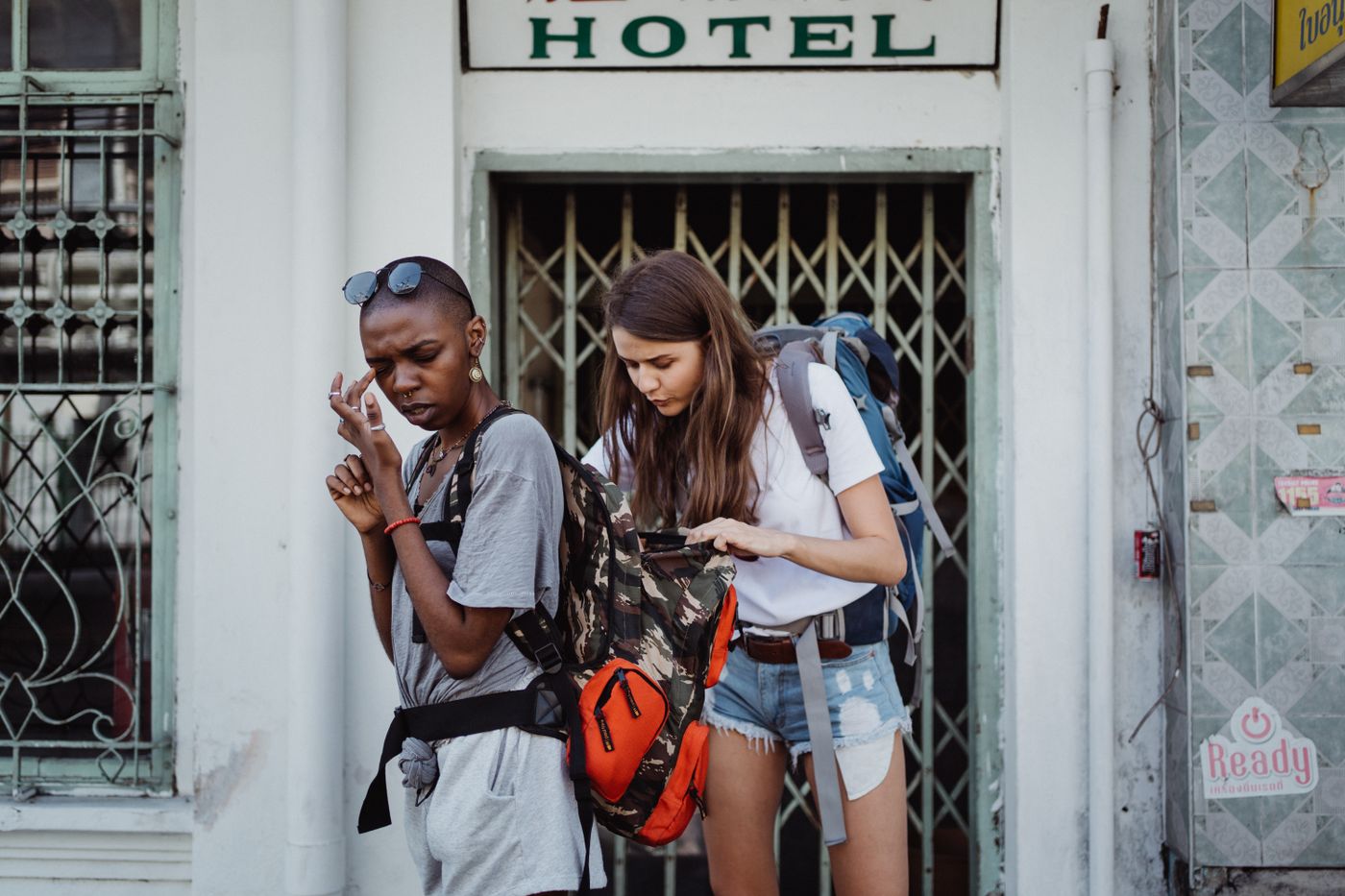 name tag keychain for backpack — Two young female backpackers checking their belongings outside a hotel entrance
Photo: Ketut Subiyanto / Pexels
The first is heat. PLA is the most widely used filament in fused filament fabrication, but it has poor heat resistance unless annealed. A tag left on a car dashboard in an Indian summer, or in a bag in a hot boot, can soften and distort.
The second is abrasion at the ring hole. Printed parts are built in layers, and the bond between layers is the weakest plane. At Nuho India we print at about 215 °C and fuse the lettering to a continuous backing plate, so there is no glued-on letter set to peel away — but the ring hole is still a stress concentration. A reinforced boss around it, and a ring that is not rusted sharp, makes the difference.
The trade-offs:
- Acrylic gives a flat, glossy print and is cheap, but it is brittle at narrow letterforms and cracks when a bag is dropped.
- Cast zinc or brass is close to indestructible and handles heat, but it is heavy on a small bag, scuffs dull and rattles.
- Laser-engraved wood looks warm and the lettering does not rub off, but wood swells with moisture and can split along the grain.
- 3D printed PLA+ sits in the middle: about 14–18 g, tough enough for daily handling, waterproof enough for rain, and able to hold a shaped outline that flat materials cannot.
If the bag lives in a hot car, metal is better; for a shaped, colourful personalised tag at a low price, PLA+ is practical.
What should you put on a backpack name tag?
The best tag answers one question — whose bag is this? — without answering questions the owner did not intend to publish.
For a child's bag, first name plus last initial is enough. Add one parent's mobile number on the reverse, and leave off the school name, class, house, address and date of birth. A tag is visible to strangers in a queue; it is not a form.
For travel, a name and one phone number in international format is more useful than an address, because a finder can call immediately. Never print a home address on a visible tag.
Three design rules improve legibility at distance:
- High contrast. Dark lettering on a light plate, or the reverse. Mid-tone on mid-tone disappears in dim light.
- Uppercase or title case with generous spacing. All caps reads best at two metres; a tight script does not.
- One line for the name, one line for the number. Stacked lines beat a single cramped line every time.
Do these tags work for kids, college and travel?
They do, but the priorities shift with the user.
For children, the tag must survive being dragged, chewed at the corners and used as a handle. A 50–60 mm tag with a printed loop, rounded corners and no detachable small parts is the safest configuration. Our guide to 3D printed name keychains for kids covers school-bag sizing and name formats in more detail.
For college and office bags, the tag is part identification and part accessory; a 60–70 mm tag in a neutral colour, clipped to a webbing loop, reads as deliberate rather than childish. The bike keychain ring size and fit guide applies here too: the same ring, hole and clearance numbers apply to bag hardware.
For schools or teams buying in bulk, per-piece cost matters more than design. Bulk name keychain pricing explains how quantity changes the per-tag rate and why spelling must be confirmed in writing.
How does Nuho make a backpack name tag?
Every tag is printed to order in PLA+ at about 215 °C in GN Mills, Coimbatore, Tamil Nadu. The letters are fused to a continuous backing plate as one print, not glued on as cut-outs, so a narrow i or l does not fall off after a term.
Tags sit in the ₹129–₹149 band, and manufacturing and despatch take 24–48 hours in India. Sizes, colours and loop options are chosen at checkout; the Nuho India products page shows the current range. Measure the anchor before choosing a loop — the width of the zip pull or D-ring decides whether a printed loop will fit.
How should you clean and care for a bag tag?
Warm water, a drop of mild dish soap and a soft brush are enough. Rinse and dry with a cloth, and avoid acetone, thinner, alcohol-heavy sanitisers and anything abrasive on the printed face — these dull the surface and can attack the colour.
Do not dishwash a PLA+ tag or pour boiling water over it: both combine heat and mechanical load, which PLA handles worst. A heat-warped tag can sometimes be flattened with gentle, even warmth, but the lettering will never be perfectly crisp again.
Finally, treat the ring as a consumable. A split ring that has rusted or opened up is the most common reason a tag goes missing, and replacing a ₹10 ring is cheaper than replacing a ₹139 tag. Check it when the bag is cleaned, and the tag will usually outlast the bag it was bought for.
Frequently Asked Questions
More Articles You Might Like
3D Printed Wedding Gifts in India: Keepsakes That Last
A practical guide to 3D printed marriage gifts in India: which keepsakes the couple actually keeps, honest PLA+ limits, real costs and lead times.
3D Printed Keychains With a Custom Name: Ordering Explained
Ordering a 3D printed keychain with a custom name comes down to four details. Here is the exact brief, the font and size rules, and what it costs in India.
Custom Stickers in Any Shape: Artwork, Bleed and Cut Lines
Custom stickers in any shape need bleed, a closed cut line and a 3 mm safe area. A practical artwork guide for die-cut stickers made in India in 24-48 hours.