
3D Printed Motorcycle Accessories: What Actually Holds Up on the Road
Nuho India Team
Nuho Creative Team
Key Takeaways & TL;DR
- PLA+ has a glass transition of about 60-65 °C, so keep printed parts away from exhaust-adjacent and full-sun tank-top mounts in Indian summer.
- PETG suits damp, impact-prone spots such as luggage hooks and cable guides; ASA belongs on permanently sun-facing bodywork.
- Four or more perimeters, 40%+ infill and a flat print orientation are what stop layer lines from turning into vibration cracks.
- Phone mounts, hand guards and fairing brackets should stay metal - printed equivalents fatigue at the layer lines.
- Nuho India keychains are printed in PLA+ at about 215 °C, weigh 14-18 g, cost ₹129-₹149 and dispatch in 24-48 hours.
3D Printed Motorcycle Accessories: What Actually Holds Up on the Road
3D printed accessories for motorcycle use survive on the road only when the filament matches the mounting point. PLA+ handles low-heat, low-stress jobs such as keychains, cockpit trims and cable guides. PETG suits damp, impact-prone spots. ASA belongs on anything permanently sun-facing. Load-bearing parts - phone mounts, hand guards, fairing brackets - should stay metal. That one decision decides whether a printed part lasts a season or a week.
Every claim below is grounded in published material data rather than road-test impressions, so you can check the sources yourself and apply them to your own bike.
What the material data says about 3D printed motorcycle parts
PLA is the most widely used filament in desktop 3D printing, and the reason is straightforward: it prints at a low temperature - typically 190-220 degrees Celsius at the nozzle on a 45-60 degree bed - and produces stiff, dimensionally accurate parts cheaply, per the Simplify3D materials guide to PLA. The same guide names the two weaknesses that matter on a motorcycle: low heat resistance and being not suitable for outdoors under sunlight exposure.
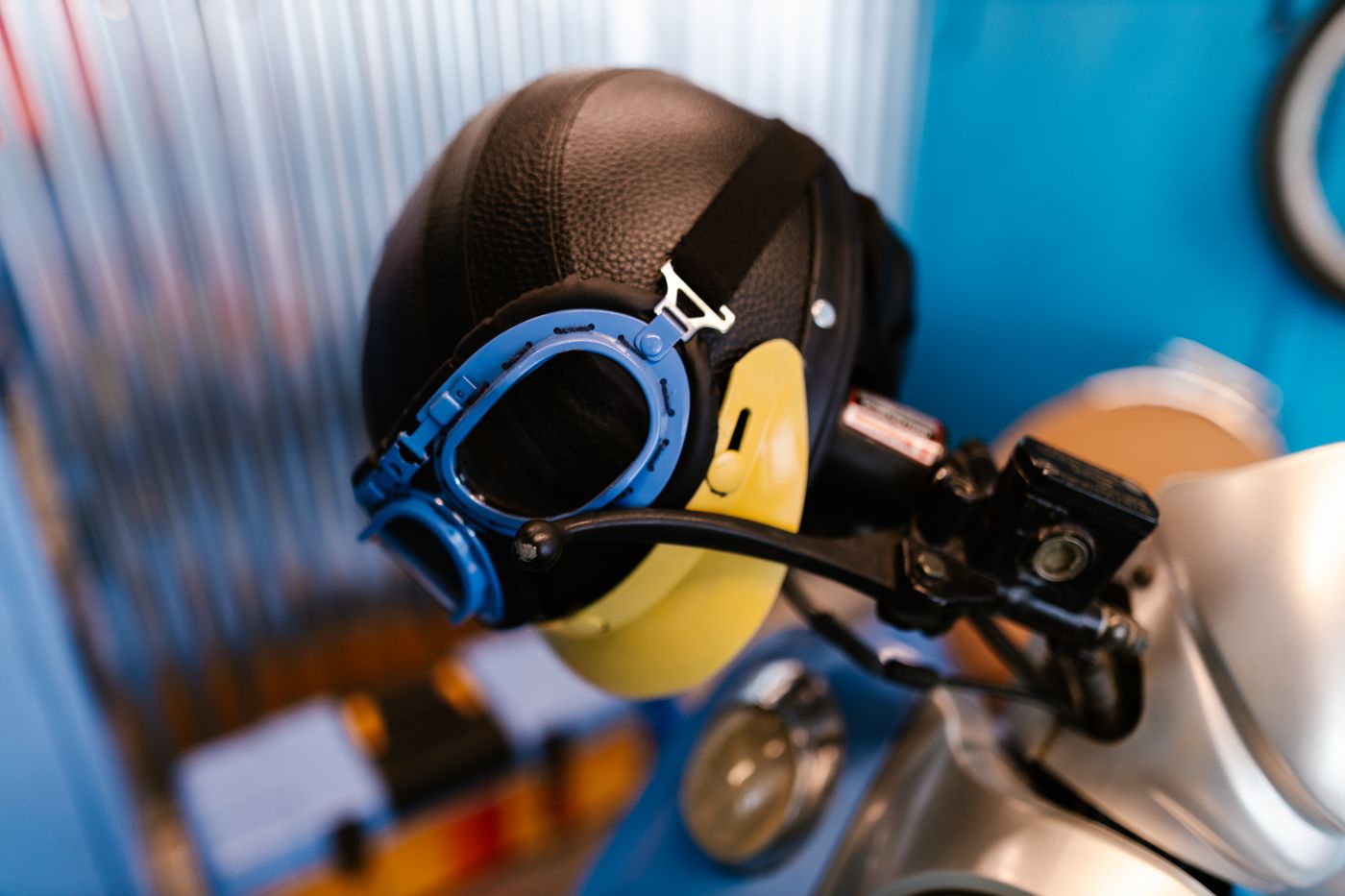 3d printed accessories for motorcycle — Close-up of a vintage-style motorcycle helmet and goggles on display indoors
Photo: RDNE Stock project / Pexels
The numbers behind that warning come from the polymer itself. PLA has a glass transition temperature of about 60-65 degrees Celsius, the band where the plastic shifts from rigid to rubbery, and plain PLA is brittle, breaking below 10% elongation, as summarised in the Wikipedia entry on polylactic acid. PLA+ is a toughened formulation of that same base polymer - more impact-tolerant and less snappy than generic PLA - but it inherits the same glass transition unless the part is heat-treated afterwards.
None of this makes PLA+ useless on a bike. It makes placement everything.
Where heat actually limits a PLA+ part
The roughly 60-65 degree glass transition is worth holding in your head, because dark surfaces parked in direct Indian summer sun sit somewhere in that neighbourhood. Treat it as an approximate range rather than a published figure: surface temperature swings hard with colour, angle to the sun, parking duration and season, so a cheap surface thermometer will tell you more about your own parking spot than any article can.
The practical zone map for a printed part:
- Never here: exhaust heat shields, engine-adjacent covers, anything bolted near a head, and flat black tank-top mounts baking in noon sun. These approach or pass the glass transition, and a part that softens under clamp load does not spring back.
- Usually fine: under-seat panels, cockpit areas in the fork's shadow, inner-fairing trims, luggage-rack sides, and anything that lives in a pocket. Pocket duty sits close to ambient temperature at all times.
- Judge it locally: tank pads and side-panel trims. A black part in Ahmedabad summer is a different thermal problem from the same part in shaded basement parking in Coimbatore.
If a part must live in a genuinely hot zone, that is a job for a high-heat material, not PLA+ - the cheat sheet below covers which one.
Vibration, layer lines and why orientation decides failure
Fused filament printing builds parts in layers, and the bond between those layers is the weak direction. A bracket that puts its load across layer lines cracks; the same geometry printed with the load running inside the layers will outlast the bike. Three rules cover most printed-part failures on two-wheelers:
- Print the load flat. A keyring loop, hook or bracket should have its working load travelling within a layer, not prying layers apart.
- Use enough plastic. Four or more perimeters and 40% or higher infill on small parts costs minutes, not hours, and turns a fragile shell into a solid block.
- Never thread vibrating steel into bare printed plastic. Use brass heat-set inserts, through-bolts with nyloc nuts, or a printed sleeve around a metal fastener. A screw tapped straight into PLA+ will work itself loose on a single-cylinder long before the first service interval.
Vibration also favours small, light parts over big cantilevered ones. A 15 gram tag on a keyring barely notices engine vibration; a 120 gram phone perch clamped to a mirror stalk multiplies every pothole into flex at the mount base.
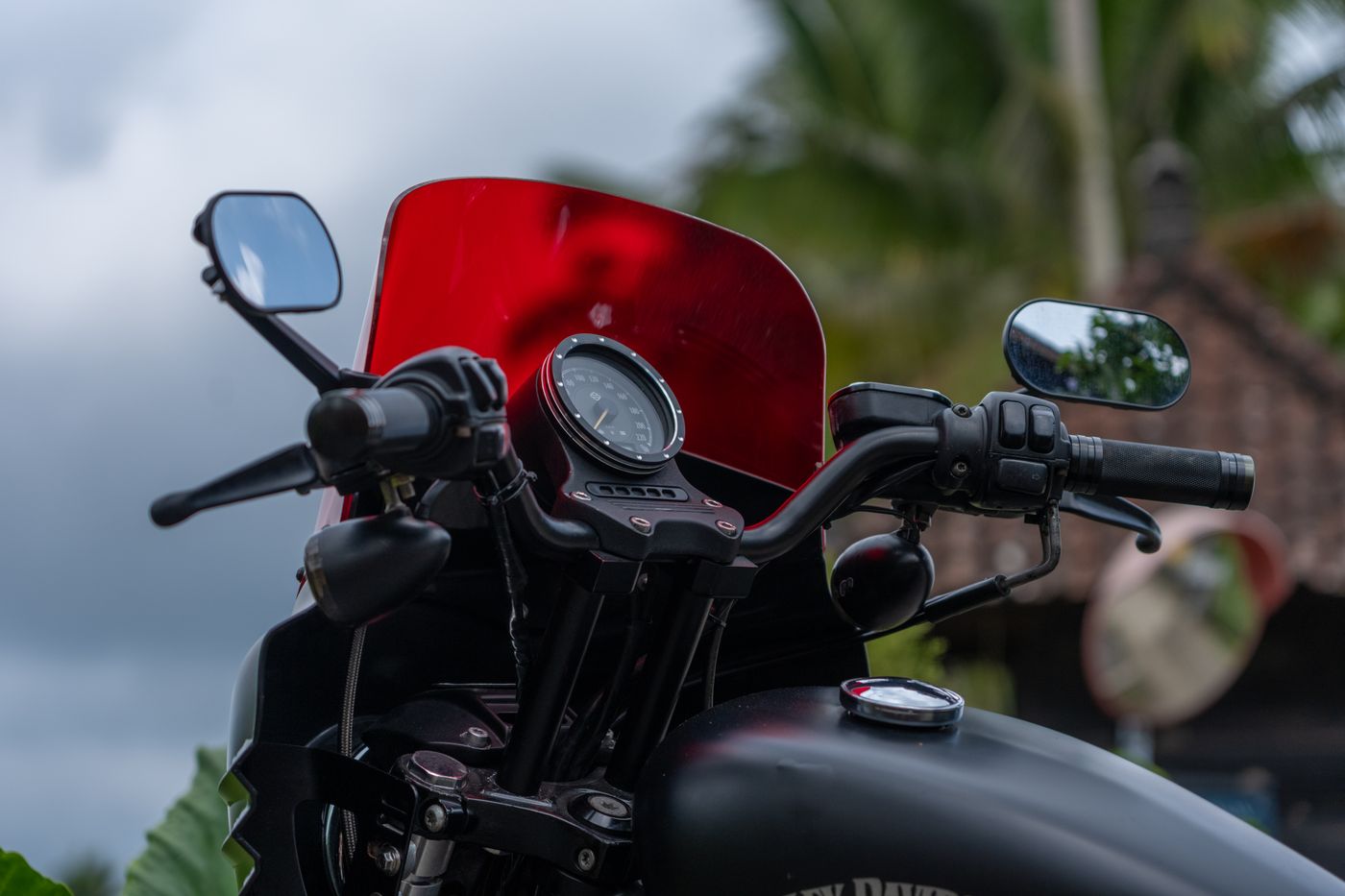 3d printed accessories for motorcycle — Close-up of a motorcycle's handlebars and red windshield, outdoors
Photo: Sergei Starostin / Pexels
Sun and monsoon: UV, water and colour fade
Monsoon rain is the easy half. PLA does not swell or rot with moisture the way laser-engraved wood does, and PETG is routinely chosen for wet duty - published material guides list waterproof applications among its common uses, alongside good impact resistance and negligible warping. Printed parts that get rained on and dry out again are fine.
Sunlight is the hard half. Long-term UV exposure embrittles and fades PLA, which is why the material guides steer it away from permanent outdoor duty. The engineered answer is ASA: an acrylate-rubber-modified styrene copolymer whose rubber phase makes it far more weather- and ultraviolet-resistant than ABS, with higher long-term heat resistance - which is why it is a standard material for exterior vehicle parts. ASA and PETG are both mildly hygroscopic, so dry them before printing; a few hours in a dry box removes the stringing and weak layer bonds that come with wet filament.
3D printed motorcycle accessories: the material cheat sheet
| Mounting spot | Best filament | Why it works | Main watch-out |
|---|---|---|---|
| Keychain, fob tag, pocket duty | PLA+ | Tough, light (14-18 gram tags), cheap to re-make | Keep it away from exhaust-side heat |
| Under-seat trim, cockpit covers | PLA+ | Low stress, shaded from direct sun | Do not over-clamp thin walls |
| Tank pad, side-panel trim | PETG or ASA | Sun plus flex; PETG shrugs off impact | Print dry; PETG surfaces scratch |
| Luggage hooks, cable guides, reservoir covers | PETG | Impact tolerance and waterproof duty | Size the hook for the load, not the look |
| Permanently sun-facing bodywork | ASA | About ten times ABS's UV and weathering resistance | Wants an enclosure for clean prints |
| Phone mount, hand guard, fairing bracket, mirror perch | Metal, not printed | Structural and safety-relevant | Printed equivalents fatigue at the layer lines |
Prices and specs change - verify with the filament manufacturer before you commit to a batch.
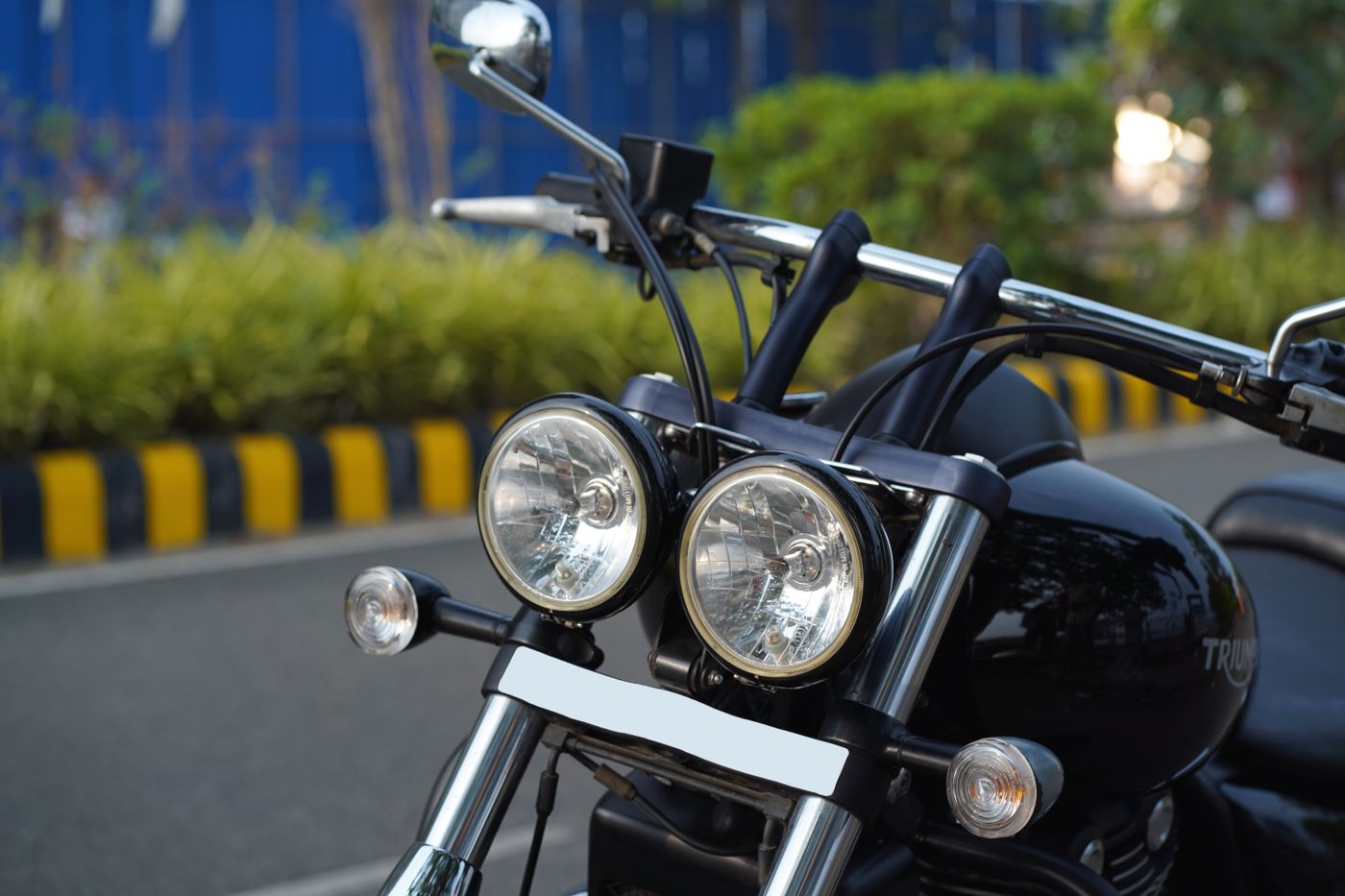 3d printed accessories for motorcycle — Detailed view of motorcycle handlebars and headlights with street background in India
Photo: Nandhu Kumar / Pexels
The accessories worth printing - and the ones that are not
Worth printing: switch-panel trims, tank-bag base plates, reservoir covers, chain-case trims, cable guides, small brackets that carry a wire rather than a load, and decorative surrounds that sit in shade. These are the parts where a printed piece beats an injection-moulded one on cost, because the production volume is one, not one lakh.
Not worth printing: anything between you and the road. Hand guards, mirror perches, phone mounts, top-box stays and fairing brackets are structural. A printed failure at 60 km/h is not a cosmetic problem. There is also an India-specific caution: a printed frame or cover around your number plate must never obscure the plate lettering. The registration plate rules that apply to metal plates apply to whatever gets bolted around them, so check the current requirements before printing anything plate-adjacent.
The honest summary: printed parts shine as trim and small convenience items, and disappoint as structure. If a part's failure would only cost money, print it in the right filament. If its failure would cost skin, buy metal.
A quick design checklist before you print anything for your bike
- Map the temperature at the mount point before choosing a material - sun-facing and engine-adjacent are different problems.
- Choose filament by exposure: PLA+ for shade and pocket duty, PETG for damp and impact, ASA for permanent sun.
- Orient for layer strength so the working load runs inside the layers, never across them.
- Design for metal fasteners: heat-set inserts or through-bolts with nyloc nuts, never bare threads tapped into plastic.
- Dry the filament - PETG and ASA especially - and print small parts with four or more perimeters.
- Anneal if heat matters: controlled heat treatment raises PLA's heat resistance considerably, at the cost of some dimensional accuracy, so only do it where a millimetre of shrinkage does not matter.
If you have already printed a few trims and want the wider picture, our guide to 3D printed accessories for bike builds in India covers more mounting points, and the PLA vs PETG durability comparison goes deeper on how the two materials wear in real use.
Why a 3D printed keychain is the safest first motorcycle accessory
If you want one printed part on the bike - or on its key - start with the keychain. It lives in a pocket at ambient temperature, carries no load, adds almost nothing to the weight hanging from the ignition barrel, and if it ever does give up, replacing it costs less than a coffee. It is also the part where 3D printing's strengths are all on show: names, plates and shapes that injection moulding cannot produce economically at a run of one.
That is the part of this market we actually make. Nuho India prints custom keychains in PLA+ at about 215 degrees Celsius in Coimbatore, Tamil Nadu, with the letters fused to a continuous backing plate rather than glued on as brittle cut-outs - the same layer-bonding logic this article has been arguing for. Tags land around 14-18 grams in the ₹129-₹149 band, with manufacturing and dispatch in 24-48 hours across India. You can see current designs and order a name tag, a plate-style tag or a vehicle-matched piece at nuho.in/products.
For what suits a specific bike, our guide to the best keychain for a bike - weight, fit and ring size walks through sizing against a real key head, and our custom number plate keychain guide covers plate styling and fonts for riders who want the plate look on the key.
The bottom line
3D printed motorcycle accessories are not a category that succeeds or fails as a whole - they succeed or fail one mounting point at a time. Match PLA+ to shade and pocket duty, PETG to damp and impact, ASA to permanent sun, and keep printed parts away from structure and exhaust heat, and an inexpensive spool of filament will outlast the accessories it replaced. Skip that match and even a beautifully printed bracket becomes a vibration crack looking for a weekend.
Print the trim. Buy the structure. And when in doubt, measure the temperature at the mount before you browse the catalogue.
Frequently Asked Questions
More Articles You Might Like
3D Printed Accessories for Bike: What Holds Up in Indian Heat
3D printed accessories for bike riders in India: which parts survive heat, UV and monsoon, which fail, and why a PLA+ keychain is the one safe print.
Bike Keychain Ring Sizes: What Fits an Indian Bike Key
Bike keychain ring sizes explained in millimetres: actual split ring diameters, why 25 mm fits most Indian bike keys, and how to size the tag hole.
Bike Keychains With Name and Number: Fit, Size and Style
Bike keychains with name and number need the right size, weight and font. Here is what fits a bike key fob, what stays legible, and what to order.